TorontoOntario · 36 tours
 Niagara FallsOntario · 25 tours
 New York CityNew York · 30 tours
 Las VegasNevada · 8 tours
 San FranciscoCalifornia · 16 tours
 VancouverBritish Columbia · 17 tours
 DubaiUAE · 54 tours
 Abu DhabiUAE · 5 tours
 Buenos AiresArgentina · 23 tours
 AthensGreece · 31 tours
 AucklandNew Zealand · 38 tours
 CancunMexico · 54 tours
No destinations match “”. Try searching all tours instead — that search understands full questions, not just place names.
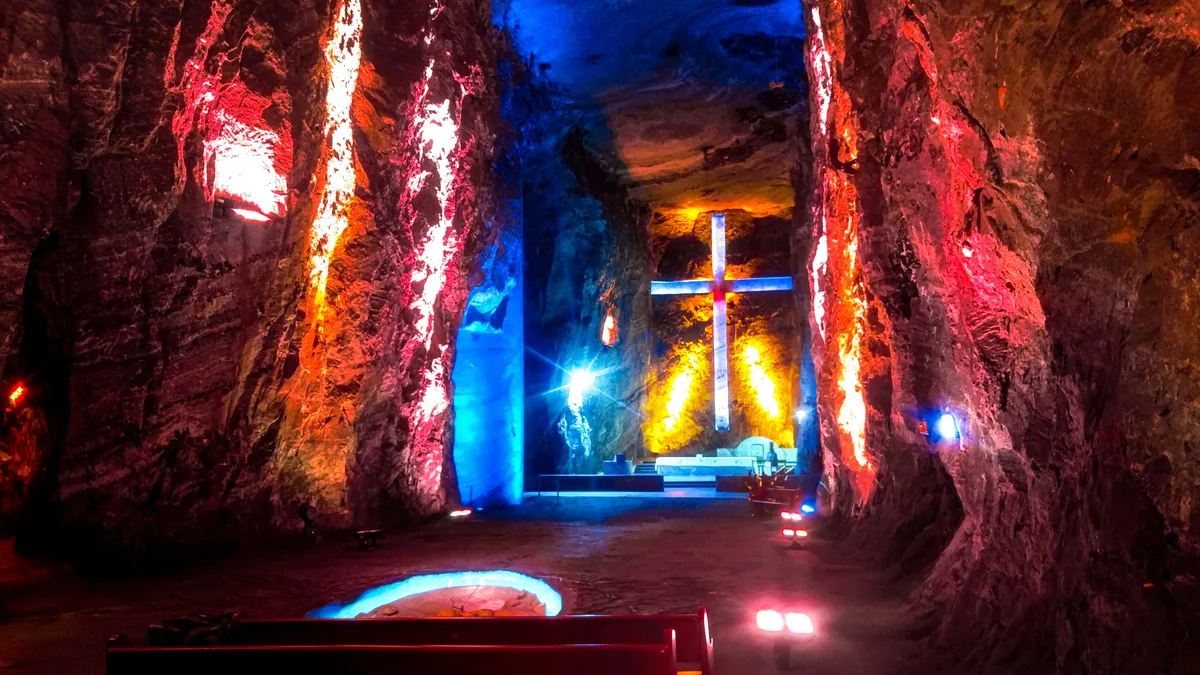
An underground Catholic church carved roughly 180 meters inside a working salt mine in the town of Zipaquira, about an hour from Bogota. The cathedral's tunnels and stations are cut entirely from rock salt and illuminated with shifting colored light, and it remains an active place of worship.
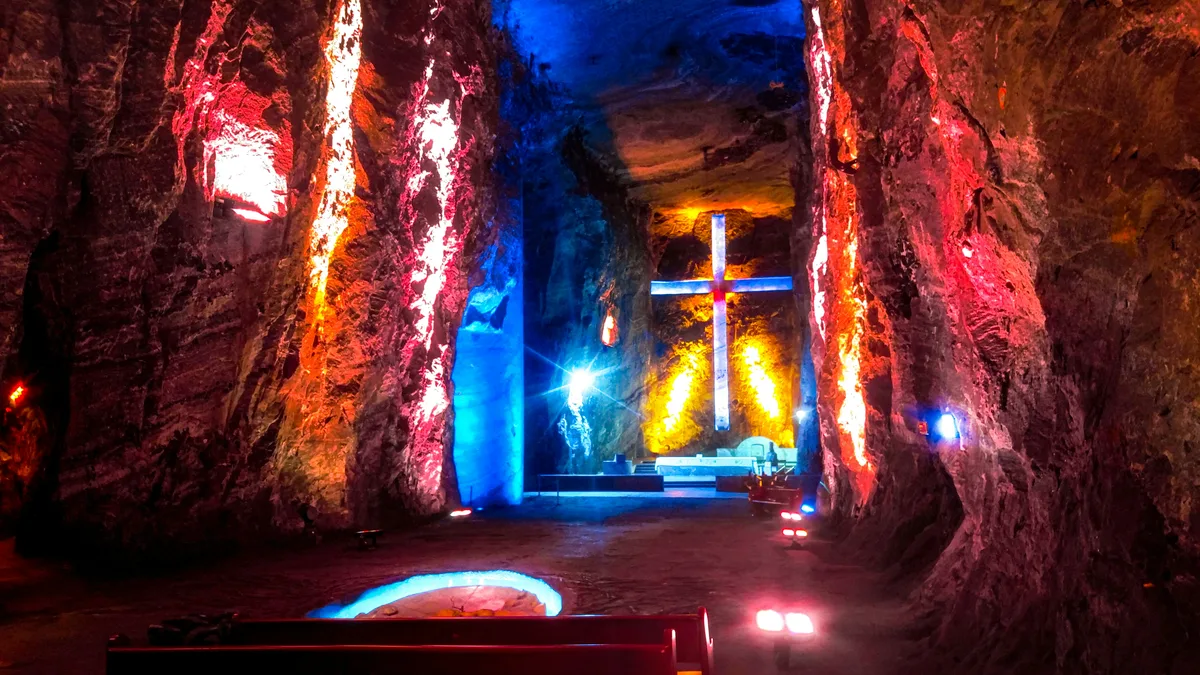 Private Tours
A private driver-guide takes you about an hour outside Bogota to Zipaquira, where you'll explore the Salt Cathedral, an underground Catholic church built inside the tunnels of a salt mine, before a traditional Colombian lunch.
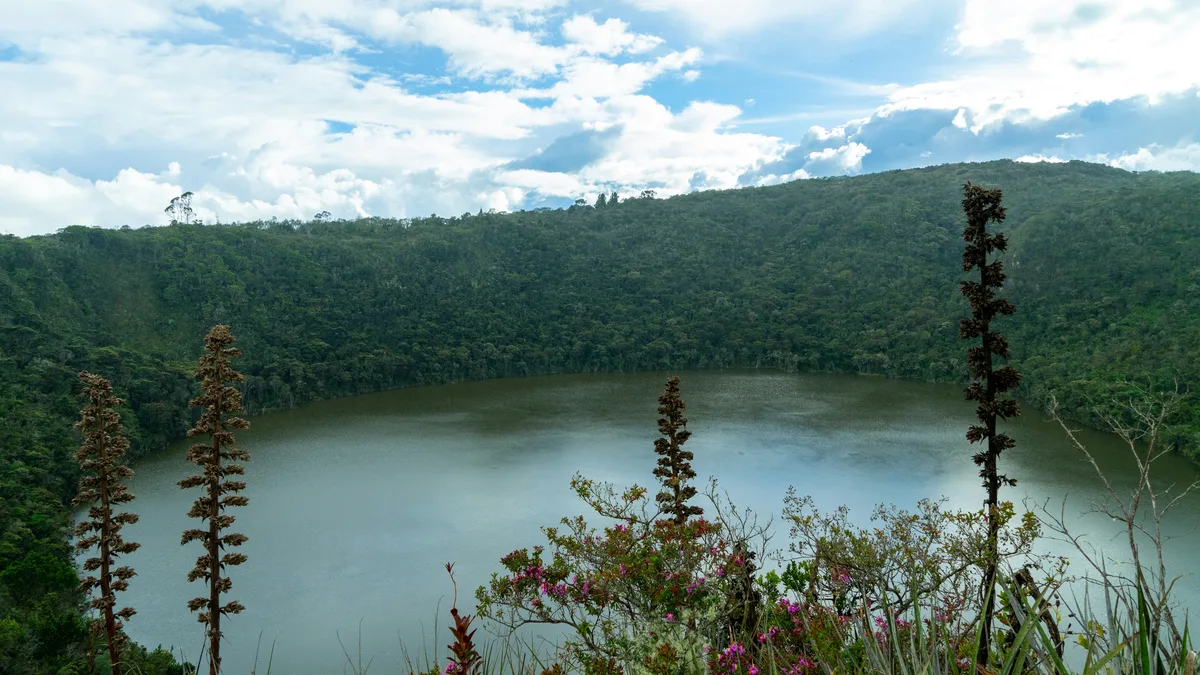 Private Tours
A private guide takes you to the Zipaquira Salt Cathedral and Lake Guatavita, the crater lake tied to the legend of El Dorado, with a traditional lunch included.
Visitor guide
The Salt Cathedral of Zipaquira is an underground Roman Catholic church built inside the tunnels of a salt mine about 180 metres below the surface, near the town of Zipaquira in Cundinamarca, Colombia. It is both a tourist destination and a place of pilgrimage.
According to Wikipedia, the cathedral lies within a halite mountain roughly 49 kilometres north of Bogota, at an altitude of about 2,652 metres. The salt deposits formed around 250 million years ago and were raised above sea level when the Andes rose during the late Tertiary. The church has three sections representing the birth, life and death of Jesus, and its icons, ornaments and architectural details are hand carved in the rock, with a few marble sculptures.
It is a working church that receives large crowds on Sundays, but it has no bishop and therefore no official status as a cathedral in Catholic terms, despite the name.
The halite mines were exploited by the pre-Columbian Muisca, whose salt production dates back to around the fifth century BC and was one of their major economic activities. The naturalist Alexander von Humboldt visited in 1801 and described the deposit as larger than the main salt mines of the time in Spain, Switzerland, Poland and Tyrol. Around 1932 miners carved a small sanctuary where they prayed for protection before starting work.
A larger church was begun in 1950 and inaugurated on 15 August 1954, dedicated to Our Lady of the Rosary, patron of miners. It had three naves and a monumental cross, but because it was carved inside an active mine, structural and safety concerns led authorities to close it in September 1992.
A competition for a new design was won by Roswell Garavito Pearl, and construction of the new cathedral began in 1991, about 60 metres deeper than the old one. It was inaugurated on 16 December 1995, built by carefully enlarging caverns left by earlier mining. Its main sections include the Stations of the Cross, 14 small chapels with crosses and kneeling platforms carved into the salt at the entrance, and the dome at the end of the descending ramp. The three naves are linked by a crack that symbolises the birth and death of Christ, and four large cylindrical columns represent the Four Evangelists. Copies of the Creation of Adam and the Pieta can also be seen.
The cathedral is part of a larger complex called the Salt Park, which covers 32 hectares and includes a mining and geology museum, a salt dome, a Brine Museum explaining extraction, a reservoir, forests and an auditorium. A carved halite cross 4.2 metres high stands in the Sacred Axis square.
The visit involves a descent into the mine and a return along ramps and steps, so comfortable footwear is useful. A private visit from Bogota suits the town well, which is also known for its connection to the Sabana tourist train and the nearby El Abra archaeological site.
See every tour and attraction we cover in Bogota.