TorontoOntario · 36 tours
 Niagara FallsOntario · 25 tours
 New York CityNew York · 30 tours
 Las VegasNevada · 8 tours
 San FranciscoCalifornia · 16 tours
 VancouverBritish Columbia · 17 tours
 DubaiUAE · 54 tours
 Abu DhabiUAE · 5 tours
 Buenos AiresArgentina · 23 tours
 AthensGreece · 31 tours
 AucklandNew Zealand · 38 tours
 CancunMexico · 54 tours
No destinations match “”. Try searching all tours instead — that search understands full questions, not just place names.
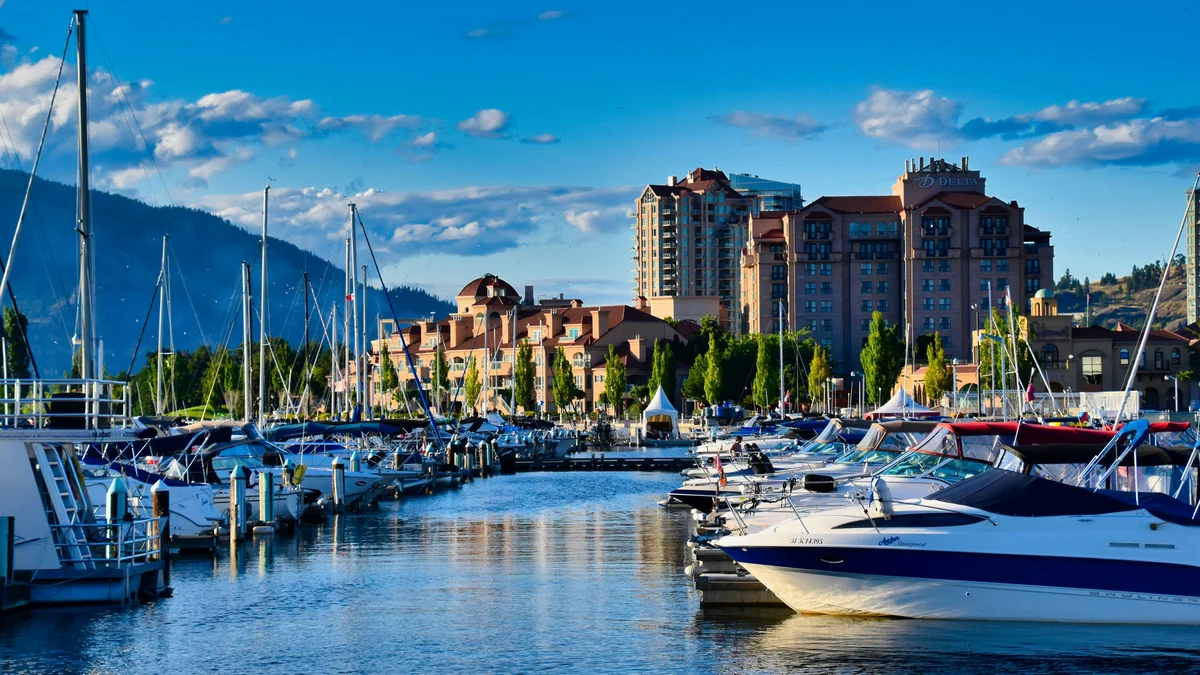
Okanagan Lake is a 135-kilometre glacial lake that runs the length of the Okanagan Valley, with Kelowna sitting roughly at its midpoint along the eastern shore. Warm summer temperatures make it a popular freshwater destination for swimming, boating, and paddleboarding, and it's home to the local legend of Ogopogo, a lake monster said to live in its depths.
Visitor guide
Okanagan Lake is the long, narrow centrepiece of British Columbia's Okanagan Valley, a glacier-carved fjord lake that runs roughly 113 to 135 kilometres (depending on the source) from Vernon in the north to Penticton in the south. Kelowna sits about midway along its shores, and the lake shapes almost everything about the city, from its beaches and bridge to its orchards and wineries.
Wikipedia gives the lake a length of about 135 km, a width of no more than around 5 km, a surface area of roughly 348 square kilometres and a surface elevation of about 342 metres. Wikipedia lists the deepest point, near Grant Island, at 232 metres, while the Okanagan Basin Water Board's basin study gives 242 metres; the average depth is about 76 metres. Water drops away quickly from shore in places; one description notes that depths of 100 metres can be reached only 10 metres offshore. Different sources round these figures slightly differently, so treat them as approximate.
The basin was scoured out by repeated glaciations and is classed as a fjord lake. In places, the valley floor is filled with as much as 750 metres of glacial and post-glacial sediment. The benches and terraces that now carry vineyards and fruit orchards above the shoreline are reported to be remnants of an earlier glacial lake, Lake Penticton, that lowered in stages. The lake is slow to renew its water: the residence time is given as roughly 53 years, and the Okanagan River drains it at the south end through Penticton into Skaha Lake and on toward the Columbia River. It has frozen over only rarely; Wikipedia lists the winters of 1906-07 and 1949-50.
The valley is the homeland of the Syilx (Okanagan) people, and the lake has its own name in the Okanagan language, kɬúsx̌nítkw. Syilx stories also describe a powerful being of the water, written n̓x̌ax̌aitkʷ or N'ha-a-itk. Representatives of the Westbank First Nation have said that the later image of a menacing monster grew partly out of misunderstanding between early settlers and the Syilx, who regard the being as a sacred protector of the valley. That is a living tradition rather than a quaint tale, and it is worth keeping in mind before treating the subject as a joke.
The settler-era version of the story is the Ogopogo, and it should be labelled plainly as legend: no confirmed animal has ever been documented. Folklore writers trace a detailed settler account to Susan Allison in 1872, and the playful name is generally linked to an English music-hall song heard in the Okanagan in 1924, though historian Mark Orkin has suggested the name may have been in use as early as 1912. Skeptics suggest sightings are most likely misidentified waterfowl, otters or beavers. The creature is now a fixture of Kelowna's tourism identity, including statues and a play structure.
Before good roads, the lake was the valley's main highway. The Canadian Pacific Railway's lake service linked Penticton with Okanagan Landing, near Vernon, where passengers and freight connected to the mainline. Sternwheelers such as the SS Aberdeen, SS Okanagan and SS Sicamous worked these waters, and the Sicamous survives today as a museum ship in Penticton. Crossings have changed too: the five-lane floating William R. Bennett Bridge now links Kelowna with West Kelowna, replacing the older floating Okanagan Lake Bridge, which had a lift span, in 2008.
Rainbow trout and kokanee are the fish most associated with the lake. In summer it is a working playground of beaches, marinas, swimming and boating, and Squally Point is known locally for cliff jumping. Always check current conditions, water-quality advisories and any local boating rules before planning a swim or paddle.
The lake is best understood from several angles, which is easy with a private vehicle and driver and door-to-door pickup: the waterfront in Kelowna, a lakeshore drive toward Peachland or Okanagan Centre, and the benchland roads above the water. Your driver can build stops around your interests, from wineries to viewpoints, without anyone needing to park or navigate.
See every tour and attraction we cover in Kelowna.