TorontoOntario · 36 tours
 Niagara FallsOntario · 25 tours
 New York CityNew York · 30 tours
 Las VegasNevada · 8 tours
 San FranciscoCalifornia · 16 tours
 VancouverBritish Columbia · 17 tours
 DubaiUAE · 54 tours
 Abu DhabiUAE · 5 tours
 Buenos AiresArgentina · 23 tours
 AthensGreece · 31 tours
 AucklandNew Zealand · 38 tours
 CancunMexico · 54 tours
No destinations match “”. Try searching all tours instead — that search understands full questions, not just place names.
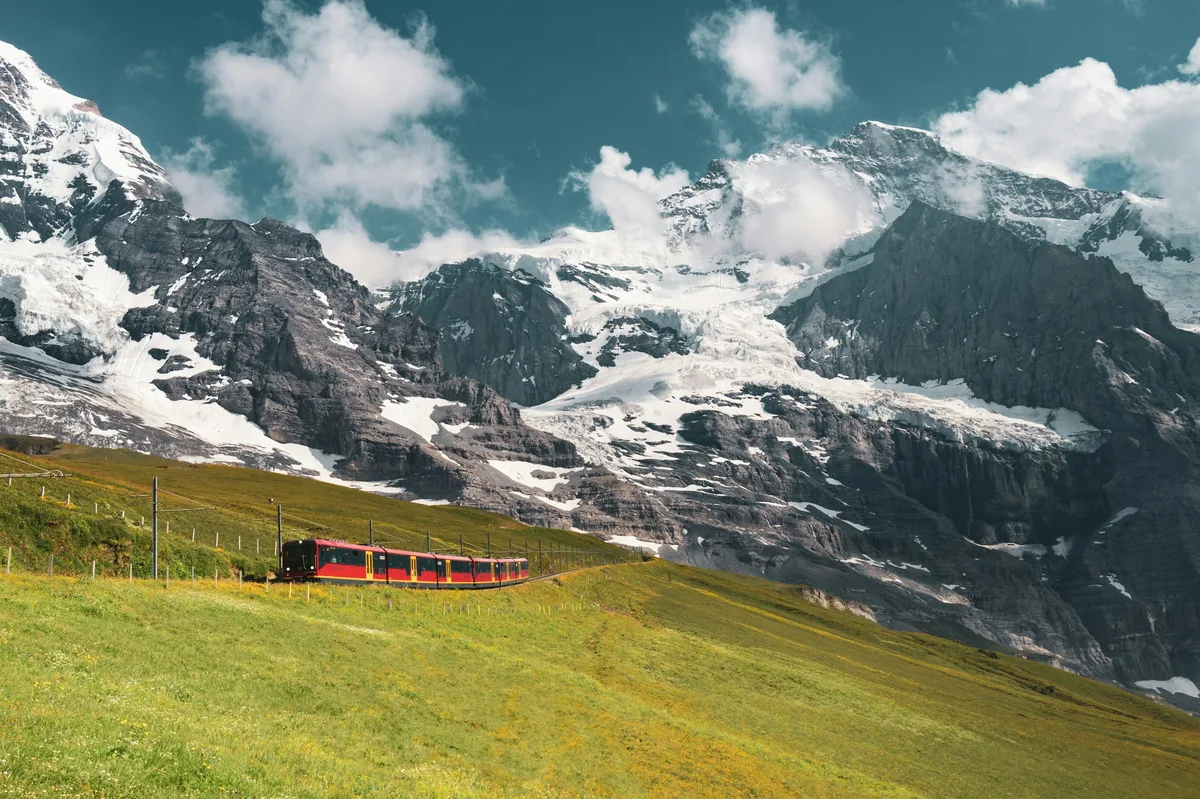
Europe's highest railway station, reached by the Jungfraubahn cogwheel train from Kleine Scheidegg through tunnels cut into the Eiger and Mönch to a saddle between the Mönch and the Jungfrau.
Visitor guide
The Jungfraujoch is a glacier saddle in the Bernese Alps of Switzerland, lying between the Mönch and the Jungfrau. Its railway station, reached by the Jungfrau Railway from Kleine Scheidegg, is the highest in Europe, and the complex there is marketed as the Top of Europe.
Wikipedia gives the Jungfraujoch's elevation as 3,463 metres, while the station is cited at 3,454 or 3,450 metres depending on the source. The saddle sits on the upper snows of the Aletsch Glacier, on the border between the cantons of Bern and Valais, about halfway between Interlaken and Fiesch. 'Joch' means 'saddle', and the name Jungfrau is probably derived from the nuns of Interlaken Monastery.
The surrounding region forms part of the UNESCO site Swiss Alps Jungfrau-Aletsch, inscribed in 2001 and extended in 2007. The Aletsch Glacier is 23 kilometres long and up to 900 metres thick at Konkordiaplatz, and the precipitous north faces of the Eiger, Mönch and Jungfrau stretch about 20 kilometres.
Adolf Guyer-Zeller first proposed the tunnel idea in 1893, and construction began on 27 July 1896 and took about 16 years. A 1908 accident in which 30 tons of dynamite exploded accidentally was the worst of the construction period. The line has been accessible to tourists since 1912. It was built only to the saddle and not to the Sphinx summit as originally planned.
The tunnel is about 7 kilometres long with gradients up to 25 percent. It runs from Kleine Scheidegg through the Eiger and Mönch with stops at Eigerwand and Eismeer. The climb takes about 50 minutes and the descent about 35 minutes.
The Sphinx Observatory, at about 3,571 metres, is the second-highest accessible point in Switzerland and is reached by elevator. It houses a Global Atmosphere Watch research station. The Top of Europe complex contains restaurants, shops, exhibitions and a post office, and a radio relay station nearby, not open to the public, is Europe's highest.
The Jungfraujoch is officially the coldest place in Switzerland, though unmonitored higher peaks may be colder. It has a tundra and ice cap climate, a record low of minus 35.4 degrees Celsius, and averages about 1,773 sunshine hours a year. Visibility and temperature can change quickly, so conditions on the day are worth keeping in mind.
The first ascent of the north side of the Jungfrau area was made in July 1862 by Leslie Stephen and a party of climbers and guides, long before the railway made the saddle reachable to non-climbers.
UNESCO inscribed the area in 2001 as Jungfrau-Aletsch-Bietschhorn and extended and renamed it Swiss Alps Jungfrau-Aletsch in 2007; it covers 82,388 hectares. According to Wikipedia, the Finsteraarhorn, at about 4,270 metres, is the highest peak in the Bernese Alps, and eight other summits above 4,000 metres lie in the area, including the Jungfrau. The Jungfraujoch's mean annual temperature is cited as about minus 8.5 degrees Celsius, and the 1991 to 2020 average daily maximum was minus 3.8 degrees. Visitors approach from the north on the Jungfrau Railway, which can be reached from Kleine Scheidegg, at 2,061 metres, or via the Eiger Express from Grindelwald.
A private guide and driver can manage the approach to the railway and onward connections around Interlaken and the Jungfrau region, leaving you free to focus on the high-altitude views.
See every tour and attraction we cover in Switzerland.