TorontoOntario · 36 tours
 Niagara FallsOntario · 25 tours
 New York CityNew York · 30 tours
 Las VegasNevada · 8 tours
 San FranciscoCalifornia · 16 tours
 VancouverBritish Columbia · 17 tours
 DubaiUAE · 54 tours
 Abu DhabiUAE · 5 tours
 Buenos AiresArgentina · 23 tours
 AthensGreece · 31 tours
 AucklandNew Zealand · 38 tours
 CancunMexico · 54 tours
No destinations match “”. Try searching all tours instead — that search understands full questions, not just place names.
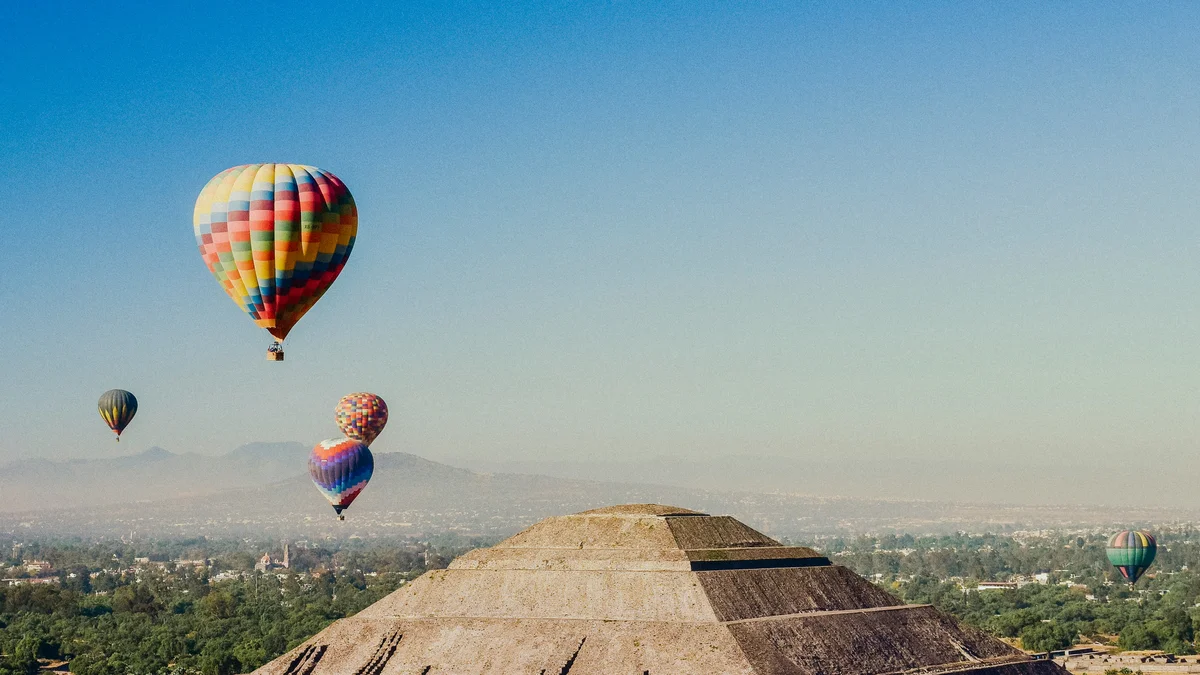
Teotihuacán was once one of the largest cities in the pre-Columbian Americas, built by a civilization that predates the Aztecs and whose name even remains unknown. The Pyramid of the Sun, one of the largest pyramids in the world, and the Pyramid of the Moon anchor the Avenue of the Dead, which runs roughly 5 kilometres including parts not yet excavated, running through the ruins. Sunrise hot-air balloon flights over the site have become one of the most popular ways to see the pyramids from above.
Visitor guide
Teotihuacan is an ancient Mesoamerican city roughly 40 to 50 kilometers northeast of Mexico City, famous for the Pyramid of the Sun, the Pyramid of the Moon and the long Avenue of the Dead. It is not an Aztec city: it predates the Aztec Empire by many centuries, and it was inscribed as a UNESCO World Heritage Site in 1987.
The Aztecs, who spoke Nahuatl, gave the city its name centuries after it was abandoned; it is often glossed as birthplace of the gods, reflecting Nahua creation myths set there. The original name is unknown, and Maya hieroglyphic texts refer to it as Place of Reeds. According to Wikipedia, settlement in the area dates to about 600 BCE, growth accelerated around 100 BCE, and at its height, probably in the first half of the first millennium CE, it was the largest city in the Americas, with population estimates ranging from about 25,000 to around 100,000 or more. At its peak the city stretched over about 36 square kilometers, according to UNESCO.
The Pyramid of the Sun stands on the east side of the Avenue of the Dead and has a base of roughly 220 by 230 meters and a height of about 65 meters, making it among the largest pyramids in the world. The Pyramid of the Moon closes the northern end of the avenue and is the second-largest structure in the complex. In 1971, workers installing a light show found a tunnel and cave system beneath the Pyramid of the Sun, which later study indicated was man-made.
The Avenue of the Dead is the city's central axis, running for several kilometers and lined with temples, residences and platforms. Its name was given by the Aztecs, who thought the platforms were tombs; scholars now regard them as ceremonial platforms topped by temples. At the southern end lies the Citadel, a large plaza that the Spanish named because they thought it was a fort. Its main structure is the Temple of the Feathered Serpent, dedicated to Quetzalcoatl, whose facade has sculptures of the deity. In 2003, a tunnel was found beneath the temple after a sinkhole appeared, and excavations there revealed offerings including jade-inlaid masks.
Most residents lived in multi-family apartment compounds, with estimates of around 2,000 compounds each housing perhaps 60 to 100 people. Craft workshops for pottery, textiles and obsidian tools were common, and the city drew migrants from many regions. Teotihuacan's murals are among its celebrated achievements, with themes such as processions of priests, jaguars, the storm god and a Great Goddess; the peak of mural production is dated between 450 and 650 CE.
Population appears to have peaked around 400 to 500 CE and to have fallen from about 600 to 700 CE. Older theories blamed foreign invasion, but the evidence now points more to internal unrest, with burning concentrated on ruling-class structures along the avenue, and climate stress has also been proposed. Excavation began in earnest in the late 17th century under Carlos de Siguenza y Gongora, and Leopoldo Batres led a major project in 1905; the Pyramid of the Sun was restored for the 1910 centennial. Large-scale work continued through the 20th century.
The site is large, open and exposed to sun, and the pyramids involve climbing steep steps. A private guided visit with a driver is a practical way to cover the main avenue and understand what the monuments meant.
See every tour and attraction we cover in Mexico City.