TorontoOntario · 36 tours
 Niagara FallsOntario · 25 tours
 New York CityNew York · 30 tours
 Las VegasNevada · 8 tours
 San FranciscoCalifornia · 16 tours
 VancouverBritish Columbia · 17 tours
 DubaiUAE · 54 tours
 Abu DhabiUAE · 5 tours
 Buenos AiresArgentina · 23 tours
 AthensGreece · 31 tours
 AucklandNew Zealand · 38 tours
 CancunMexico · 54 tours
No destinations match “”. Try searching all tours instead — that search understands full questions, not just place names.
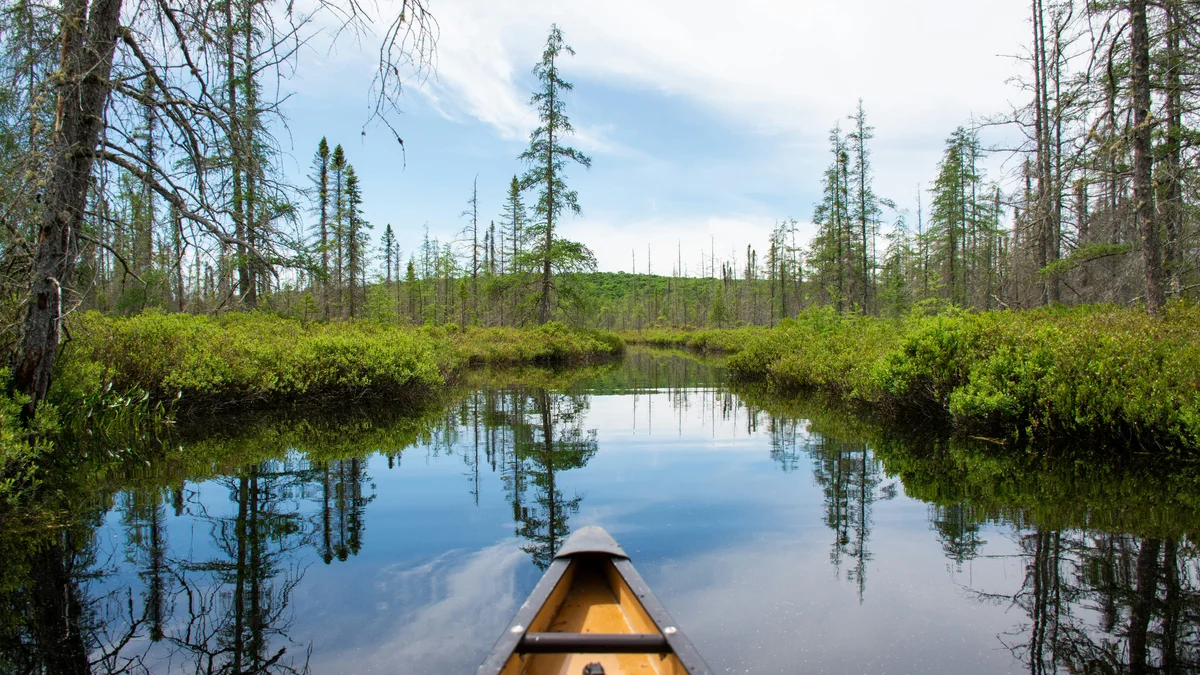
The main gateway to Algonquin Provincial Park along the Highway 60 corridor, with exhibits on the park's ecology, wildlife and human history. A viewing deck looks out over a wetland and forested ridge, a good first stop for orientation.
Visitor guide
The Algonquin Visitor Centre is the park's main interpretive stop on the Highway 60 corridor, at kilometre 43, set on a ridge above a wide valley. It opened in 1993, the year Algonquin and Ontario's provincial park system marked their 100th anniversary, and works as an orientation point before heading to trails, lakes and campgrounds.
Algonquin was created by an act of the Ontario Legislature on 23 May 1893 and is often described as Canada's oldest provincial park. It followed a five-member Royal Commission chaired by Alexander Kirkwood, Ontario's Commissioner of Crown Lands, whose March 1893 report recommended protecting the headwaters of five rivers: the Muskoka, Little Madawaska, Amable du Fond, Petawawa and South. The park was first set aside as about 3,797 square kilometres in 18 townships and is now roughly 7,600 square kilometres, though Wikipedia gives slightly different figures in different places. It holds over 2,400 lakes, and sits mostly on Canadian Shield granite and gneiss. It was renamed Algonquin Provincial Park in 1913 and became a National Historic Site in June 1992. Wikipedia lists 53 mammal species, 272 birds, 31 reptiles and amphibians, and 54 fish.
Ontario's park pages describe world-class exhibits on Algonquin's natural and human history, including dioramas, tracing the shift from wilderness to logging, railways and recreation. A theatre presentation summarizes the park's story, and an observation deck gives a panoramic view of the landscape. The Friends of Algonquin Park Bookstore supports the Friends, which funds educational and interpretive programs, and the centre also has an information desk, a picnic area and flush toilets, and is listed as accessible.
The Highway 60 corridor itself runs about 55 kilometres through the south of the park. According to Wikipedia it has 19 hiking trails and eight designated campgrounds, and the Visitor Centre is a handy place to compare them. Because the park has no civic street addresses, locations along the road are given by kilometre markers; the park lists the centre and the Fork Lake Trail at km 43.0, Centennial Ridges at 37.6, the Algonquin Logging Museum at 54.5 and the East Gate at 56.0.
The Algonquin Park Archives is housed in a fire-proof, climate-controlled room inside the Visitor Centre, with access by appointment for researchers. The park describes the holdings as tens of thousands of items, including natural history specimens, historical and archaeological artifacts and archival materials, collected only if they come from within the park or show how it developed. The collection began in 1946 with a small group of natural history specimens kept in a tent at Cache Lake. The Government of Ontario owns it, and the Friends of Algonquin Park provides substantial operating support.
Wikipedia records that Peter Thomson became the park's first chief ranger in 1893, setting boundaries and building the first structures, and that the Ottawa, Arnprior and Parry Sound Railway reached the park in 1896, giving the first easy access. Hotels followed in 1908, and rail service on the southern line ended after a flood damaged a trestle at Cache Lake in 1933. Artists including Tom Thomson and members of the Group of Seven were drawn to the landscape; Thomson, who worked as a guide, died at Canoe Lake in July 1917, and Wikipedia says a plaque stands at the Visitor Centre dock. Highway 60 through the park is named the Frank A. MacDougall Parkway after the chief ranger of 1931 to 1941, who was the first to supervise the park by airplane.
Wikipedia lists about 7,000 insect species, over 1,000 plant species and over 1,000 fungi in the park. The bedrock is mostly Precambrian metamorphic and igneous rock, chiefly quartz-feldspar gneiss and granite, with the Brent Crater's limestone and sandstone as an exception. Glaciation left till and sandy outwash, and the soils are generally coarse and poor. Visitation was reported as 1,056,821 in 2022. Because the Visitor Centre explains this landscape in one place, it helps to visit before heading out to a trail or lake.
See every tour and attraction we cover in Algonquin Provincial Park.