TorontoOntario · 36 tours
 Niagara FallsOntario · 25 tours
 New York CityNew York · 30 tours
 Las VegasNevada · 8 tours
 San FranciscoCalifornia · 16 tours
 VancouverBritish Columbia · 17 tours
 DubaiUAE · 54 tours
 Abu DhabiUAE · 5 tours
 Buenos AiresArgentina · 23 tours
 AthensGreece · 31 tours
 AucklandNew Zealand · 38 tours
 CancunMexico · 54 tours
No destinations match “”. Try searching all tours instead — that search understands full questions, not just place names.
One of the largest city squares in the world at roughly 40 hectares, Monterrey's Macroplaza anchors downtown with the Metropolitan Cathedral, City Hall, the bronze Neptune Fountain, and the 70-meter Faro del Comercio (Lighthouse of Commerce), a Luis Barragán-designed tower that sweeps a green laser beam across the night sky.
Visitor guide
The Macroplaza, also called the Gran Plaza, is a large civic plaza in the center of Monterrey, Nuevo Leon, Mexico. Spanish Wikipedia gives its area as 40 hectares and describes it as one of the largest plazas in the world, while English Wikipedia calls it the largest plaza in Mexico.
According to Spanish Wikipedia, the architect Eduardo Padilla Martinez-Negrete proposed a public corridor linking the municipal palace with the government palace in 1969. In 1980 the state government hired the firm Alternativas XXI, led by Pedro Ramirez Vazquez and Eduardo Terrazas, for a first design, and the State Congress approved the project by Decree 156 on 25 November 1981. A revised design by the firm 103 Grupo de Diseno, by Oscar Bulnes Valero and Benjamin Felix Chapman, became the definitive version. The work was launched under Governor Alfonso Martinez Dominguez, and its creation and naming are dated to 1984.
Spanish Wikipedia reports that the project required demolishing about 40 city blocks and 427 buildings, many of them from the nineteenth century and the colonial era. Critics describe this as a major loss of built heritage, while the justification offered at the time was the decline of the surrounding district. It is jointly administered by the Nuevo Leon state government and the Municipality of Monterrey.
The best-known landmark is the Faro del Comercio, a 70-metre tower designed by Luis Barragan, with laser equipment at the top that lights the sky over the city at night. The Explanada de los Heroes, an esplanade of 19,400 square metres, fronts the neoclassical Palacio de Gobierno. Other features include the Fuente de Neptuno, the Jardin Hundido or sunken garden with monuments and a fountain, and Homenaje al Sol, a monument by Rufino Tamayo at the southern end. The Kiosco Lucila Sabella stands in front of the Museo Metropolitano, which occupies the former municipal palace.
English Wikipedia gives the Faro del Comercio a height of 69.80 metres and a width of 12.33 metres, with Luis Barragan as designer and the architect Raul Ferrera as builder in 1984. It was built to mark the hundredth anniversary of the Monterrey Chamber of Commerce and to project an image of Monterrey as a progressive industrial city. The original design called for three colored lasers, but the mechanism proved impractical and the monument was out of service for several years; part of it was salvaged and redesigned to operate with green light, and the tower was reinaugurated on 16 September 2006. The tower stands near the southern end of the plaza, facing the cathedral, and its bright reddish-orange color makes it easy to identify.
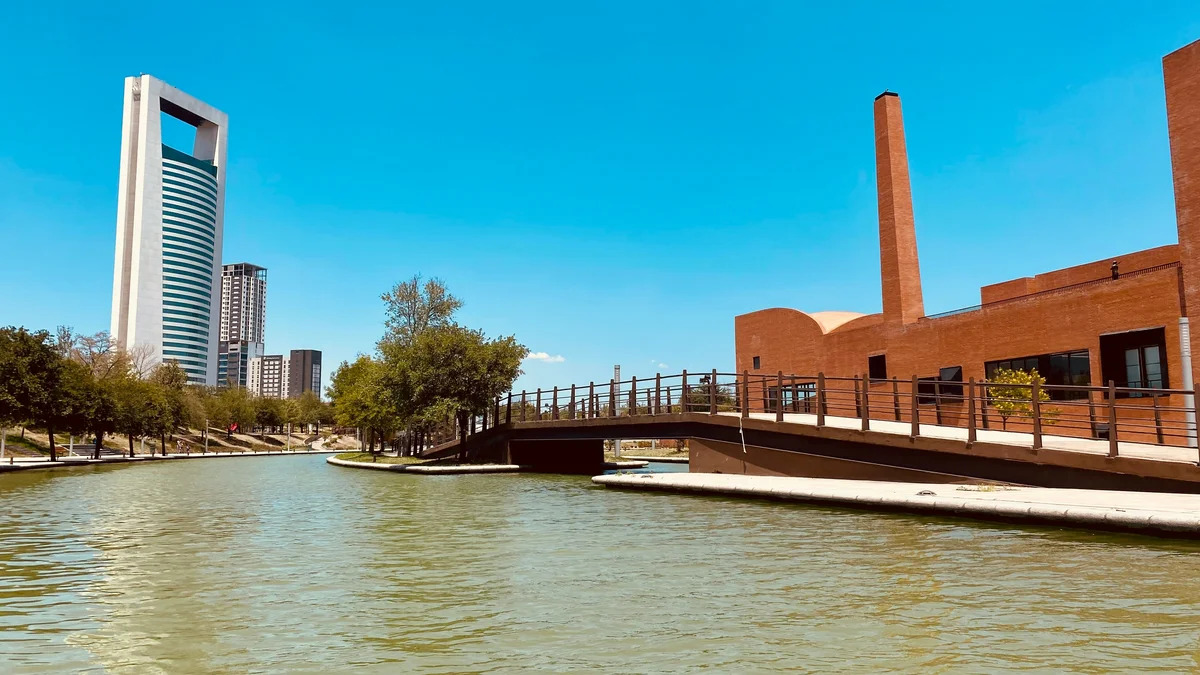
The Catedral Metropolitana de Monterrey, the Condominio Acero by architect Mario Pani, the Capilla de los Dulces Nombres, the Teatro de la Ciudad and the Biblioteca Central Fray Servando Teresa de Mier are among the buildings in or beside the plaza. Cultural institutions nearby include the Museum of Contemporary Art (MARCO), the Museo del Noreste and the Museo de Historia Mexicana. The Paseo Santa Lucia, a pedestrian waterway, links the plaza to Parque Fundidora.
The plaza is served by the General Zaragoza metro station, and Wikipedia lists the Barrio Antiguo and the Santa Lucia Riverwalk within walking distance. A private guided visit can connect the monuments, museums and nearby historic quarter in one route.
See every tour and attraction we cover in Monterrey.