TorontoOntario · 36 tours
 Niagara FallsOntario · 25 tours
 New York CityNew York · 30 tours
 Las VegasNevada · 8 tours
 San FranciscoCalifornia · 16 tours
 VancouverBritish Columbia · 17 tours
 DubaiUAE · 54 tours
 Abu DhabiUAE · 5 tours
 Buenos AiresArgentina · 23 tours
 AthensGreece · 31 tours
 AucklandNew Zealand · 38 tours
 CancunMexico · 54 tours
No destinations match “”. Try searching all tours instead — that search understands full questions, not just place names.
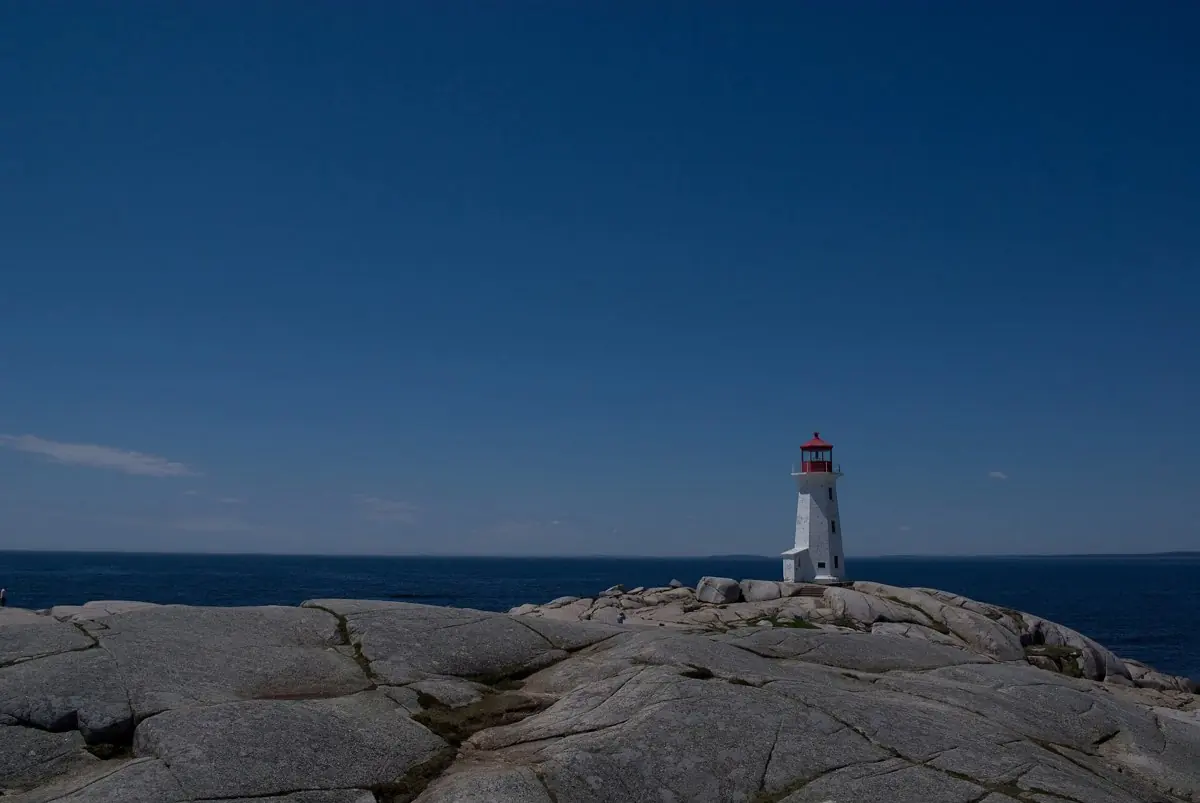
One of Canada's most photographed spots, a working lighthouse on wave-worn granite above the Atlantic.
Visitor guide
Peggys Point Lighthouse, usually called the Peggy's Cove Lighthouse, stands on a granite outcrop at the eastern entrance to St. Margarets Bay on Nova Scotia's coast, about 43 km southwest of downtown Halifax. Its octagonal reinforced-concrete tower, about 15 m tall, is one of the most photographed lighthouses in Canada.
The first lighthouse here dates to 1868 and was a wooden house with a beacon on its roof, using a kerosene lamp magnified by a silver-plated mirror to show a red light. The present tower dates from 1915 according to the Canadian Register of Historic Places, though some sources give 1914. It keeps the eight-sided shape of older wooden light towers. The wooden keeper's house was damaged by Hurricane Edna in 1954 and removed, and the light was automated in 1958. Its colour has changed over the years, returning to red in 2007. Wikipedia notes that a summer Canada Post office once operated in the tower's lower level, until it closed in November 2009. The Canadian Coast Guard operates the light.
The fishing village was founded in 1811, when Nova Scotia granted over 800 acres to six families of German descent. Where the name comes from is uncertain: Wikipedia suggests it likely refers to St. Margarets Bay, since Peggy is a nickname for Margaret, while a popular legend tells of a shipwreck survivor known as "Peggy of the Cove". Treat the legend as folklore. The village has only a few dozen year-round residents, with a commercial fishery that continues alongside tourism.
The bare rock comes from the Great Nova Scotia batholith, a mass of granite formed in the Devonian Period, more than 400 million years ago. Glaciers later deposited large boulders called glacial erratics across the headland, giving it the windswept, moonlike look visitors remember. Published age figures for individual boulders differ between sources, so a general description is safer than a single number.
Beyond the lighthouse, the William E. deGarthe monument, a 30 m carved granite sculpture honouring Nova Scotian fishermen, is a short walk away. A memorial near the cove also remembers the 229 people killed when Swissair Flight 111 crashed into the sea on September 2, 1998, about five nautical miles (roughly nine kilometres) to the southwest, according to the Transportation Safety Board; Peggy's Cove served as a staging point for responders. A large viewing area was built in 2021 to improve accessibility and to keep people off the nearby rocks.
The danger here is real. Signs, including a bronze plaque on the lighthouse, warn of unpredictable surf, and the dark, wet rocks near the water are slippery and exposed to sudden large waves. Several people each year are swept off, and some have drowned. A provincial patrol programme run under Build Nova Scotia has focused on educating visitors; stay on the pale, dry rock well back from the water, and do not turn your back to the sea. Fog, wind and swell can change in minutes. The lighthouse is a federally owned and operated aid to navigation, so check with the Canadian Coast Guard and local authorities for current access, parking and any closures.
The drive from Halifax follows the coast road along St. Margarets Bay, with small communities and coves along the way. A Voyzo private tour can run this as a door-to-door trip with a private vehicle and driver, which suits timing a visit outside the busiest hours and stopping at roadside viewpoints on the return.
See every tour and attraction we cover in Halifax.