TorontoOntario · 36 tours
 Niagara FallsOntario · 25 tours
 New York CityNew York · 30 tours
 Las VegasNevada · 8 tours
 San FranciscoCalifornia · 16 tours
 VancouverBritish Columbia · 17 tours
 DubaiUAE · 54 tours
 Abu DhabiUAE · 5 tours
 Buenos AiresArgentina · 23 tours
 AthensGreece · 31 tours
 AucklandNew Zealand · 38 tours
 CancunMexico · 54 tours
No destinations match “”. Try searching all tours instead — that search understands full questions, not just place names.
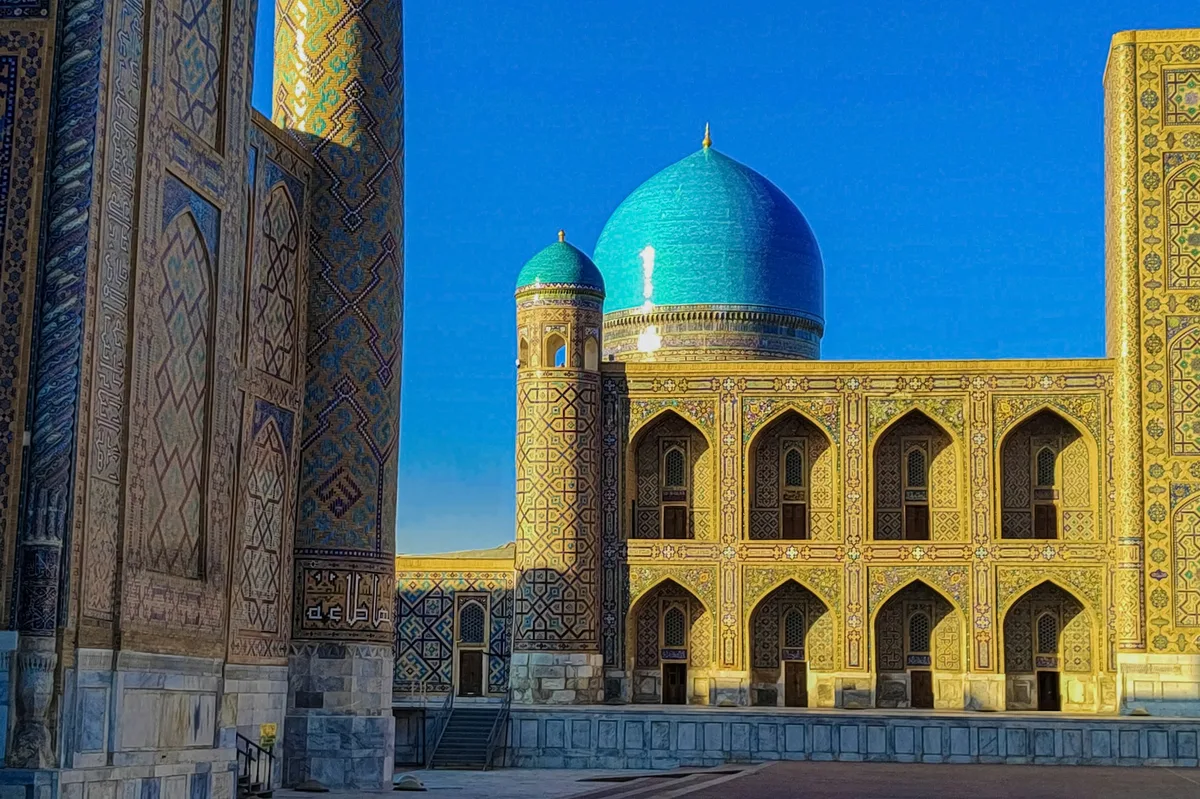
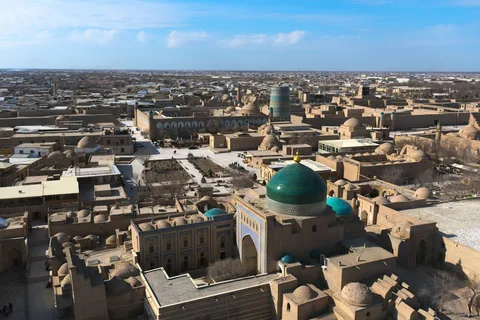
The monumental heart of old Samarkand, three tiled madrasas facing a shared square that has been the city's central landmark since the Timurid era.
 Multi-Day Tours
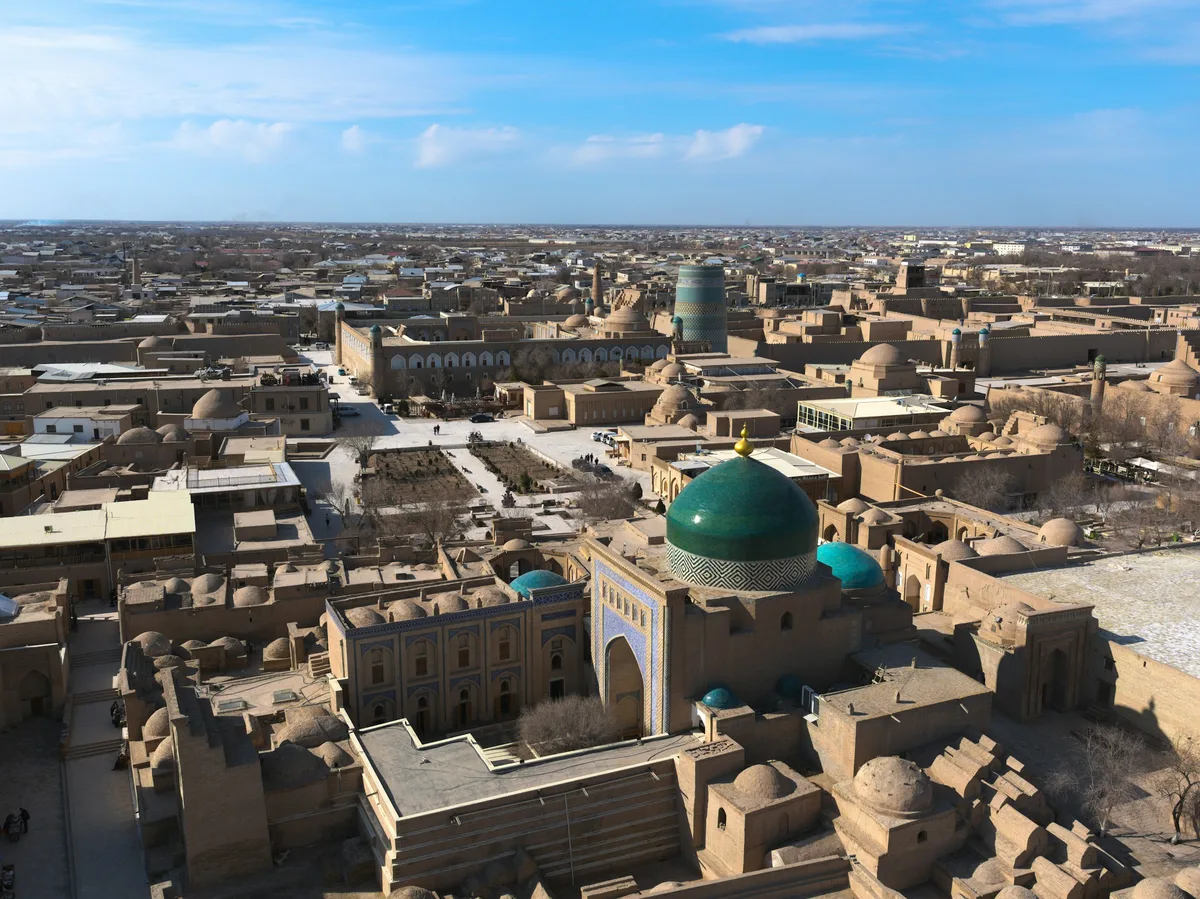
A 17-day Silk Road journey — 11 nights across Uzbekistan's Tashkent, Khiva, Bukhara, and Samarkand, followed by 5 nights in Kyrgyzstan's Osh, Bishkek, and the shores of Issyk-Kul Lake.
 Multi-Day Tours
A 27-day grand tour through five Central Asian countries, spending the most time in Uzbekistan's Fergana Valley, Samarkand, Shakhrisabz, Bukhara, and Khiva, alongside real time in Kyrgyzstan, Tajikistan's Pamirs, Turkmenistan's Karakum Desert, and a first stop in Kazakhstan.
Visitor guide
The Registan is the historic public square at the heart of Samarkand in Uzbekistan, framed on three sides by monumental madrasas, or Islamic schools. Its name is a Persian term commonly translated as "place of sand," and the ensemble is inscribed on the UNESCO World Heritage List as part of Samarkand's historic centre.
According to Wikipedia, a Friday mosque was built on the square after the Mongol conquest, and the same ground had earlier been the focal point of the Sarbadar uprising of 1365. Over the centuries the Registan served as the political, commercial and ceremonial centre of the city. Royal proclamations were announced here, heralded by blasts from huge copper pipes known as dzharchis, and the square was also used for public executions. Historians regard it as the hub of the Timurid Renaissance, when Samarkand was the capital of Timur's empire.
The oldest of the three buildings is the Ulugh Beg Madrasa, built between 1417 and 1420 by Ulugh Beg, the grandson of Timur. It has a large vaulted portal, or iwan, with a lancet-arch pishtaq facing the square, flanked by tall minarets, and geometric stylised ornament above the entrance arch. Behind the portal lie a courtyard, a mosque, lecture rooms and student cells. The building was originally two storeys tall, with four domed lecture halls, or darskhona, at the corners.
In the fifteenth century it was one of the leading centres of religious and scholarly learning in the Muslim East. The poet and scholar Jami is recorded as having studied there, and Ulugh Beg himself is said to have lectured within its walls.
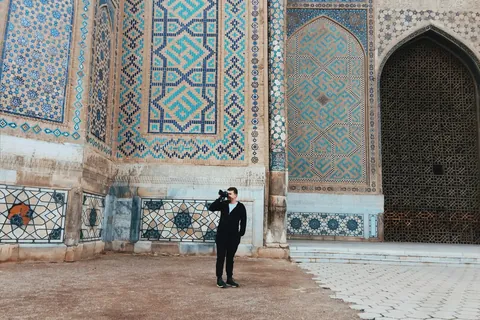
Facing it across the square, the Sherdar Madrasa was built between 1619 and 1636 on the orders of the Uzbek ruler of Samarkand, Yalangtoush Bakhodir. Its portal mosaics depict tigers, often described as lions, with a rising sun on their backs, an unusual use of living creatures in Islamic decoration that blends Turkic and Persian traditions. The name is usually explained as relating to the tiger, since sher means tiger in Persian, though translations vary.
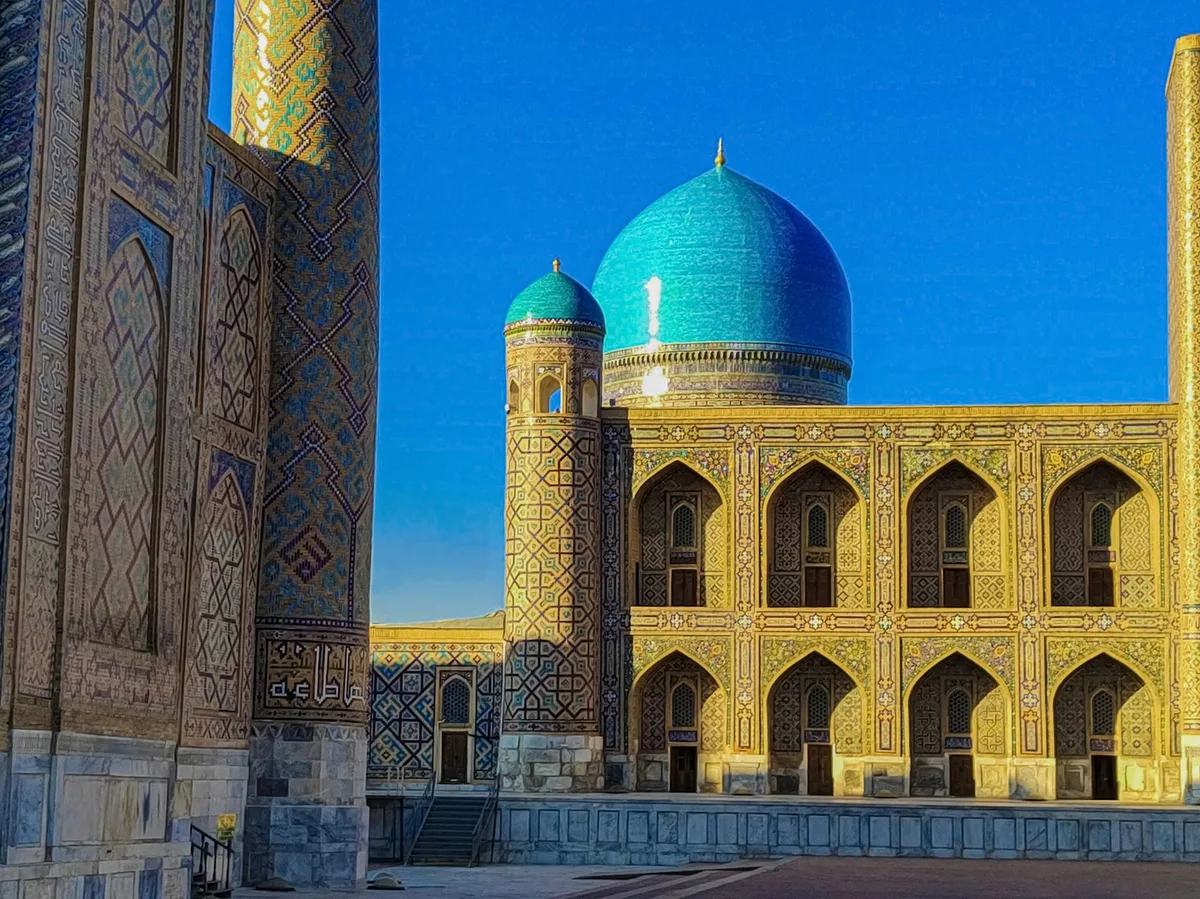
The Tilla-Kari Madrasa, built between 1646 and 1660, closes the third side of the square. Its name is commonly translated as the Gilded Madrasa, and it served both as a residential college and as a grand mosque. It has a two-storey main facade and a large courtyard lined with student cells, with galleries along four axes. The mosque stands in the western part of the courtyard, and its main hall is richly gilded.
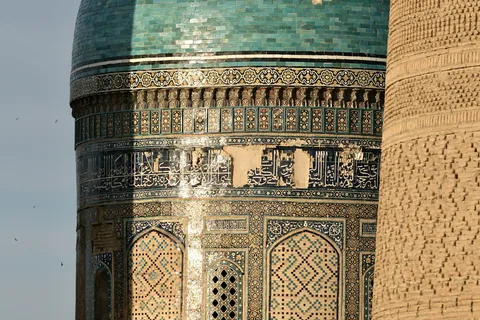
Together the three buildings are widely described as among the finest examples of Islamic architecture in Central Asia. The ensemble is known for soaring iwans, turquoise domes, mosaic tilework and muqarnas, the honeycomb-like vaulting. The three madrasas were built over roughly 230 years, and inscriptions on them appear in Persian, Chagatai Turkic and Arabic.
Other structures belong to the wider Registan precinct. The 16th-century Mausoleum of the Shaybanids lies east of the Tilla-Kari Madrasa, and the Chorsu trading dome, dating in its present form to 1785, stands just behind the Sherdar Madrasa at a historic crossroads linking Samarkand with Tashkent, Bukhara and Shahrisabz. After renovation the dome now houses an art gallery.
UNESCO inscribed Samarkand's historic centre, which includes the Registan, in 2001 under criteria (i), (ii) and (iv). The square is one of the most recognisable landmarks in Uzbekistan and is typically visited as part of a wider Silk Road itinerary through the country. The courtyards and facades reward unhurried viewing, and a private guided visit with a driver makes it easy to move between the Registan and Samarkand's other monuments at your own pace.
See every tour and attraction we cover in Uzbekistan.