TorontoOntario · 36 tours
 Niagara FallsOntario · 25 tours
 New York CityNew York · 30 tours
 Las VegasNevada · 8 tours
 San FranciscoCalifornia · 16 tours
 VancouverBritish Columbia · 17 tours
 DubaiUAE · 54 tours
 Abu DhabiUAE · 5 tours
 Buenos AiresArgentina · 23 tours
 AthensGreece · 31 tours
 AucklandNew Zealand · 38 tours
 CancunMexico · 54 tours
No destinations match “”. Try searching all tours instead — that search understands full questions, not just place names.
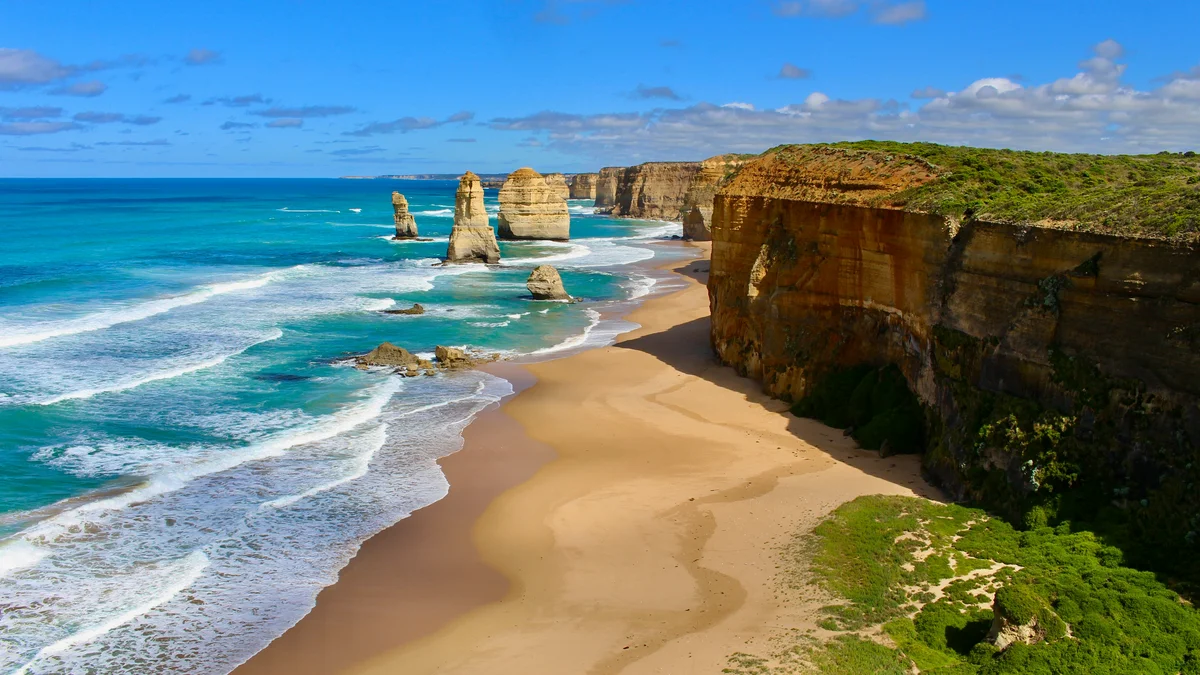
Rising out of the Southern Ocean along Victoria's Great Ocean Road, the Twelve Apostles are limestone sea stacks formed by centuries of wave erosion carving away the coastline's soft cliffs. Despite the name, only a handful of stacks remain today, as the same erosion that created them continues to wear them down, and the site's dramatic cliff-top viewing platforms make it one of Australia's most visited natural landmarks.
Visitor guide
The Twelve Apostles are a group of limestone sea stacks standing just off the shore of Port Campbell National Park on the Great Ocean Road in Victoria, Australia. They rise from the Southern Ocean beside tall coastal cliffs, and their closeness to one another makes them one of the most photographed coastal sights in the country.
The stacks have had several names. Wikipedia notes that they were earlier called the Pinnacles and the Sow and Pigs, or Sow and Piglets, with Muttonbird Island as the Sow. The Twelve Apostles name was adopted officially to attract more tourists, even though only nine stacks are believed to have existed originally, and Wikipedia adds that there may never have been twelve. Seven of the original nine are reported to remain standing. The site is in the Shire of Corangamite near the town of Port Campbell.
The rock is Port Campbell Limestone, deposited in the mid to late Miocene, roughly 15 to 5 million years ago. Waves and weather first carved caves into the soft cliffs, which grew into arches. When the arches collapsed, free-standing stacks, some up to about 50 metres high, were left offshore. The same erosion continues to work on the coastline, and Wikipedia says existing headlands are expected to become new stacks over time while the existing ones eventually fall.
That process is not only theoretical. In July 2005 a stack about 50 metres high collapsed into the sea, and another fell in 2009, according to Wikipedia. The shape of the coast is therefore continually changing, which is why local viewpoint photographs from different decades can look quite different.
Port Campbell National Park was established on 5 May 1964 to protect limestone formations along the coast, and has since grown to about 1,750 hectares. Wikipedia describes it as lying roughly 190 km southwest of Melbourne. Besides the Twelve Apostles, it includes London Bridge, Loch Ard Gorge, Gibson Steps and The Grotto, all along what is known as the Shipwreck Coast. The cliffs overlook islets, gorges, arches and blowholes.
The park's plant life is shaped by salt-laden winds, with heaths and grasslands such as sun orchids, spider orchids and coast daisy bush. Birds are the main wildlife, including honeyeaters, fairy wrens, peregrine falcons and hooded plovers, while penguins, gannets and short-tailed shearwaters are associated with the shoreline and sea. Southern brown bandicoots and echidnas are among the land animals.
In March 2023 the Federal Court of Australia recognised the Eastern Maar people as the traditional owners of about 8,578 square kilometres of southwest Victoria, including the Twelve Apostles, under the Native Title Act 1993. The waters off the stacks are also protected as the Twelve Apostles Marine National Park.
The Twelve Apostles are reached along the Great Ocean Road, with viewing platforms on the cliff top. Light, tide and weather change the look of the coastline, and the Southern Ocean can be windy and cool even in summer, so layers are a good idea. A private tour allows time for the other stops along the coast.
See every tour and attraction we cover in Melbourne.