TorontoOntario · 36 tours
 Niagara FallsOntario · 25 tours
 New York CityNew York · 30 tours
 Las VegasNevada · 8 tours
 San FranciscoCalifornia · 16 tours
 VancouverBritish Columbia · 17 tours
 DubaiUAE · 54 tours
 Abu DhabiUAE · 5 tours
 Buenos AiresArgentina · 23 tours
 AthensGreece · 31 tours
 AucklandNew Zealand · 38 tours
 CancunMexico · 54 tours
No destinations match “”. Try searching all tours instead — that search understands full questions, not just place names.
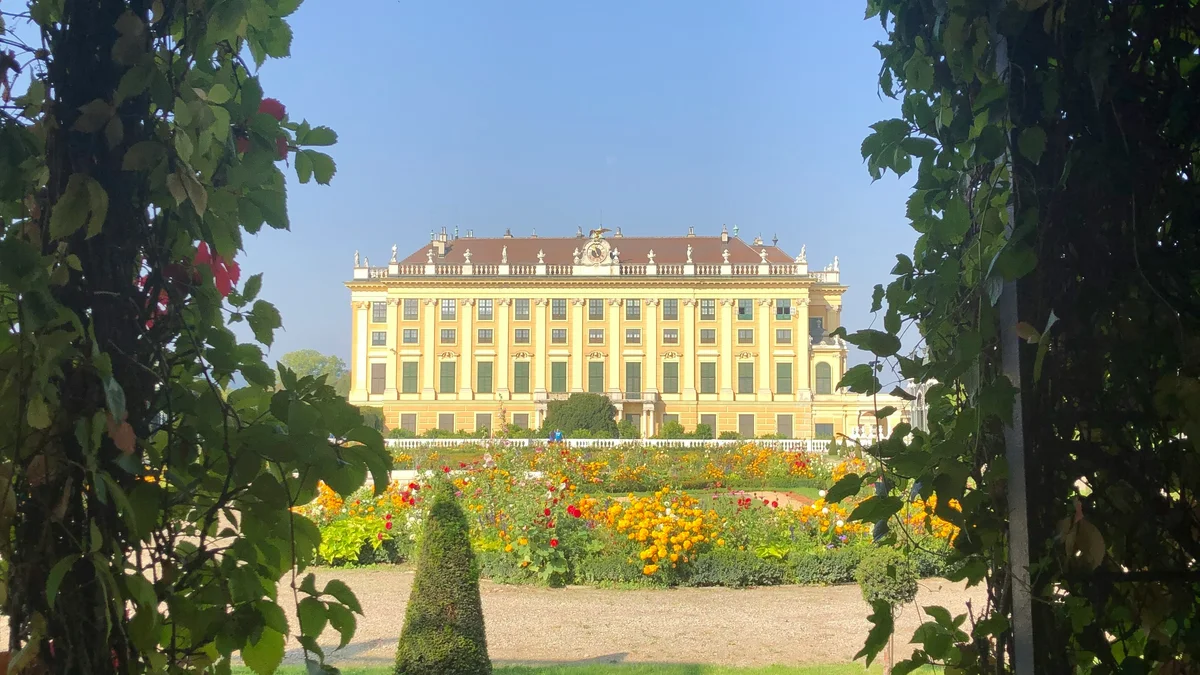
Schönbrunn Palace was the summer residence of the Habsburg emperors for more than 250 years and remains one of the most important Baroque palace complexes in Europe, with 1,441 rooms behind its yellow facade. Visitors can tour a portion of the state apartments, including rooms once used by Empress Maria Theresa and Emperor Franz Joseph, and walk the formal gardens up to the Gloriette, a colonnaded monument on the hill behind the palace with sweeping views back over Vienna. The palace and gardens were named a UNESCO World Heritage Site in 1996.
Visitor guide
Schönbrunn Palace (Schloss Schönbrunn) was the main summer residence of the Habsburg rulers and stands in Hietzing, Vienna's 13th district. The 1,441-room Baroque palace and its vast gardens are among Austria's most important architectural and historic monuments, and UNESCO placed them on the World Heritage List in 1996.
According to Wikipedia, the name Schönbrunn means beautiful spring and comes from an artesian well used by the court. In 1569 Holy Roman Emperor Maximilian II bought a floodplain of the Wien river beneath a hill and had it fenced as a hunting ground stocked with game; fishponds were dug, and exotic birds were kept in a small separate area. The name Schönbrunn first appears in 1642 on an invoice, when Eleonora Gonzaga, widow of Ferdinand II, added a palace to an existing mansion called Katterburg between 1638 and 1643.
The palace in its present form was built and remodelled in the 1740s and 1750s by Baron Diego Pereira d'Aguilar under Empress Maria Theresa, who had received the estate as a wedding gift. Franz I later commissioned the neoclassical redecoration of the exterior.
Franz Joseph, the longest-reigning Emperor of Austria, was born at Schönbrunn, spent much of his life there and died in the palace on 21 November 1916 at the age of 86. After the Habsburg monarchy fell in November 1918, the palace passed to the new Austrian Republic and was preserved as a museum. It was bombed in February 1945 and then requisitioned during the Allied occupation to house British offices and a small garrison. It has remained available for important events, such as the 1961 meeting between U.S. President John F. Kennedy and Soviet premier Nikita Khrushchev.
Since 1992 the palace and gardens have been run by a limited-liability company owned wholly by the Republic of Austria, which carries out preservation and restoration without state subsidies. UNESCO described the site as a remarkable Baroque ensemble and an example of the synthesis of the arts.
The sculpted space between the palace and the Neptune Fountain is the Great Parterre. A French garden was planned in 1695 by Jean Trehet, a disciple of André Le Nôtre. The grounds also hold an orangery erected around 1755, the Tiergarten (a zoo within the gardens), and a palm house that by 1882 replaced about ten smaller glasshouses.
The garden axis aims at a 60-metre hill crowned since 1775 by the Gloriette. Maria Theresa intended it to glorify Habsburg power and had it built from stone left over from the near demolition of Schloss Neugebäude. Another feature is the Roman Ruin, originally called the Ruin of Carthage, a set of follies erected in 1778 to evoke an ancient edifice slowly crumbling, reflecting the fashion for picturesque ruins in Romantic taste.
Wikipedia calls Schönbrunn Vienna's most popular tourist destination, with almost 4 million visitors in 2017. The Vienna Philharmonic has performed the Summer Night Concert Schönbrunn in the gardens annually since 2004, and the Schönbrunn Palace Orchestra, founded in 1997, gives concerts. The palace has been used for films and television, including the Sissi trilogy of the 1950s and the James Bond film The Living Daylights.
A private guided visit lets guests choose between the palace interiors and the long garden walk up to the Gloriette, at a pace that suits the group.
See every tour and attraction we cover in Vienna.