TorontoOntario · 36 tours
 Niagara FallsOntario · 25 tours
 New York CityNew York · 30 tours
 Las VegasNevada · 8 tours
 San FranciscoCalifornia · 16 tours
 VancouverBritish Columbia · 17 tours
 DubaiUAE · 54 tours
 Abu DhabiUAE · 5 tours
 Buenos AiresArgentina · 23 tours
 AthensGreece · 31 tours
 AucklandNew Zealand · 38 tours
 CancunMexico · 54 tours
No destinations match “”. Try searching all tours instead — that search understands full questions, not just place names.
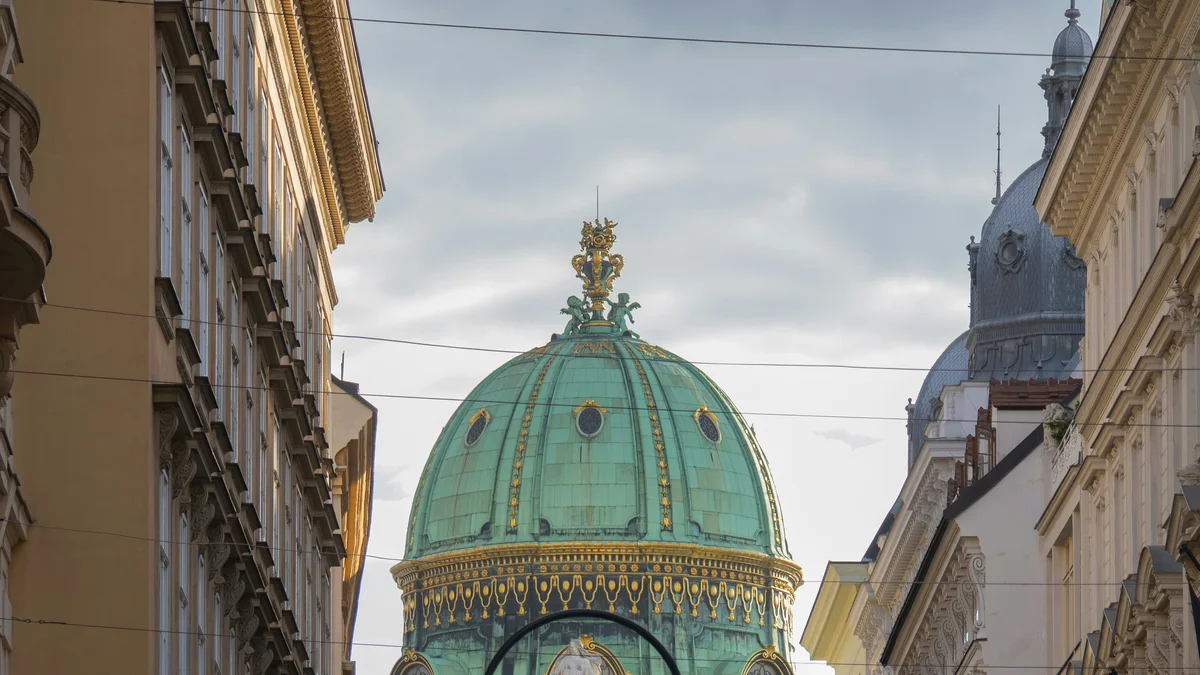
The Hofburg was the principal winter residence of the Habsburg dynasty for more than six centuries and grew, wing by wing, into the sprawling complex of courtyards and buildings that now sits at the heart of Vienna's old town. Today it houses the Sisi Museum, dedicated to Empress Elisabeth of Austria, the Imperial Apartments where the imperial family actually lived, and the Imperial Treasury, home to the Habsburg crown jewels and imperial regalia. The complex also includes the Spanish Riding School, famous for its Lipizzaner horses, and the domed Michaelertor gate is one of its most photographed entrances.
Visitor guide
The Hofburg is the former principal imperial palace of the Habsburg dynasty, in the centre of Vienna. Begun in the 13th century and expanded repeatedly over the following centuries, it served as the imperial winter residence while Schönbrunn Palace was the summer residence.
According to Wikipedia, the palace was first built by the last of the Babenbergs or by Ottokar II of Bohemia, and the Hofburg area has been the documented seat of government since 1279. From 1438 to 1583 and again from 1612 to 1806 it was the seat of the Habsburg kings and emperors of the Holy Roman Empire, and until 1918 the seat of the Emperors of Austria.
The oldest sections form the Swiss Court (Schweizerhof), which originally had a square plan with four turrets and a moat. The Swiss Gate bears the many titles of Ferdinand I, and the court contains the Gothic Burgkapelle of the 15th century and the Imperial Treasury (Schatzkammer), which holds the imperial insignia of the Holy Roman Empire and the Empire of Austria. The Vienna Boys' Choir traditionally sings mass on Sundays in the Court Music Chapel.
The Amalienburg was built for Rudolph II and carries a small tower with an astronomical clock. The Leopold Wing is named for Leopold I; a fire in 1668 destroyed the recently completed first building, and the wing standing today dates from the 1670s. The Imperial Chancellery Wing, planned by Johann Lukas von Hildebrandt, later housed apartments for Napoleon's son the Duke of Reichstadt and for Franz Joseph I.
The Court Library has the Prunksaal hall, built between 1722 and 1737 to plans by Johann Bernhard Fischer von Erlach and containing Prince Eugene of Savoy's book collection and an enormous ceiling fresco by Daniel Gran. Wikipedia calls this the most significant part of the Hofburg in artistic terms. The Hall of Ceremonies, built for Francis II/I with 26 crystal chandeliers and 24 columns in scagliola, is where Napoleon I is said to have asked for the hand of Archduchess Marie Louise.
The Stallburg was originally built as a residence for the crown prince Maximilian, later housed the art collection of Archduke Leopold Wilhelm, which forms the core of the Kunsthistorisches Museum from 1889, and was converted to hold imperial horses. It is used by the Spanish Riding School, whose Winter Riding School stands opposite and where Austria's first parliament sat in 1848.
Heroes Square (Heldenplatz) was laid out after part of the bastion was demolished in 1809. Equestrian statues of Prince Eugene of Savoy and Archduke Charles stand on it. On 15 March 1938, Hitler proclaimed the Anschluss of Austria from the balcony of the Neue Burg, a part of the history that the square also carries.
After Vienna's city walls were demolished in the 1860s, the Hofburg had its last major expansion. A planned Imperial Forum linking the Hofburg with the twin museums across the Ringstrasse was led by Gottfried Semper and Karl von Hasenauer, but only the museums, completed in 1891, and the Neue Burg were built, the latter over several decades from 1879, with its interiors finished in the 1920s. The Neue Burg now houses several museums, including the Ephesos Museum and the Collection of Arms and Armour, as well as reading rooms of the national library.
The complex is large and mixed in use, containing offices of state, a congress centre and museums, so a guide helps in choosing what to see. A private tour can combine the Hofburg with St. Stephen's Cathedral and the Ringstrasse sights nearby.
See every tour and attraction we cover in Vienna.