TorontoOntario · 36 tours
 Niagara FallsOntario · 25 tours
 New York CityNew York · 30 tours
 Las VegasNevada · 8 tours
 San FranciscoCalifornia · 16 tours
 VancouverBritish Columbia · 17 tours
 DubaiUAE · 54 tours
 Abu DhabiUAE · 5 tours
 Buenos AiresArgentina · 23 tours
 AthensGreece · 31 tours
 AucklandNew Zealand · 38 tours
 CancunMexico · 54 tours
No destinations match “”. Try searching all tours instead — that search understands full questions, not just place names.
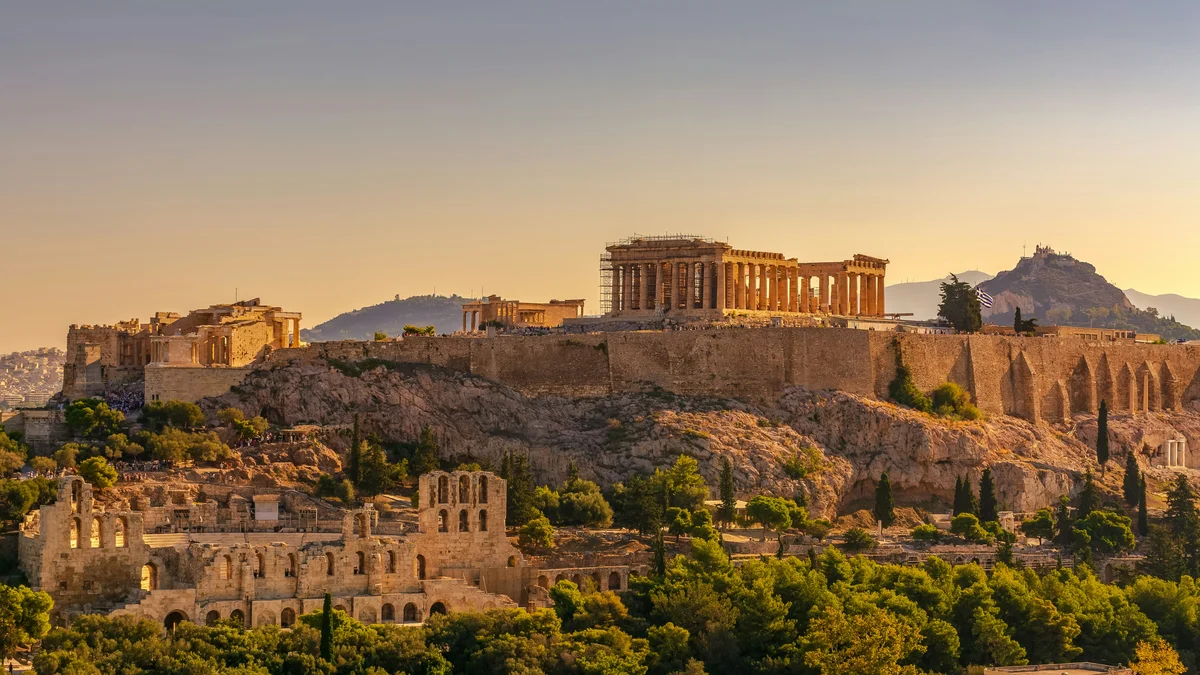
The Acropolis is the ancient citadel crowning central Athens, home to the Parthenon and among the most significant surviving monuments of classical Greek civilization. Built in the 5th century BC under the statesman Pericles, its temples were dedicated to the goddess Athena, the city's patron. Visiting early in the morning is the best way to beat both the crowds and the midday heat on the shadeless marble summit.
Visitor guide
The Acropolis of Athens is an ancient citadel on a rocky outcrop about 150 metres above sea level in the centre of Athens, Greece. Its name combines the Greek words for highest point and city, and it is crowned by the Parthenon and other 5th-century BC temples that make it one of the most significant surviving monuments of classical Greek civilisation.
The hill was inhabited as early as the 4th millennium BC. A Mycenaean palace probably stood there in the late Bronze Age, and a massive Cyclopean wall about 760 metres long served as its main defence until the 5th century BC. Earlier temples stood on the summit, including the Hekatompedon of around 570 to 550 BC and the Old Temple of Athena built between 529 and 520 BC. The Persians sacked the site in 480 BC, and the debris was buried in pits and used as fill for the later classical plateau.
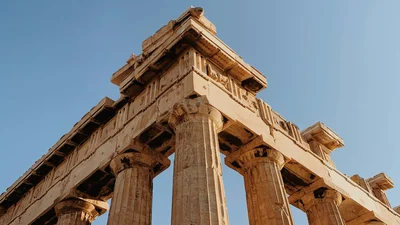
Pericles coordinated the rebuilding during the Golden Age of Athens, with the sculptor Phidias and the architects Ictinus and Callicrates responsible for the reconstruction. Phidias's bronze statue of Athena Promachos, about nine metres tall, was built between 450 and 448 BC. The Parthenon, the Temple of Athena Parthenos, sits at the centre of the summit and is the site's most famous building. The marble for the buildings came from Mount Pentelicus northeast of the city.
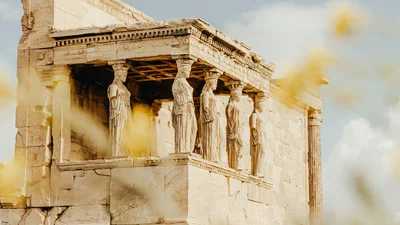
The Propylaea, the monumental western gateway begun by Mnesicles in 437 BC, was nearly complete by 432 BC. South of it stands the small Ionic Temple of Athena Nike, completed between 421 and 409 BC. The Erechtheion, built between 421 and 406 BC, was designed around very uneven ground and several existing shrines. Its southwestern porch is supported by female figures called caryatids, and its eastern part honoured Athena Polias while the western part served the cult of Poseidon-Erechtheus.
Under Byzantine rule the Parthenon became a church dedicated to the Virgin Mary, and during the Latin Duchy of Athens it served as a cathedral. Under the Ottomans it was converted into a mosque with a minaret. During the Venetian siege of 1687 in the Morean War, the Ottomans were using it to store gunpowder, and when Venetian artillery hit it the powder exploded and the building was severely damaged. The mosque was demolished in 1843 as part of efforts after independence to remove later additions.
The Greek War of Independence brought three sieges of the Acropolis, two by the Greeks in 1821 and 1822 and one by the Ottomans in 1826 and 1827. Afterwards many Byzantine, Frankish and Ottoman features were removed to restore the monument to its classical form. The Acropolis Restoration Project began in 1975 and has collected stone fragments, reassembled original pieces where possible and used new Pentelic marble sparingly, with titanium dowels designed to be reversible.
On the south slope below the summit lie the Theatre of Dionysus and the Odeon of Herodes Atticus, built around AD 161 and reconstructed in the 1950s after destruction by the Herulians. The rock itself is a klippe, an isolated remnant of limestone thrust over softer schist, which makes it prone to rockfalls and explains the retaining walls and rock bolts used to stabilise it.
UNESCO inscribed the Acropolis as a World Heritage Site in 1987 under cultural criteria i, ii, iii, iv and vi. The summit has little shade, so a private guided visit can plan the walk around the weather and help interpret the temples and the story of their survival.
See every tour and attraction we cover in Athens.