TorontoOntario · 36 tours
 Niagara FallsOntario · 25 tours
 New York CityNew York · 30 tours
 Las VegasNevada · 8 tours
 San FranciscoCalifornia · 16 tours
 VancouverBritish Columbia · 17 tours
 DubaiUAE · 54 tours
 Abu DhabiUAE · 5 tours
 Buenos AiresArgentina · 23 tours
 AthensGreece · 31 tours
 AucklandNew Zealand · 38 tours
 CancunMexico · 54 tours
No destinations match “”. Try searching all tours instead — that search understands full questions, not just place names.
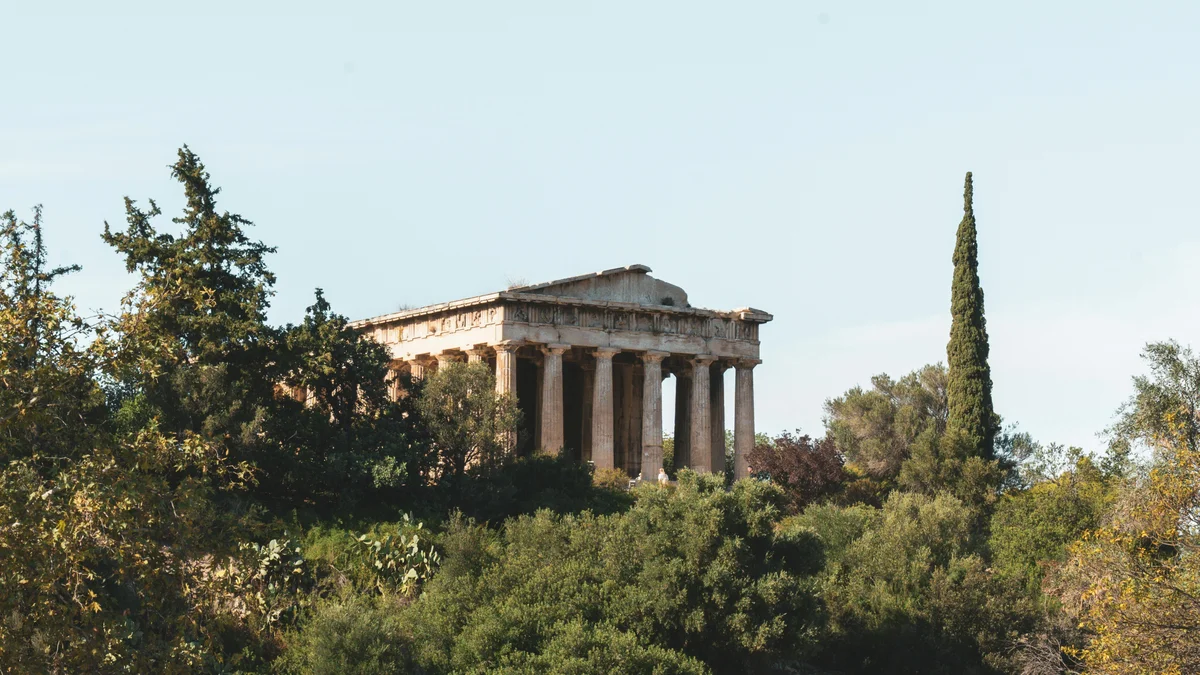
The Ancient Agora was the civic and commercial heart of classical Athens, where citizens gathered for markets, philosophy, and the earliest practice of democratic government — Socrates himself is said to have taught here. Its best-preserved building, the Temple of Hephaestus, is one of the most intact Doric temples anywhere in Greece, still largely standing since around 415 BC. The reconstructed Stoa of Attalos on the site now houses a museum of finds excavated from the Agora.
Visitor guide
The Ancient Agora of Athens is the excavated civic and commercial centre of the classical city, lying northwest of the Acropolis, bounded by the Areopagus on the south and the hill of Agoraios Kolonos, also called Market Hill, on the west. It served as a gathering place for trade, assembly and daily public life.
The Agora was a multipurpose civic centre. It held a Bouleuterion for the council, stoas for social gatherings and business, temples and altars for worship, and a monument that posted public notices. The Monument of the Eponymous Heroes honoured the ten heroes of Athens's tribes and served as a notice board for new legislation, public events and military conscription.
On the north side the Stoa Poikile, or Painted Stoa, was built in the 5th century BC and used for socialising, while the Altar of the Twelve Gods was discovered in the 1934 excavation season and the Royal Stoa in 1932. A marble statue possibly carved by Bryaxis was found behind the Royal Stoa. The Temple of Ares was added to the north half of the Agora.
On the west side excavators found the Bouleuterion, the assembly building of the council, in 1933, along with the Metroon nearby, and the Tholos in 1934. The Temple of Hephaestus on Market Hill is the temple associated with the site, famed for its state of preservation. The sculptor Alcamenes, an associate of Phidias, made bronze cult statues of Hephaestus and Athena for it.
The Stoa of Attalos was built in the 2nd century BC on the east side as a stoa lined with shops. The Hellenistic building was reconstructed in the 1950s and now houses the Museum of the Ancient Agora, with storage and offices for the excavation team. Its collection includes objects from the 7th to the 5th centuries BC, many connected with Athenian democracy.
The Archaeological Society of Athens excavated near Vrysaki in 1851 and 1852, aiming to find the Bouleuterion, Metroon and Tholos, but did not uncover them. Wilhelm Dorpfeld of the German Archaeological Institute led further digs from 1882 to 1888, with later work in 1895 to 1896 and 1907 to 1908. In 1924 a bill to expropriate properties was defeated, and only foreign institutes could raise sufficient capital.
The American School of Classical Studies at Athens began excavations in 1931 under T. Leslie Shear with major funding from John D. Rockefeller Jr., and in 1939 alone 56,000 tons of earth were cleared. During the 1938 season excavators plotted the course of the Panathenaic Way, which allowed the Agora's boundaries to be established. Work was halted by the Second World War in 1940 and resumed after 1945. In 1974 a lead letter written by a slave named Lesis was discovered, one of the few recorded instances of slave literacy. John McK. Camp directed the excavations from 1994 until his retirement in 2022.
The open site is a landscape of foundations, shaded paths and the surviving temple, and the Stoa of Attalos museum helps interpret it. A private guided visit suits the Agora, since much of its meaning lies in what has been lost and what a guide can reconstruct from the ruins and finds.
See every tour and attraction we cover in Athens.