TorontoOntario · 36 tours
 Niagara FallsOntario · 25 tours
 New York CityNew York · 30 tours
 Las VegasNevada · 8 tours
 San FranciscoCalifornia · 16 tours
 VancouverBritish Columbia · 17 tours
 DubaiUAE · 54 tours
 Abu DhabiUAE · 5 tours
 Buenos AiresArgentina · 23 tours
 AthensGreece · 31 tours
 AucklandNew Zealand · 38 tours
 CancunMexico · 54 tours
No destinations match “”. Try searching all tours instead — that search understands full questions, not just place names.
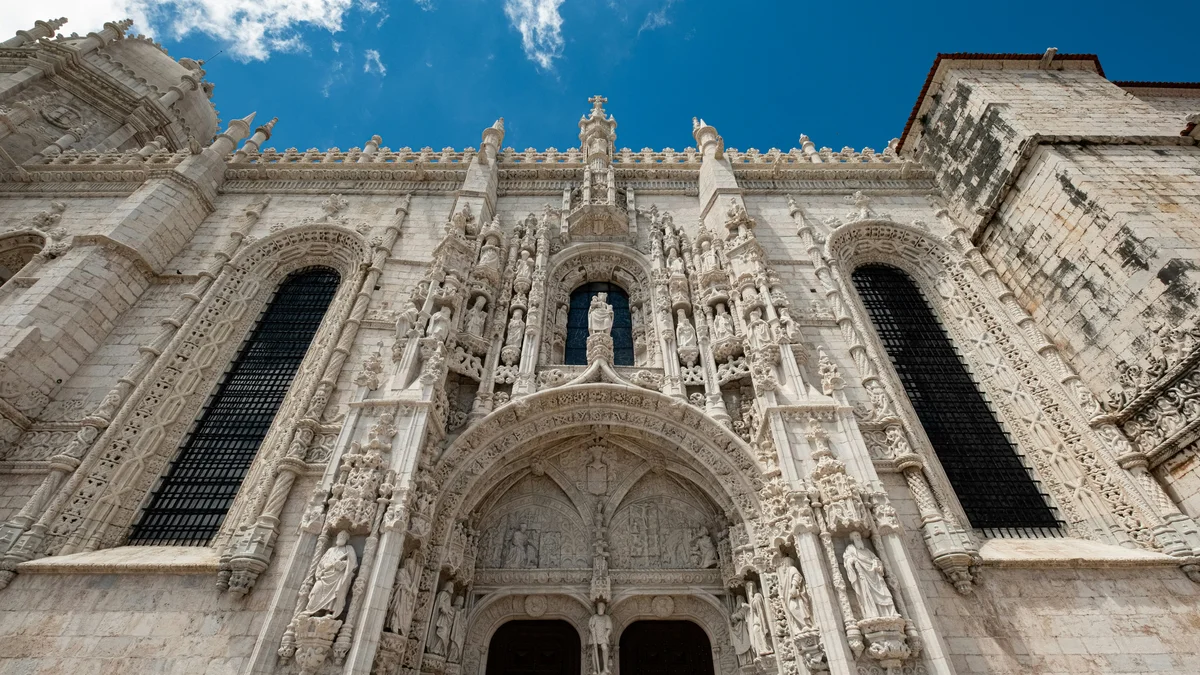
Founded by King Manuel I in the late 15th century and begun in 1501, Jerónimos Monastery in Lisbon's Belém district is a UNESCO World Heritage Site and one of the finest examples of Manueline architecture, Portugal's distinctive late-Gothic style rich with maritime and botanical carving. Vasco da Gama himself is entombed inside, and the monastery's elaborate south portal, covered in intricate stonework, remains one of the most photographed facades in the city.
Visitor guide
Jerónimos Monastery (Mosteiro dos Jerónimos) is a former monastery in the Belém district of Lisbon, Portugal, and one of the great monuments of the Manueline style. UNESCO listed it in 1983 together with the nearby Tower of Belém, and it is closely tied to Portugal's Age of Discovery.
The monastery replaced the Hermitage of Restelo, a church dedicated to Santa Maria de Belém where monks aided seafarers. According to Wikipedia, King Manuel I ordered the new building in 1495 as a final resting place for the House of Aviz, and he petitioned the Holy See for permission in 1496. Vasco da Gama and his men spent a night in prayer at the old hermitage before sailing for India in 1497.
Construction began on 6 January 1501 and took about a century. It was funded by the Vintena da Pimenta, a 5 percent tax on trade from Africa and the Orient. Hieronymite monks lived there for over four centuries, praying for the king's soul and supporting sailors.
Diogo de Boitaca pioneered the richly ornate Manueline style, with maritime motifs, using local limestone. The Spanish architect and sculptor Juan de Castillo took over around 1517 and moved the design toward the Plateresque style. Nicolau Chanterene added Renaissance sculpture, including the western portal, and Diogo de Torralva resumed work in 1550. Jerónimo de Ruão continued in 1571, and work halted in 1580 with the union of Spain and Portugal.
The south portal, designed by Castillo, rises about 32 metres and is considered one of the most significant works of its time. A statue of Henry the Navigator stands between the doors, with scenes from the life of Saint Jerome. Inside, the church is a three-aisled hall with a single ribbed vault spanning about 19 metres, supported by six slender octagonal columns about 25 metres high.
The square cloister measures 55 by 55 metres, begun by Boitaca and finished by Castilho, and its walls carry nautical, European, Moorish and Eastern motifs. In the main chancel the tombs of Manuel I and Maria of Aragon, and of João III and Catherine of Austria, rest on marble elephants. The tombs of Vasco da Gama and the poet Luís de Camões are in the lower choir, moved there in 1880, and Fernando Pessoa is entombed in a cloister arcade.
The monastery withstood the 1755 Lisbon earthquake with little damage. It was secularised by a decree of 28 December 1833, and restoration began after 1860. The Maritime Museum opened in its western wing in 1963, and the National Archaeology Museum is also housed there. It was designated a national monument in 1907, and the Treaty of Lisbon was signed there on 13 December 2007. A private tour with a local guide suits the monastery, which stands close to Belém Tower.
See every tour and attraction we cover in Lisbon.