TorontoOntario · 36 tours
 Niagara FallsOntario · 25 tours
 New York CityNew York · 30 tours
 Las VegasNevada · 8 tours
 San FranciscoCalifornia · 16 tours
 VancouverBritish Columbia · 17 tours
 DubaiUAE · 54 tours
 Abu DhabiUAE · 5 tours
 Buenos AiresArgentina · 23 tours
 AthensGreece · 31 tours
 AucklandNew Zealand · 38 tours
 CancunMexico · 54 tours
No destinations match “”. Try searching all tours instead — that search understands full questions, not just place names.
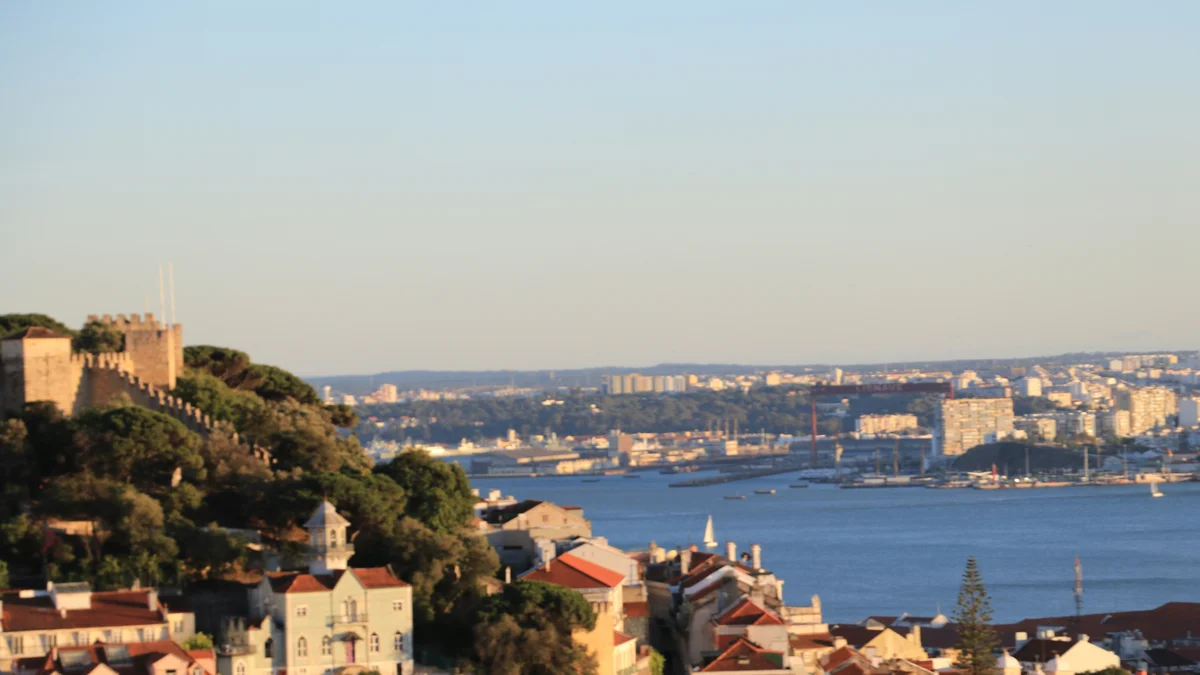
Perched on Lisbon's highest hill above the historic Alfama district, São Jorge Castle traces its fortifications back to the Moorish period before the city's reconquest in 1147, though the site itself has been fortified since well before that. Its crenellated walls and towers now enclose a peaceful garden and archaeological ruins, and the ramparts offer one of the best panoramic views over Lisbon's rooftops and the Tagus River below.
Visitor guide
São Jorge Castle (Castelo de São Jorge) is a medieval castle on a hilltop above the Alfama district of Lisbon, Portugal. It is a national monument and museum and one of the city's principal landmarks, with terraces that look out over the rooftops and the Tagus.
According to Wikipedia, archaeological excavations show human presence in the Tagus valley from at least the 8th century BC, and the first fortifications on the hilltop are dated to around the 1st century BC. The hill was used first by Celtic tribes, then by Phoenicians, Greeks and Carthaginians as a defensive outpost, and later Romans, Suebi, Visigoths and Moors each held it in turn. Islamic-period walls are documented from the 10th century, when an inscription of 985 records repairs to the city wall under Almanzor; the Islamic settlement on the hill may date to the 8th century.
Afonso Henriques and northern European knights took the castle and city from the Almoravids in the 1147 Siege of Lisbon, part of the Second Crusade. A widely repeated legend says the knight Martim Moniz noticed an open door and threw his body into the gap to stop it closing, allowing Christian soldiers to enter at the cost of his life. Wikipedia presents this as legend rather than documented history.
In 1255 Lisbon became capital of the kingdom, and the castle served as the alcáçova, a fortified residence for Afonso III. The castle's own history page says the Royal Palace is first recorded in the 13th century, probably begun or substantially redeveloped under Afonso III, and the castle was further altered under King Denis. Between 1373 and 1375 Ferdinand I ordered the Cerca Fernandina, a new wall with 77 towers and a perimeter of 5,400 metres. In 1498 to 1502 Manuel I received Vasco da Gama at the castle after his return from India, and Gil Vicente staged a play there in 1502.
The palace gradually lost importance after the Ribeira Palace was built beside the river, and a 1531 earthquake added to the decline. During Spanish rule the castle became barracks and a prison, and the 1755 earthquake severely damaged it. From 1780 to 1807 the charity Casa Pia used the citadel to educate poor children. Portugal's first geodetic observatory was built in 1788 atop one of its towers.
By the 1930s the castle was almost hidden by later additions. The Salazar government began extensive renovations, demolishing incongruous structures, and a replica of Soares dos Reis's statue of Afonso Henriques was installed on 25 October 1947. The city of Lisbon took over its operation in 1942.
The citadel is roughly square. The castle proper has ten towers, and stairways lead to walkways along the walls. A dry moat is crossed by a stone bridge to the main gate, which bears the date 1846 and opens onto the Praça d'Armas, with old cannons and a bronze statue of Afonso Henriques. The Tower of Ulysses has had a camera obscura since 1998, giving a 360-degree view of the city. The hilltop is steep, so a private tour with a local driver is a practical way to reach it.
See every tour and attraction we cover in Lisbon.