TorontoOntario · 36 tours
 Niagara FallsOntario · 25 tours
 New York CityNew York · 30 tours
 Las VegasNevada · 8 tours
 San FranciscoCalifornia · 16 tours
 VancouverBritish Columbia · 17 tours
 DubaiUAE · 54 tours
 Abu DhabiUAE · 5 tours
 Buenos AiresArgentina · 23 tours
 AthensGreece · 31 tours
 AucklandNew Zealand · 38 tours
 CancunMexico · 54 tours
No destinations match “”. Try searching all tours instead — that search understands full questions, not just place names.
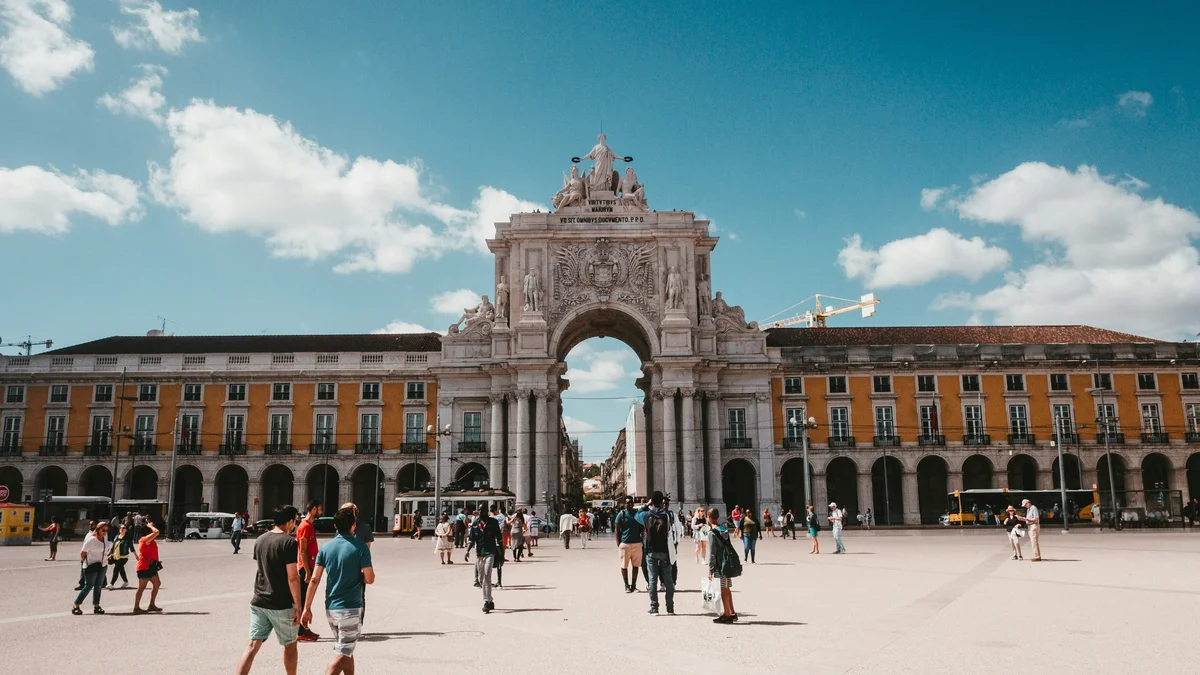
This grand riverside square was rebuilt as the centerpiece of Lisbon's reconstruction after the devastating 1755 earthquake, replacing the royal palace that once stood on the site. Its yellow arcaded buildings frame three sides of the square, while the monumental Rua Augusta Arch on the north side, topped with statues representing Glory crowning Genius and Valor, opens onto the city's main pedestrian street.
Visitor guide
Praça do Comércio, also called Terreiro do Paço or Palace Yard, is a large riverside square in Lisbon, Portugal, facing the Tagus. Covering about 30,600 square metres, it was laid out after the 1755 earthquake as the centrepiece of the rebuilt city.
In the early 16th century King Manuel I built the Ribeira Palace by the river outside the city walls. The waterfront grew around it with a port, the Ribeira das Naus shipyards, the Casa da Índia and administrative buildings that regulated trade with Europe, Africa, Asia and the Americas. According to Wikipedia, the palace's library is often put at around 70,000 volumes, though some accounts give higher figures, and its destruction meant the loss of a major archive of Portuguese literature.
On 1 November 1755 an earthquake, a tsunami and fires destroyed much of Lisbon, including the Ribeira Palace. The Marquis of Pombal oversaw the rebuilding, and the architect Eugénio dos Santos designed a U-shaped square open to the river, with arcaded ground floors and two towers at the ends of the arms, recalling the lost palace tower. The plan was nearly fully realised, though the east tower and the Rua Augusta Arch were not finished until the 19th century.
The square was named Praça do Comércio to reflect its new economic role. Its buildings housed offices handling customs and port activity, and from the 19th century they held ministries of finance, internal administration, agriculture and maritime affairs. The square became shorthand for central government, and the Supreme Court is also located here.
The equestrian statue of King José I was unveiled in 1775 at the centre of the square. Designed by Joaquim Machado de Castro, it is described by Wikipedia as the first monumental statue dedicated to a king in Lisbon, and shows the king symbolically crushing snakes beneath his horse.
The Rua Augusta Arch opens onto the pedestrian street that links the square with the Rossio. It carries a clock and statues of Glory, Ingenuity and Valor, plus figures including Viriatus, Nuno Álvares Pereira, Vasco da Gama and the Marquis of Pombal. Wikipedia gives inconsistent architects and completion dates for it, 1873 and 1875.
On 1 February 1908 King Carlos I was assassinated in the square as his carriage returned to the royal palace, and his heir Luís Filipe was mortally wounded. Two years later the monarchy was overthrown. The square was classified as a national monument in June 1910, and on 10 June, Portugal Day, it fills with military personnel and residents.
The café Martinho da Arcada, established in 1782, is described by Wikipedia as the oldest café in Lisbon. A tram on the northern side runs toward Belém, a ferry crosses the Tagus from the waterfront, and the western tower houses the Baixa location of the Museum of Lisbon. A grand marble staircase at the water's edge, dating from before 1755, was built to receive royal dignitaries. The square is a natural starting point for a private tour of central Lisbon.
See every tour and attraction we cover in Lisbon.