TorontoOntario · 36 tours
 Niagara FallsOntario · 25 tours
 New York CityNew York · 30 tours
 Las VegasNevada · 8 tours
 San FranciscoCalifornia · 16 tours
 VancouverBritish Columbia · 17 tours
 DubaiUAE · 54 tours
 Abu DhabiUAE · 5 tours
 Buenos AiresArgentina · 23 tours
 AthensGreece · 31 tours
 AucklandNew Zealand · 38 tours
 CancunMexico · 54 tours
No destinations match “”. Try searching all tours instead — that search understands full questions, not just place names.
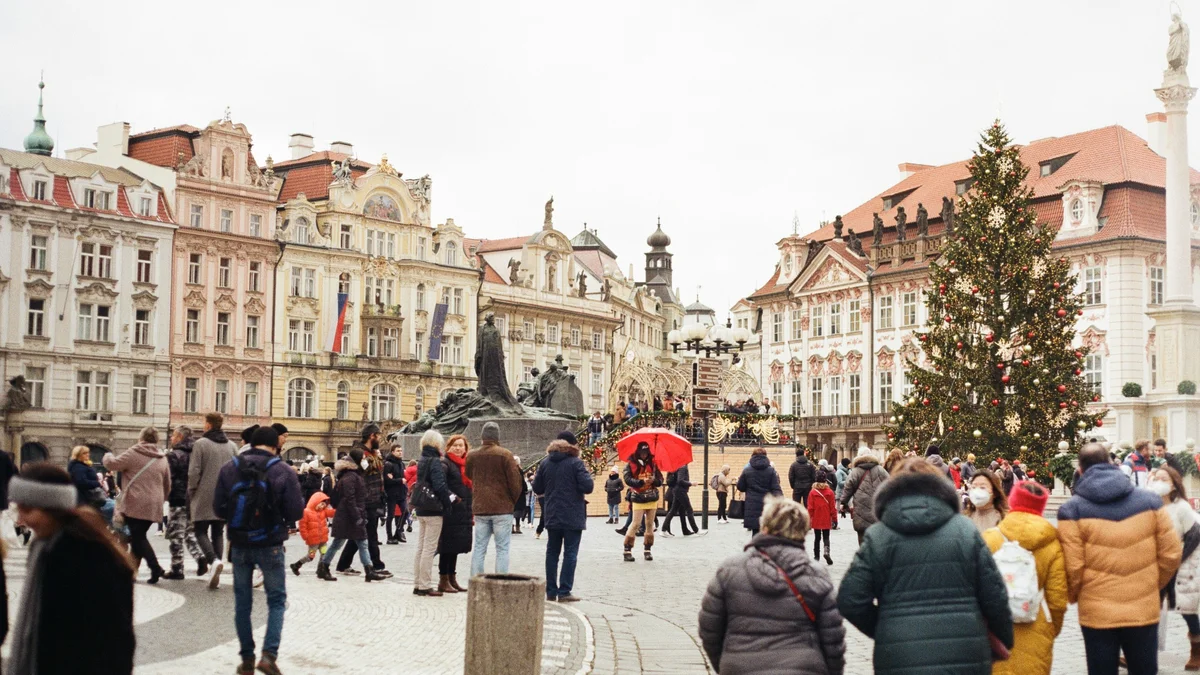
This historic square at the heart of Prague dates back to the 12th century and is anchored by the Prague Astronomical Clock, installed in 1410 and still the oldest astronomical clock in the world still operating. The Gothic twin spires of the Church of Our Lady before Týn rise above the surrounding pastel townhouses. Crowds gather on the hour to watch the clock's mechanical Apostles parade past its dial.
Visitor guide
Old Town Square (Staroměstské náměstí, colloquially Staromák) is a historic square in the Old Town quarter of Prague, Czech Republic, between Wenceslas Square and Charles Bridge. It gathers buildings of several architectural styles around the Jan Hus Memorial, the Old Town Hall with its astronomical clock and the twin towers of the Church of Our Lady before Týn.
The Gothic Church of the Mother of God before Týn has been the main church of this part of the city since the 14th century. Its two towers are 80 metres high, and each spire is topped by eight smaller spires in two layers of four. A Romanesque church for foreign merchants visiting the nearby Týn Courtyard stood here in the 11th century and was replaced by an early Gothic church in 1256. The present building was designed in late Gothic style under the influence of Matthias of Arras and later Peter Parler.
The church was controlled by Hussites for two centuries. A sculpture of King George of Poděbrady and a huge golden chalice, the symbol of the Hussites, once adorned the gable but were removed in 1626 after the Battle of White Mountain and replaced by a sculpture of the Virgin Mary with a halo made from the melted chalice. The southern tower was completed in 1511 under architect Matěj Rejsek. A new golden chalice was installed in 2017. The Baroque St. Nicholas Church also stands on the square.
The Old Town Hall was formed in 1338 when the councillors bought a patrician house, and it was extended over time by acquiring adjoining houses, so it is architecturally unusual in being built from many smaller houses. Its tower, completed in 1364, was the tallest in the medieval city and is open to the public with panoramic views.
The Prague astronomical clock, or Orloj, is mounted on the southern wall. Its mechanical clock and astronomical dial date from 1410, and the first recorded mention is 9 October 1410. Wikipedia says that is the third-oldest astronomical clock in the world and the oldest still working. The clock includes an astronomical dial, statues of saints, a calendar dial, and the hourly Walk of the Apostles, in which a skeleton representing Death strikes the time. A famous legend that the clockmaker Hanuš was blinded so he could not repeat his work comes from the writer Alois Jirásek, and later research shows that attribution of the clock to Hanuš was a historical mistake. The clock was heavily damaged during the Prague uprising in May 1945 and working again by 1948.
At the centre stands the Jan Hus Memorial, erected on 6 July 1915 for the 500th anniversary of the death of the religious reformer Jan Hus, who was burned at the stake in Konstanz. His death led to the Hussite Wars. In front of the Old Town Hall, 27 crosses in the pavement commemorate the 27 Bohemian leaders executed by the Habsburgs here on 21 June 1621 after the Battle of White Mountain; a plaque with their names dates from 1911. A Marian Column erected after the Thirty Years' War was demolished on 3 November 1918 during celebrations of independence and re-erected in 2020.
The Kinský Palace on the square houses an art museum of the Czech National Gallery. Christmas and Easter markets resemble medieval markets, and Wikipedia describes the Christmas markets as the largest in the Czech Republic, with CNN ranking Prague's among the ten best in the world in 2016. A private guided visit can time the square, tower and nearby Charles Bridge together.
See every tour and attraction we cover in Prague.