TorontoOntario · 36 tours
 Niagara FallsOntario · 25 tours
 New York CityNew York · 30 tours
 Las VegasNevada · 8 tours
 San FranciscoCalifornia · 16 tours
 VancouverBritish Columbia · 17 tours
 DubaiUAE · 54 tours
 Abu DhabiUAE · 5 tours
 Buenos AiresArgentina · 23 tours
 AthensGreece · 31 tours
 AucklandNew Zealand · 38 tours
 CancunMexico · 54 tours
No destinations match “”. Try searching all tours instead — that search understands full questions, not just place names.
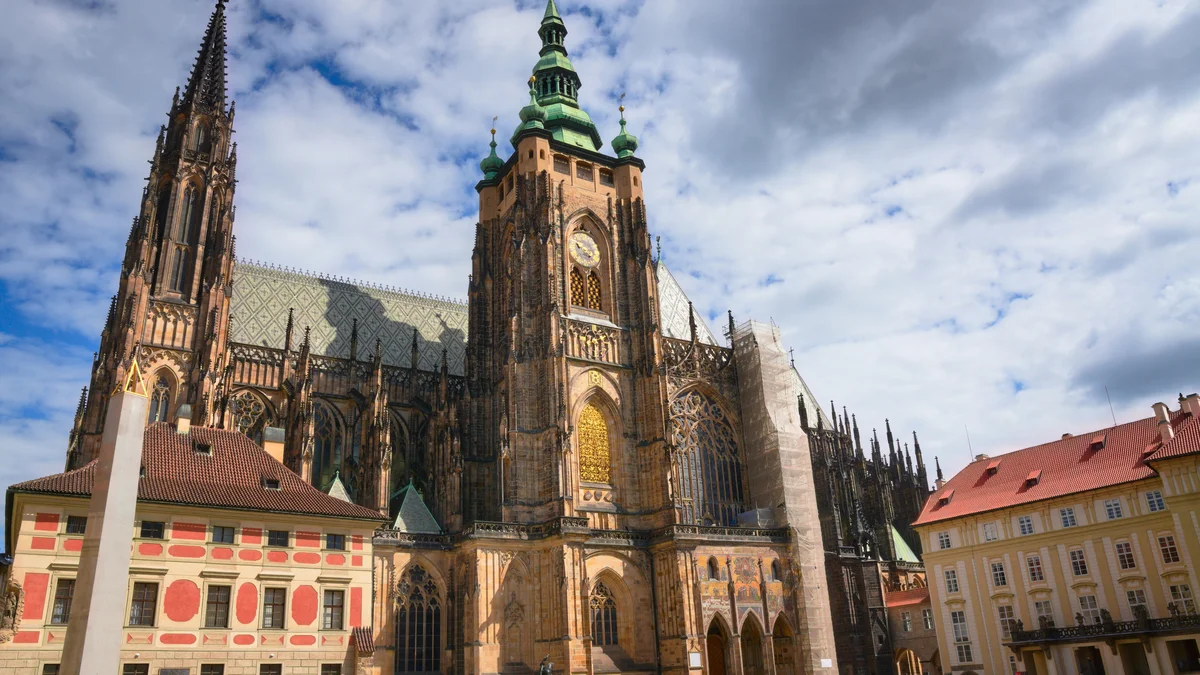
Construction of this soaring Gothic cathedral began in 1344 inside the walls of Prague Castle, but it wasn't finished until 1929, nearly 600 years later. It's Prague's main and largest church, housing the Bohemian Crown Jewels and the tombs of Bohemian kings and saints. Its stained-glass windows and flying buttresses dominate the Prague skyline from almost any vantage point in the city.
Visitor guide
St. Vitus Cathedral, formally the Metropolitan Cathedral of Saints Vitus, Wenceslaus and Adalbert, is a Catholic cathedral within Prague Castle in Prague, Czech Republic, and the seat of the Archbishop of Prague. Wikipedia calls it a prominent example of Gothic architecture and the largest and most important church in the country, with dimensions of 124 by 60 metres and a main tower 102.8 metres high.
The present cathedral is the third religious building on the site dedicated to St. Vitus. The first was an early Romanesque rotunda founded in 930 by Wenceslaus I, Duke of Bohemia, who had acquired the arm of St. Vitus as a relic from Emperor Henry I. It is also possible, Wikipedia notes, that the saint was chosen partly because the Czech name Svatý Vít sounds like that of the Slavic deity Svantevit. In 1060 Prince Spytihněv II began a larger Romanesque basilica, which incorporated the southern apse of the rotunda containing the tomb of St. Wenceslaus.
Construction of the Gothic cathedral began on 21 November 1344, when Prague became an archbishopric, with King John of Bohemia laying the foundation stone. Charles IV, soon to be Holy Roman Emperor, intended it as a coronation church, family crypt and treasury for the kingdom's most precious relics. The first master builder was the Frenchman Matthias of Arras, who designed a triple-naved basilica in French Gothic style but lived to build only the easternmost parts of the choir.
After his death in 1352, 23-year-old Peter Parler took over. Trained as a sculptor, he designed bold net vaults with double diagonal ribs over the choir, original window tracery in which no two windows are the same, and triforium busts depicting the royal family, saints, bishops and the master builders, including Parler himself. Parler's successors, including his sons, finished the transept and the great south tower. A portal nicknamed the Golden Gate, likely for its gold mosaic of the Last Judgment, was used by kings entering for coronation.
The Chapel of St. Wenceslaus, built by Parler between 1356 and 1364, houses the saint's relics. Its lower walls are decorated with more than 1,300 semi-precious stones and paintings of the Passion from 1372 to 1373, and the upper walls have paintings of the life of St. Wenceslaus from 1506 to 1509. A Gothic statue of the saint by Jindřich Parler dates from 1373. The chapel is not open to the public but can be viewed from the doorways. A small door with seven locks in its southwest corner leads to the Crown Chamber with the Bohemian crown jewels.
Work halted with the Hussite Wars, and Hussite iconoclasm damaged the furnishings; a great fire in 1541 caused further damage. For centuries the cathedral stood half-finished, closed by a provisional wall beyond the transept. Baroque additions include the spire of the south tower by Nikolaus Pacassi, built between 1753 and 1775.
In 1844 a society was formed to complete the cathedral. Josef Kranner led repairs in the 1860s, foundations of a new nave were laid in 1870, and Josef Mocker, followed by Kamil Hilbert, designed the Neo-Gothic west facade with two towers. Alfons Mucha decorated windows in the north nave, and František Kysela designed the rose window in 1925 to 1927. The cathedral was finished by the St. Wenceslaus jubilee of 1929, nearly 600 years after it was begun. Although the entire western half is a Neo-Gothic addition, much of Parler's design was used.
Wikipedia credits St. Vitus Cathedral with a tremendous influence on late Gothic style in central Europe. Members of the Parler family designed churches elsewhere, including the Church of St. Barbara in Kutná Hora, and Parler's net vaults inspired ornate vaulting throughout the region. In 1997 the cathedral's dedication was extended to include Saints Wenceslaus and Adalbert.
See every tour and attraction we cover in Prague.