TorontoOntario · 36 tours
 Niagara FallsOntario · 25 tours
 New York CityNew York · 30 tours
 Las VegasNevada · 8 tours
 San FranciscoCalifornia · 16 tours
 VancouverBritish Columbia · 17 tours
 DubaiUAE · 54 tours
 Abu DhabiUAE · 5 tours
 Buenos AiresArgentina · 23 tours
 AthensGreece · 31 tours
 AucklandNew Zealand · 38 tours
 CancunMexico · 54 tours
No destinations match “”. Try searching all tours instead — that search understands full questions, not just place names.
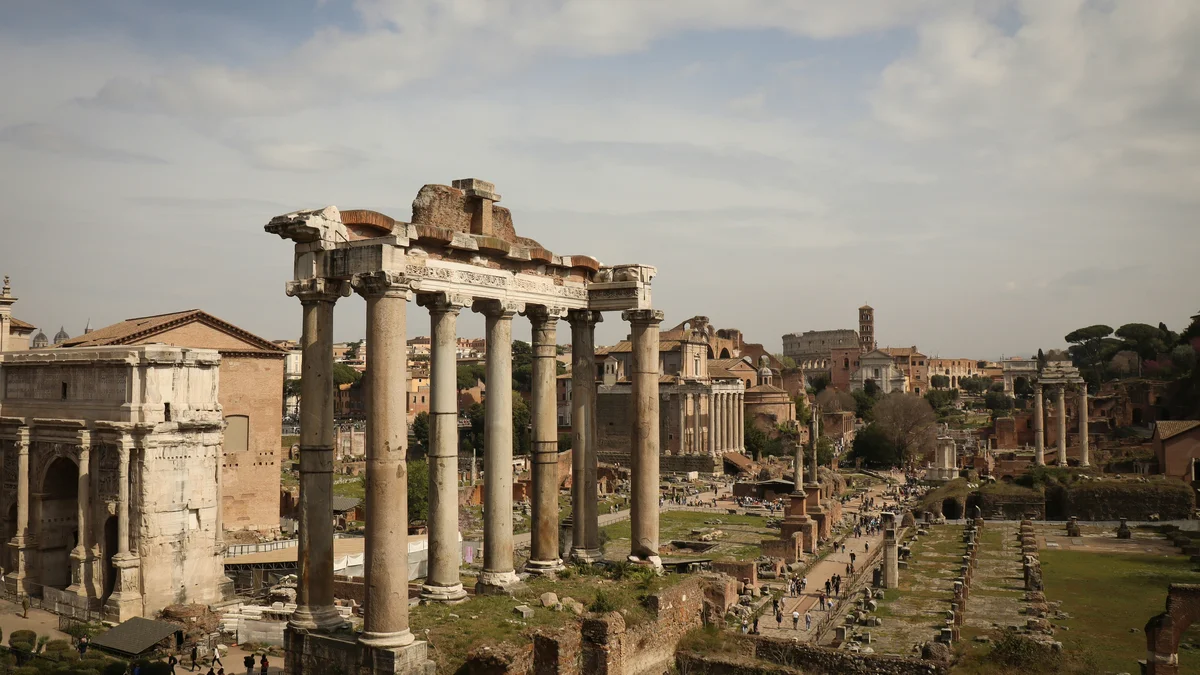
For centuries this was the political, religious, and commercial heart of ancient Rome, where the ruins of temples like the Temple of Saturn and monuments like the Arch of Titus still stand among fallen columns. Rising above it, Palatine Hill is traditionally identified as the site where Rome was founded, and later became home to the lavish palaces of Roman emperors. Walking the site today means tracing more than a thousand years of the city's history in a single visit.
Visitor guide
The Roman Forum and Palatine Hill form the core of ancient Rome, lying side by side in the centre of the modern city, between the Capitoline Hill and the Colosseum. The Forum was the rectangular public plaza at the heart of Roman life, and the Palatine Hill above it was the home of the city's wealthy and later its emperors. Today both are archaeological areas where ruins of temples, basilicas, arches and palaces can be seen.
Located in the small valley between the Palatine and Capitoline hills, the Roman Forum was originally a marketplace and became the centre of day-to-day life in Rome. According to Wikipedia, it hosted triumphal processions and elections, public speeches, criminal trials and gladiatorial matches, and was the nucleus of commercial and legal affairs. Its oldest structures on the southeastern edge included the Regia, the former royal residence of the 8th century BC, and the Temple of Vesta, dating to the 7th century BC, with the complex of the Vestal Virgins.
In the Republic the Comitium was the assembly area where the Senate began. Julius Caesar later built the Basilica Julia and the new Curia Julia, and the last major building project was the Basilica of Maxentius, begun by Maxentius around AD 308 and completed by Constantine. Over the centuries the large buildings reduced the open area to a rectangle of about 130 by 50 metres.
After the fall of the Western Roman Empire the Forum fell into ruin and was largely abandoned. From the 6th century some buildings were converted into Christian churches, and the Column of Phocas, erected in AD 608, was the last monumental addition. In the Middle Ages the site became known as the Campo Vaccino, the cattle field, and its monuments were largely buried under debris. During the Renaissance, and particularly between 1540 and 1550, it was heavily quarried for building material for the new St. Peter's Basilica. Systematic excavation and preservation came later, and the Forum now attracts around 4.5 million visitors a year, according to Wikipedia.
The Palatine is the centremost of the seven hills of Rome and has been called the first nucleus of the Roman Empire. Excavations show that people have lived there since the 10th century BC, and Roman tradition holds that it was where the she-wolf found Romulus and Remus in the cave known as the Lupercal, and where Romulus founded the city. These are legends, not documented history.
In the Republican period many wealthy Romans lived on the hill. From the start of the Empire in 27 BC, Augustus built his palace there and the hill gradually became the domain of emperors, and ruins of the palaces of at least Augustus, Tiberius and Domitian can still be seen. The word palace itself derives from the hill's name. The House of Livia, conventionally attributed to Augustus's wife, is notable for its frescoes.
Later the hill was owned by the Farnese family, whose gardens still partly survive above the remains of the Domus Tiberiana, and the Palatine Museum now occupies part of a former villa and convent and houses finds from excavations.
The Forum and Palatine are open-air sites with uneven ancient paving and limited shade, and the ruins are fragments that are easier to understand with context. A private guided visit with a driver can help you read what each remaining structure was and plan the walk from the Forum up to the palaces.
See every tour and attraction we cover in Rome.