TorontoOntario · 36 tours
 Niagara FallsOntario · 25 tours
 New York CityNew York · 30 tours
 Las VegasNevada · 8 tours
 San FranciscoCalifornia · 16 tours
 VancouverBritish Columbia · 17 tours
 DubaiUAE · 54 tours
 Abu DhabiUAE · 5 tours
 Buenos AiresArgentina · 23 tours
 AthensGreece · 31 tours
 AucklandNew Zealand · 38 tours
 CancunMexico · 54 tours
No destinations match “”. Try searching all tours instead — that search understands full questions, not just place names.
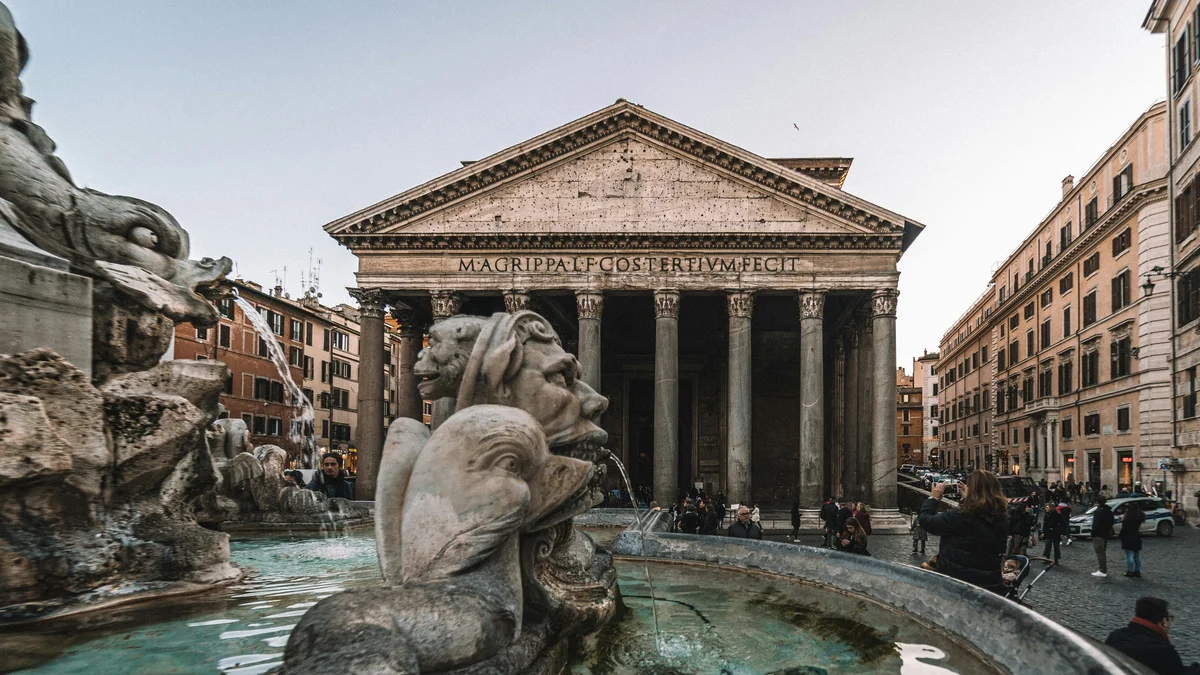
Rebuilt by Emperor Hadrian around 126 AD on the site of an earlier temple, the Pantheon remains one of the best-preserved buildings from ancient Rome. Its coffered dome, still the largest unreinforced concrete dome in the world, is open to the sky through a central oculus that floods the interior with light. Long a place of worship, it now functions as a church and holds the tomb of the painter Raphael.
Visitor guide
The Pantheon is an ancient Roman temple in Rome, Italy, originally built under the emperor Augustus and reconstructed under Hadrian. Since AD 609 it has been a Catholic church, the Basilica of St. Mary and the Martyrs. Wikipedia describes it as one of the best-preserved ancient Roman buildings, largely because it has been in continuous use throughout its history.
The present building stands on the site of an earlier temple commissioned by Marcus Vipsanius Agrippa during the reign of Augustus. After that building burned down, the current Pantheon was completed under Hadrian and probably dedicated around AD 126. Because Hadrian chose to reuse Agrippa's inscription on the new temple, the exact date of construction is uncertain, and some scholars argue construction began earlier under Trajan.
The name comes from the Greek for of all the gods, but Wikipedia notes that this is debated. The Roman writer Cassius Dio speculated that the name came either from the statues of many gods placed around the building or from the dome's resemblance to the heavens, and some scholars think Pantheon was merely a nickname. How the building was actually used in antiquity is not known.
A portico with granite Corinthian columns, eight across the front, leads through a vestibule to a round rotunda covered by a coffered concrete dome with a central opening, the oculus, open to the sky. The height to the oculus and the diameter of the interior are the same, about 43 metres, so the interior would fit within a cube. Almost two thousand years after it was built, the dome is still the world's largest unreinforced concrete dome, according to Wikipedia.
Light from the oculus moves around the interior through the day, like a sundial that marks time with light rather than shadow. Because the oculus was never covered, rain falls through it, and the floor is slightly inclined with drains below. The dome has coffers arranged in five rings of 28, which may have had symbolic meaning. The weight of the dome is reduced in its upper layers by lighter materials and hidden chambers.
In 609 the Byzantine emperor Phocas gave the building to Pope Boniface IV, who consecrated it as a church dedicated to St. Mary and the Martyrs on 13 May 609. Being a church saved the building from the worst of the spoliation that affected many ancient Roman buildings, though in 663 the emperor Constans II is recorded as stripping its bronze roof tiles. The square in front is called the Piazza della Rotonda, and the church was long known as Santa Maria Rotonda.
The Pantheon contains the tomb of King Victor Emmanuel II, who died in 1878, and that of Umberto I. A golden lamp above the first king's tomb burns in his honour. The building has been influential: its domed rotunda with a temple front was unique in Roman architecture but became a standard model when classical styles were revived and has been copied many times by later architects.
The Pantheon is state property managed by Italy's cultural heritage authorities. It stands in the historic centre of Rome, and a private guided visit with a driver can combine it with nearby sights.
See every tour and attraction we cover in Rome.