TorontoOntario · 36 tours
 Niagara FallsOntario · 25 tours
 New York CityNew York · 30 tours
 Las VegasNevada · 8 tours
 San FranciscoCalifornia · 16 tours
 VancouverBritish Columbia · 17 tours
 DubaiUAE · 54 tours
 Abu DhabiUAE · 5 tours
 Buenos AiresArgentina · 23 tours
 AthensGreece · 31 tours
 AucklandNew Zealand · 38 tours
 CancunMexico · 54 tours
No destinations match “”. Try searching all tours instead — that search understands full questions, not just place names.
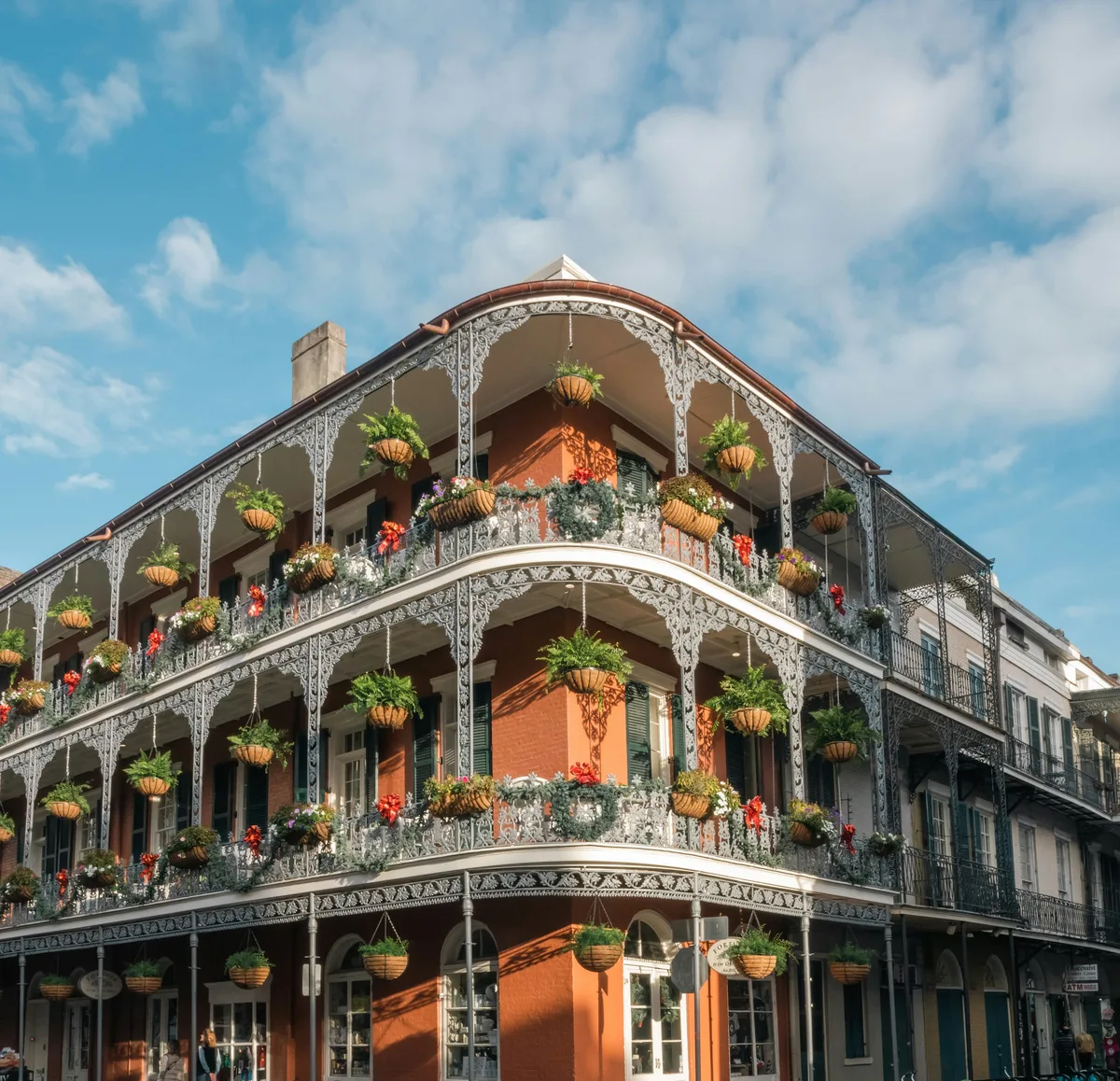
New Orleans' oldest neighborhood, known for wrought-iron and cast-iron balconies, jazz clubs, and Creole architecture.
Visitor guide
The French Quarter, or Vieux Carre, is the oldest neighborhood in New Orleans, laid out along the Mississippi River after Jean-Baptiste Le Moyne de Bienville founded the city in 1718. It is a National Historic Landmark district whose current buildings mostly date from the Spanish colonial period and the decades after.
Military engineers laid out the original grid in the early 1720s, with Adrien de Pauger credited as its designer (the National Park Service dates his street plan to 1722); the Cultural Landscape Foundation counts 80 rectilinear blocks in the original grid, making it one of the earliest planned cities in America, and the National Park Service describes the surviving district as an approximately 120-block area. Streets such as Bourbon were named for French royal houses and Catholic saints. Spain took control in the 1760s, and great fires in 1788 and 1794 destroyed much of the city, so most of the Quarter's surviving buildings date from 1794 to about 1850, in a mix of French, Spanish and later Greek Revival styles, according to the NPS.
After the Louisiana Purchase of 1803, English-speaking Americans settled mostly upriver of Canal Street. Italian immigrants, many from Sicily, arrived between 1884 and 1924 and gave the Quarter the nickname Little Palermo. The district declined through the early 20th century. The Vieux Carre Commission, founded in 1925 and given regulatory authority after a 1936 referendum, protects its architecture. A planned elevated expressway through the area was canceled in 1969.
The district is a National Historic Landmark, but sources differ on the date: the city's Vieux Carre Commission and Wikipedia say 1965, while the Cultural Landscape Foundation and a National Register record give 1966. The National Register record lists the boundaries as the Mississippi River, Rampart Street, Canal Street and Esplanade Avenue, and the district covers about 0.66 square miles.
Jackson Square is the heart of the district, ringed by the Cabildo, the Presbytere, the Pontalba Buildings and St. Louis Cathedral. Nearby is the French Market, described by the Cultural Landscape Foundation as one of America's oldest public markets. The foundation also lists the Old Ursuline Convent, the Beauregard-Keyes House, Gallier House and Hermann-Grima House among related historic sites, plus riverfront spaces such as Woldenberg Riverfront Park and the Moon Walk. Bourbon Street, Cafe du Monde and the jazz venues are among the Quarter's best-known features.
The ironwork that defines the streetscape is cast and wrought-iron balconies over narrow streets. The district blends commercial, hotel, entertainment and residential uses. Hurricane Katrina left the Quarter largely dry, with minor flooding and wind damage, and it reopened to businesses on September 26, 2005.
Streets, venues and attractions change, so check each site for current hours and access, and confirm any restrictions on vehicles in the Quarter. A private tour with Voyzo includes a private vehicle and driver with door-to-door pickup, which is helpful in a dense district of narrow streets: your driver can drop you at Jackson Square and meet you when you are done.
See every tour and attraction we cover in New Orleans.