TorontoOntario · 36 tours
 Niagara FallsOntario · 25 tours
 New York CityNew York · 30 tours
 Las VegasNevada · 8 tours
 San FranciscoCalifornia · 16 tours
 VancouverBritish Columbia · 17 tours
 DubaiUAE · 54 tours
 Abu DhabiUAE · 5 tours
 Buenos AiresArgentina · 23 tours
 AthensGreece · 31 tours
 AucklandNew Zealand · 38 tours
 CancunMexico · 54 tours
No destinations match “”. Try searching all tours instead — that search understands full questions, not just place names.
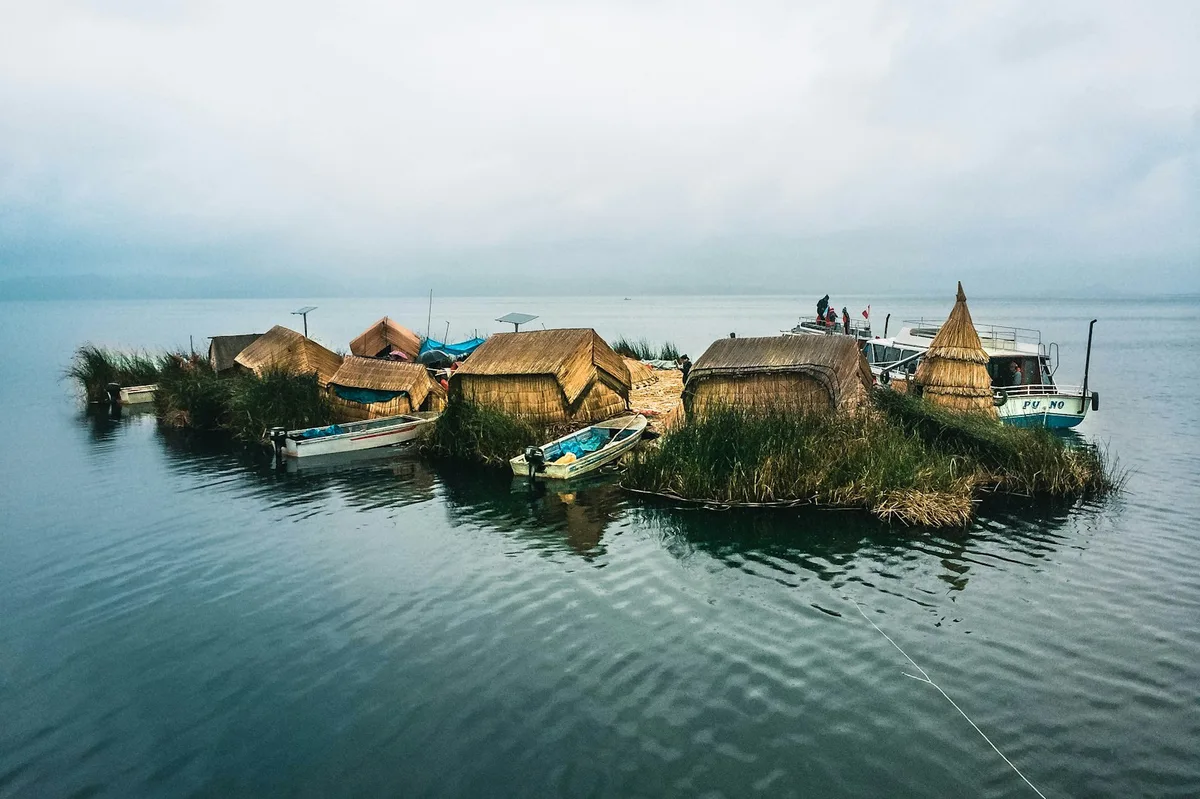
The highest navigable lake in the world, on the Peru-Bolivia border, home to the Uros people's hand-built floating reed islands near Puno.
Visitor guide
Lake Titicaca is a high Andean lake on the border between Peru and Bolivia, and its Peruvian shore centres on the port city of Puno. It is best known for the Uros floating reed islands and for island communities such as Taquile and Amantani, where Quechua- and Aymara-speaking families keep long-established farming and weaving traditions.
According to Wikipedia, the lake sits at a surface elevation of about 3,812 metres at the northern end of the Altiplano basin. Its western part lies in Peru's Puno Region and its eastern side in Bolivia's La Paz Department. It covers roughly 8,372 square kilometres, with a maximum length of about 190 kilometres, and is described as the largest freshwater lake in South America.
The lake is often called the highest navigable lake in the world, a description that refers to commercial vessels, since smaller lakes lie at greater elevations. Two nearly separate sub-basins are joined by the Strait of Tiquina. Five major rivers feed it, and its only outlet, the Desaguadero River, carries a small share of the water south, while most is lost to evaporation. The water is slightly brackish and the lake does not freeze.
Near Puno, the Uros people live on artificial islands built from layers of totora reeds that grow in the shallows. Many islands are small, on the order of fifteen metres across, and the reeds are renewed continuously from the top as the lower layers rot. Wikipedia reports that around 1,200 people lived on roughly 60 islands as of 2011, and that tourism is a major source of income. One local account holds that the Uru originated in the Amazon and built floating islands to escape hostile neighbours; this is tradition rather than established history.
Taquile lies about 45 kilometres east of Puno and has been owned by its Taquileño community since 1970. Its textile art is on UNESCO's Representative List of the Intangible Cultural Heritage of Humanity (inscribed 2008); UNESCO says it is produced by both men and women of all ages, and the knitted chullo hat and woven calendar waistband are its best-known pieces. Amantani is a larger island of about 15 square kilometres with roughly 4,000 Quechua-speaking residents in ten communities, hand-farmed terraces and no cars. Families there host overnight visitors in a community-run arrangement.
In Inca tradition, the sun god was said to have been born on the Isla del Sol on the Bolivian side, and Manco Capac is associated with the lake in origin stories. These are legends, not documented history. Underwater excavations near the Khoa reef have recovered offerings left by Inca pilgrims.
The lake supports more than 530 aquatic species. The flightless Titicaca grebe lives only here, and a large deep-water Titicaca water frog is a notable resident. Around 90 percent of the basin's fish species are reported as endemic, including more than twenty Orestias species. The lake is a Ramsar site and an Important Bird Area. Falling water levels and pollution are cited as concerns.
Puno is the largest Peruvian settlement on the lake. The steamship Yavari, launched in 1870 and shipped in pieces to the lake, is preserved at Puno Bay. Because the islands are spread over a large expanse of water and sit at high altitude, a private guided visit with a driver and a local boat operator is a sensible way to link the shore and the islands at an unhurried pace.
See every tour and attraction we cover in Peru.