TorontoOntario · 36 tours
 Niagara FallsOntario · 25 tours
 New York CityNew York · 30 tours
 Las VegasNevada · 8 tours
 San FranciscoCalifornia · 16 tours
 VancouverBritish Columbia · 17 tours
 DubaiUAE · 54 tours
 Abu DhabiUAE · 5 tours
 Buenos AiresArgentina · 23 tours
 AthensGreece · 31 tours
 AucklandNew Zealand · 38 tours
 CancunMexico · 54 tours
No destinations match “”. Try searching all tours instead — that search understands full questions, not just place names.
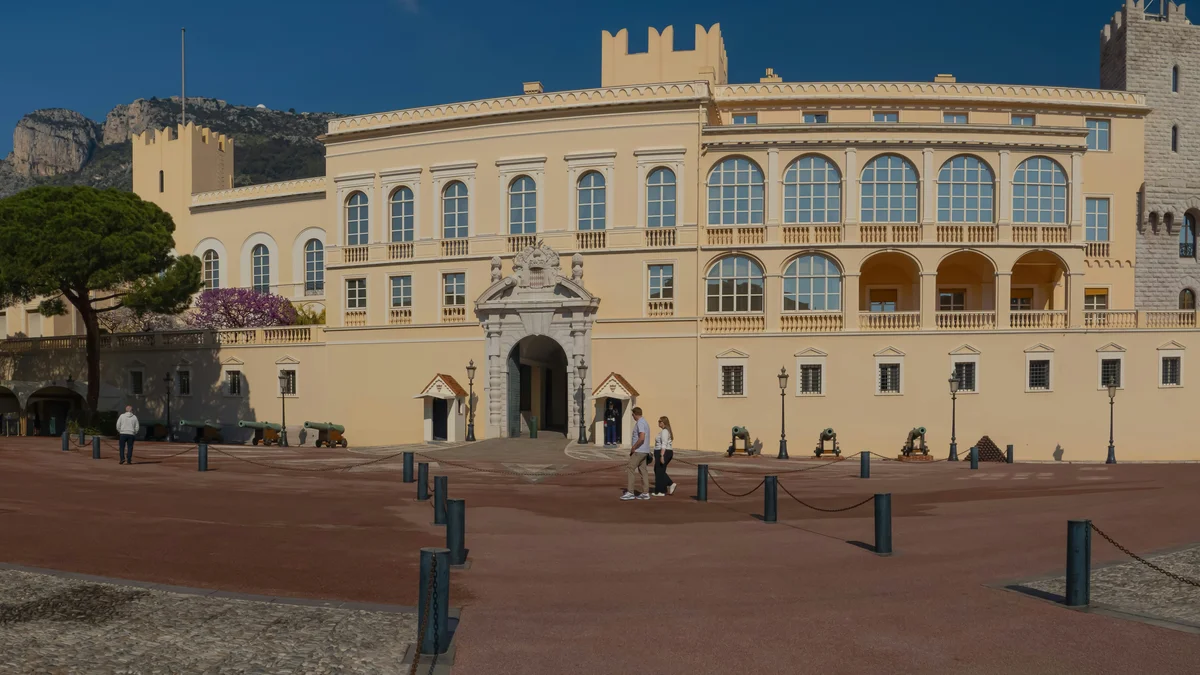
The official residence of Monaco's ruling Grimaldi family since 1297, making it one of the oldest reigning dynasties in Europe, the Prince's Palace sits atop the rocky promontory of Monaco-Ville overlooking the harbor. Its Changing of the Guard ceremony takes place daily at 11:55am outside the palace gates, a tradition performed by the Prince's Carabinieri. Several state apartments are open to visitors when the reigning prince is not in residence, showcasing frescoed ceilings and centuries of royal history.
Visitor guide
The Prince's Palace of Monaco (Palais princier de Monaco) is the official residence of the Sovereign Prince of Monaco, standing on the Rocher de Monaco in the old town of the Mediterranean principality. Its site was granted to Genoa in 1191 and the Genoese began building the fortress in 1215; it has been the home and stronghold of the Grimaldi family since they first captured it in 1297.
Wikipedia dates the palace to 1191, when the Republic of Genoa acquired the harbour that Monte Carlo now borders, while the palace's official site says that grant came with a duty to fortify and that construction began in 1215. That Genoese fortress, with four towers joined by ramparts, forms the core of the present palace. The Grimaldi ruled first as feudal lords and from the 17th century as sovereign princes, but their power often rested on fragile agreements with larger neighbours.
Unlike other European sovereigns who built fresh Renaissance and Baroque palaces, the rulers of Monaco had to keep their residence fortified. As a result, the palace is described as one of the most unusual in Europe. When the fortifications relaxed in the late 18th century, the French seized the palace and stripped it of its treasures, and the Grimaldi were exiled for more than 20 years. In 1997 the family celebrated 700 years of rule from the same palace.
The palace is a blend of styles. Its principal facade appears as a terrace of Renaissance palazzi from different periods, united by a common rusticated ground floor, with towers rising behind that were mostly rebuilt in the 19th century. The court of honour has two tiers of frescoed open arcades that serve as a ceremonial balcony and state entrance.
The state apartments were laid out from the 16th century and enhanced in the style of Versailles in the 18th century. A horseshoe-shaped staircase leads to the Gallery of Hercules and the Mirror Gallery, which was inspired by the Hall of Mirrors at Versailles. Guests then move through the Officers' Room and the Blue Room to the Throne Room, whose ceiling frescoes by Orazio de Ferrari depict the surrender of Alexander the Great. Other rooms include the Red Room, the York Room and the Mazarin Room, lined with Italian gilded and painted panelling. Wikipedia notes that much of the interior's appearance results from heavy restoration in the 19th and 20th centuries.
In the 19th and early 20th centuries the palace and its owners became symbols of the glamour associated with Monte Carlo and the Riviera. Wikipedia notes that this took on a fairy-tale quality when the American film star Grace Kelly became the lady of the palace in 1956. It remains the residence of the current Prince of Monaco.
The palace stands on the Rocher de Monaco, in the old town above the harbour, and the square in front is a popular spot for viewing the palace facade. As an official residence, access to interior rooms may be limited by season and official schedules, so confirm details in advance. A private tour with a driver can combine the Rock with Monte Carlo and the harbour.
See every tour and attraction we cover in Monaco.