TorontoOntario · 36 tours
 Niagara FallsOntario · 25 tours
 New York CityNew York · 30 tours
 Las VegasNevada · 8 tours
 San FranciscoCalifornia · 16 tours
 VancouverBritish Columbia · 17 tours
 DubaiUAE · 54 tours
 Abu DhabiUAE · 5 tours
 Buenos AiresArgentina · 23 tours
 AthensGreece · 31 tours
 AucklandNew Zealand · 38 tours
 CancunMexico · 54 tours
No destinations match “”. Try searching all tours instead — that search understands full questions, not just place names.
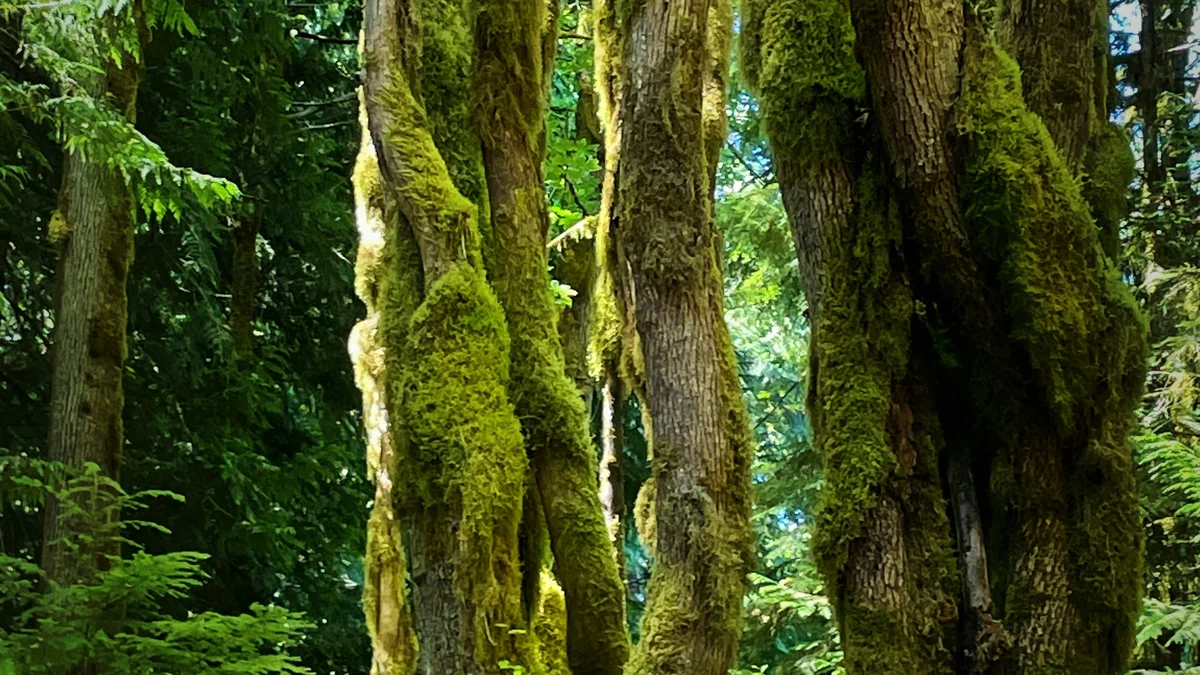
One of the largest temperate rainforests in the United States, the Hoh Rain Forest receives roughly 140 to 167 inches of precipitation a year, according to the National Park Service, feeding the thick carpets of moss that drape over its bigleaf maples and towering Sitka spruce. Its Hall of Mosses trail is the park's signature short walk, winding beneath ancient trees whose canopy can rise over 300 feet. The forest's remote location on the Olympic Peninsula's west side keeps visitor numbers lower than many national park highlights, preserving its hushed, primeval feel.
Visitor guide
The Hoh Rain Forest fills the glacier-carved valley of the Hoh River on the western side of Olympic National Park, on Washington's Olympic Peninsula. It is among the best-known temperate rain forests in the United States, a cool, green world of moss-draped maples and giant conifers.
Wikipedia describes the forest as covering about 24 square miles of low-elevation woodland along the river, and it is commonly called the wettest forest in the contiguous United States. Rainfall figures vary by source and station: the National Park Service says the area gets up to 12 feet of precipitation a year, Wikipedia cites about 140 inches in its introduction and about 129 inches in its climate table, and the park's visitor page gives an average of 140 inches. Mild winters and cool summers keep the forest damp year-round.
Giant conifers dominate. Sitka spruce and western hemlock are the characteristic canopy trees, with Douglas-fir and western red cedar among the other species, and Wikipedia reports that some trees exceed 300 feet in height. Bigleaf and vine maples host epiphytes, which is why their limbs seem to wear green fur. Fallen trees decay slowly and serve as nurse logs, supporting new seedlings, while mosses, ferns and other plants crowd the forest floor.
The valley is the ancestral home of the Hoh people. The National Park Service says logging, homestead clearing and market hunting of elk changed the valley, yet inside the park it still looks much as it did for about 5,000 years. Olympic National Park was established in 1938 to preserve what the founding language called the finest example of primeval forest and to protect the native Roosevelt elk herds. Outside the park boundary, Wikipedia notes, much of the forest along the river was logged over the last century.
The NPS estimates that about 400 to 500 of the park's roughly 3,000 to 4,000 Roosevelt elk live in the Hoh Valley, and their grazing helps keep the understory open. Wikipedia also lists black-tailed deer, black bear, cougar, banana slugs and the northern spotted owl among the forest's wildlife. The park asks visitors to stay at least 50 yards from wildlife.
The park brochure lists a short paved mini-trail of 0.1 mile, the 0.8-mile Hall of Mosses loop through old-growth forest with maples draped in club moss, and the 1.2-mile Spruce Nature Trail loop beside Taft Creek and the Hoh River. For long-distance hikers the Hoh River Trail runs 17.3 miles to Glacier Meadows, with the river beginning on glacier-capped Mount Olympus and flowing about 50 miles to the Pacific. Overnight trips need a wilderness camping permit.
The Hoh is a long drive from most Olympic Peninsula bases, which makes a private vehicle and driver with door-to-door pickup a practical way to see it without managing the road yourself.
See every tour and attraction we cover in Olympic National Park.