TorontoOntario · 36 tours
 Niagara FallsOntario · 25 tours
 New York CityNew York · 30 tours
 Las VegasNevada · 8 tours
 San FranciscoCalifornia · 16 tours
 VancouverBritish Columbia · 17 tours
 DubaiUAE · 54 tours
 Abu DhabiUAE · 5 tours
 Buenos AiresArgentina · 23 tours
 AthensGreece · 31 tours
 AucklandNew Zealand · 38 tours
 CancunMexico · 54 tours
No destinations match “”. Try searching all tours instead — that search understands full questions, not just place names.
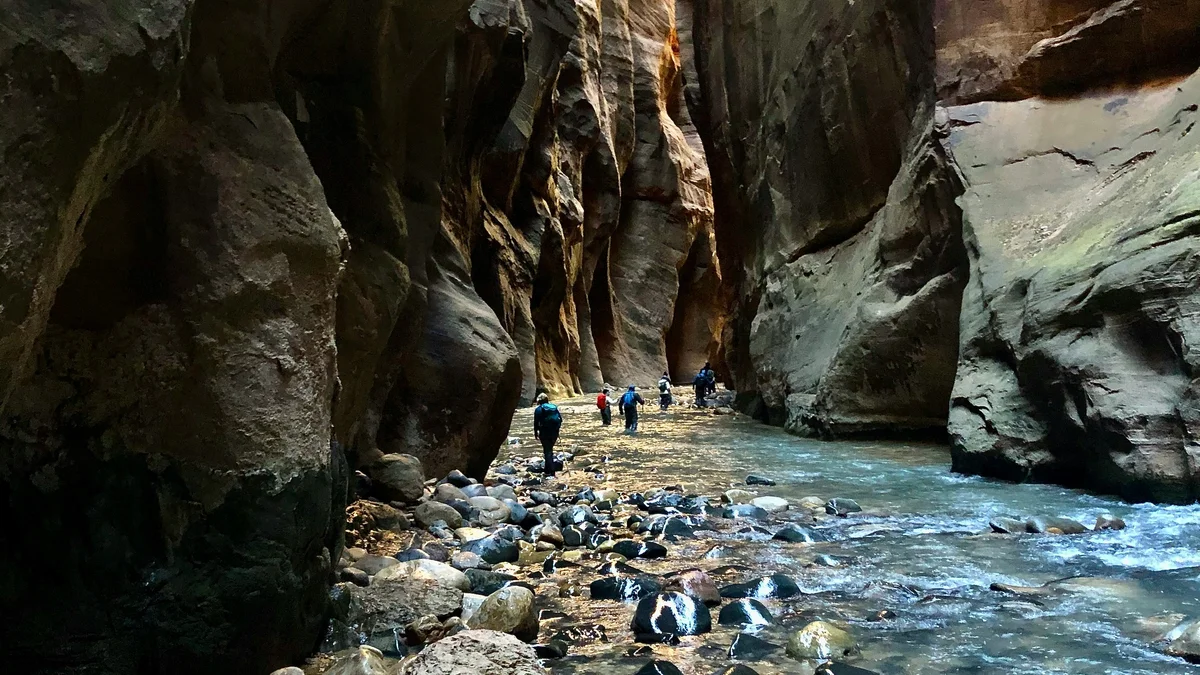
The Narrows is the section of Zion Canyon where the Virgin River has carved a passage so tight that, in places, the sandstone walls rise up to 1,000 feet on either side while the canyon floor is barely 20 to 30 feet wide. Since there's no maintained trail here, hiking it means wading and sometimes swimming directly through the river itself, which is why most visitors rent water shoes and a walking stick, and check current flow conditions before setting out. Bottom-up day hikes from the Temple of Sinawava require no permit, while the full top-down route through the canyon does.
Visitor guide
The Narrows is the narrowest section of Zion Canyon, where the North Fork of the Virgin River fills the floor of a sandstone gorge from wall to wall. The National Park Service describes the river as sometimes only 20 to 30 feet wide, with walls about 1,000 feet tall, and for much of the route the river itself is the trail.
Zion's cliffs are made of Navajo Sandstone, a formation that Wikipedia puts at 1,600 to 2,200 feet thick, with red lower layers colored by iron oxides. The North Fork of the Virgin River carved Zion Canyon, which is about 15 miles long and up to roughly 2,640 feet deep by one account; most of the cutting happens during high-water seasons, and the river carries millions of tons of sediment a year. The NPS notes that the surrounding country is largely bare rock that does not absorb water, which is why storm runoff reaches the canyon quickly.
Mormon missionary and interpreter Nephi Johnson was guided into the Zion Canyon area by a Southern Paiute guide in 1858. In 1872 geologist Grove Karl Gilbert, working on the Wheeler Survey, descended the gorge and gave The Narrows its name. After Mukuntuweap National Monument was proclaimed in 1909 and the area became Zion National Park on November 19, 1919, visitors were guided up The Narrows on horseback into the 1960s, and the through-hike grew popular in the late 1960s. The road into the main canyon ends at the Temple of Sinawava, a name Wikipedia connects to a coyote god of the Paiute people.
The bottom-up route begins at the Temple of Sinawava (Shuttle Stop 9). A paved path, the Riverside Walk, runs about a mile to the point where the pavement ends and the river begins; that marks the start of The Narrows proper. The NPS describes the hike to Big Spring as a strenuous, ten-mile round trip and an all-day adventure, though you can turn around after an hour or so for a shorter outing, and says it requires no permit. Hikers can turn around whenever they like, and the paved path alone is a dry option.
The top-down route is about 16 miles one-way from Chamberlain's Ranch to the Temple of Sinawava and requires a wilderness permit from the NPS. Hikers must arrange their own transport to the trailhead. Orderville Canyon, a tributary that joins about two miles up the bottom-up route, can be explored for about a quarter mile; going farther up it is a canyoneering objective with its own permit requirements.
Expect to walk, wade and sometimes swim over rocks the size of bowling balls. The NPS says sandals, crocs and bare feet are not appropriate; closed-toe shoes or boots, a hiking stick, and in colder months drysuits or waders are recommended. The park does not rent gear, so outfitters in the nearby town handle that. There are no restrooms along the hike itself.
Water levels and weather decide whether The Narrows is open at all. The NPS publishes flow-based guidance and closes the route when flows are high or a flash flood warning is in effect, and it advises that flooding can occur at any time. Always check the NPS and National Weather Service for current water, weather, permit and access information before you plan the day.
The Temple of Sinawava is the last stop on the canyon road, so a private vehicle and driver with door-to-door pickup can simplify logistics around the shuttle system and gear stops. Plan your gear and timing with the NPS guidance in mind rather than the clock.
See every tour and attraction we cover in Zion National Park.