TorontoOntario · 36 tours
 Niagara FallsOntario · 25 tours
 New York CityNew York · 30 tours
 Las VegasNevada · 8 tours
 San FranciscoCalifornia · 16 tours
 VancouverBritish Columbia · 17 tours
 DubaiUAE · 54 tours
 Abu DhabiUAE · 5 tours
 Buenos AiresArgentina · 23 tours
 AthensGreece · 31 tours
 AucklandNew Zealand · 38 tours
 CancunMexico · 54 tours
No destinations match “”. Try searching all tours instead — that search understands full questions, not just place names.
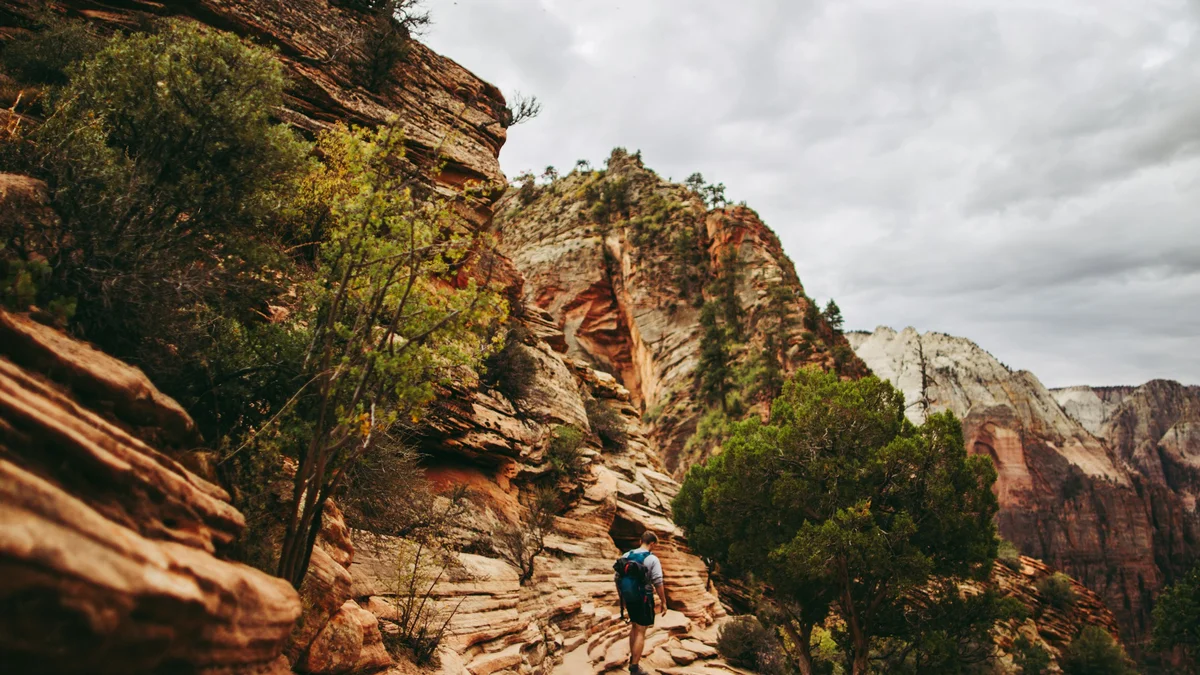
Angels Landing is a narrow sandstone fin jutting nearly 1,500 feet above the floor of Zion Canyon, reached by a roughly 5.4-mile round-trip trail that finishes with a half-mile scramble along a knife-edge ridge, holding onto chains bolted into the rock with drop-offs on both sides. It's consistently ranked among the most exhilarating and exposed day hikes in the US National Park system. Because of its popularity and the safety risk on the final chained section, the National Park Service now requires hikers to obtain a permit through a lottery system to access that stretch.
Visitor guide
Angels Landing is a narrow fin of Navajo Sandstone that rises roughly 1,500 feet above the floor of Zion Canyon, and its final half-mile along an exposed ridge, with chains bolted into the rock, is one of the best-known hikes in the U.S. national park system. The trail starts on the canyon floor and climbs to Scout Lookout, then continues along the spine to the summit.
The rock is Navajo Sandstone, the Jurassic-age layer that forms many of Zion's great cliffs. Wikipedia gives the formation's height as 1,488 feet and the summit elevation as roughly 5,790 feet, though its own pages differ slightly, so treat the figures as approximate. Before it was Angels Landing, the formation was known as the Temple of Aeolus. The popular story credits Frederick Vining Fisher, a Methodist minister who visited Zion Canyon in 1916, with remarking that only an angel could land on it. That quote is reported in secondary accounts rather than documented, so it is best told as local lore.
The National Park Service lists the hike at 5.4 miles round trip with about 1,488 feet of elevation gain, and it is rated class 3 on the Yosemite Decimal System. The trail was cut into the rock in 1926, and sources credit Walter Ruesch, an early Zion park official (accounts call him either custodian or superintendent), with its design. Sources also disagree on whether work began in 1924 or 1925. His name lives on in Walter's Wiggles, a stack of 21 tight switchbacks just below Scout Lookout. Scout Lookout is the usual turnaround for hikers who do not continue.
Beyond Scout Lookout the route narrows. The National Park Service notes that parts of the trail past this point are less than three feet wide with steep drop-offs, and chains are installed along the steep, narrow stretch to help hikers. The final section is about half a mile long.
Since April 2022, hikers who want to go from Scout Lookout to the summit need a permit under the NPS Angels Landing Pilot Permit Program, introduced in response to rising visitation and safety concerns. Permits are allocated through two lotteries on Recreation.gov: a seasonal lottery and a day-before lottery. Access is by permit; check the NPS for current permit details. Hiking the West Rim Trail as far as Scout Lookout does not require one. Rules, fees and lottery dates change, so check the National Park Service and Recreation.gov for current details before you plan around a date.
Voyzo arranges private transport with a driver and door-to-door pickup, which takes the logistics of getting to the park off your plate. The permit itself is issued to individual hikers through the NPS lottery, so check the current rules with us before building a trip around a particular date.
See every tour and attraction we cover in Zion National Park.