TorontoOntario · 36 tours
 Niagara FallsOntario · 25 tours
 New York CityNew York · 30 tours
 Las VegasNevada · 8 tours
 San FranciscoCalifornia · 16 tours
 VancouverBritish Columbia · 17 tours
 DubaiUAE · 54 tours
 Abu DhabiUAE · 5 tours
 Buenos AiresArgentina · 23 tours
 AthensGreece · 31 tours
 AucklandNew Zealand · 38 tours
 CancunMexico · 54 tours
No destinations match “”. Try searching all tours instead — that search understands full questions, not just place names.
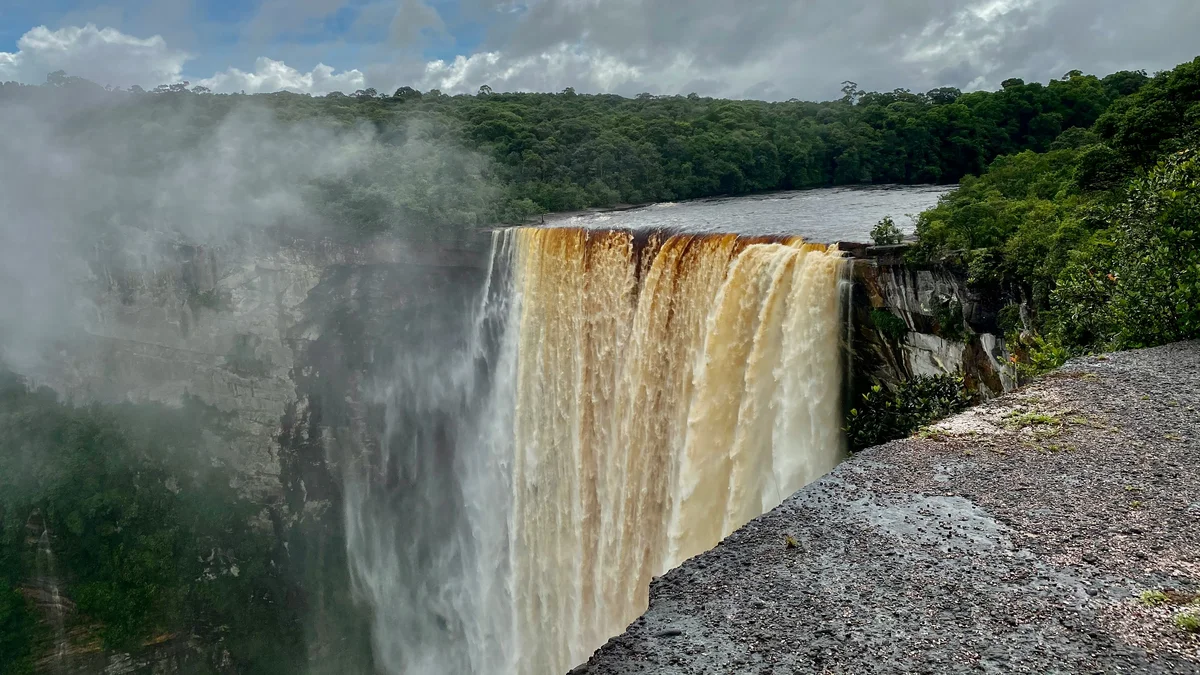
A single-drop waterfall on the Potaro River inside Kaieteur National Park, plunging about 741 feet (226m) — about four and a half times the height of Niagara Falls and roughly twice Victoria Falls. It's one of the most powerful waterfalls of its kind in the world, and sits deep enough in the rainforest that it has no direct road access; most visitors arrive by small aircraft.
Visitor guide
Kaieteur Falls is a single-drop waterfall on the Potaro River in Kaieteur National Park in central Guyana. Wikipedia describes it as one of the most powerful single-drop waterfalls in the world, plunging 226 metres over a sandstone and conglomerate cliff, set in rainforest on the Guiana highlands.
The water falls 226 metres (741 feet) to the first break, and steep cascades below bring the total height to about 251 metres (822 feet). The falls average about 113 metres in width, and Wikipedia gives an average flow of roughly 660 cubic metres per second, although the article gives slightly different flow figures in two places, so the exact value is uncertain. By comparison with famous waterfalls, Wikipedia says Kaieteur is about four and a half times the height of Niagara Falls and roughly twice that of Victoria Falls. Many waterfalls are taller or carry more water, but few combine both qualities as strongly.
The Potaro rises near Mount Ayanganna in the Pakaraima Mountains and flows about 255 kilometres to the Essequibo, which is Guyana's largest river. Kaieteur is the best known of nine waterfalls on the Potaro, and Amatuk Falls and Waratuk Falls lie downstream. Upriver of the falls the Potaro Plateau stretches towards the Pakaraima escarpment. Wikipedia notes that the falls are a geological type locality, with a cliff of sandstone and conglomerate.
Indigenous peoples had known the falls for a long time before Europeans recorded them. The first European record dates to 1870, when the British geologist Charles Barrington Brown, working as a government surveyor in British Guiana, reached the falls, and he returned a year later to take detailed measurements. According to a Patamona legend recounted by Wikipedia, the falls take their name from Kuik'tuwuk, an old man and chief who sacrificed himself by paddling over the falls to save his people. The name Kaieteur is linked to Indigenous words that mean roughly old man falls, though the legend is a tradition rather than a recorded event.
The falls lie within Kaieteur National Park, which was established in 1929 (Britannica gives 1930) and covers about 630 square kilometres after an expansion in 1999. The park lies in the Potaro-Siparuni region, roughly 633 kilometres south of Georgetown by Wikipedia's figure. It has species found nowhere else, including the golden rocket frog, which breeds only in the leaves of one bromeliad species in the park. The forest is part of the Guianan moist forest ecoregion, and Indigenous peoples have lived in the area for millennia. Wikipedia mentions that the frogs of the falls appear in David Attenborough's Life on Earth.
Kaieteur International Airport sits close to the falls, about a fifteen minute walk from the top, and the falls are a major tourist attraction reached by air from Georgetown. Visits are usually by chartered or scheduled flight, because the interior has few roads. Viewing points above and beside the falls are reached on short forest paths, and rain and mist can affect visibility. A private arrangement with a guide helps with timing and safety at the cliff edge.
See every tour and attraction we cover in Guyana.