TorontoOntario · 36 tours
 Niagara FallsOntario · 25 tours
 New York CityNew York · 30 tours
 Las VegasNevada · 8 tours
 San FranciscoCalifornia · 16 tours
 VancouverBritish Columbia · 17 tours
 DubaiUAE · 54 tours
 Abu DhabiUAE · 5 tours
 Buenos AiresArgentina · 23 tours
 AthensGreece · 31 tours
 AucklandNew Zealand · 38 tours
 CancunMexico · 54 tours
No destinations match “”. Try searching all tours instead — that search understands full questions, not just place names.
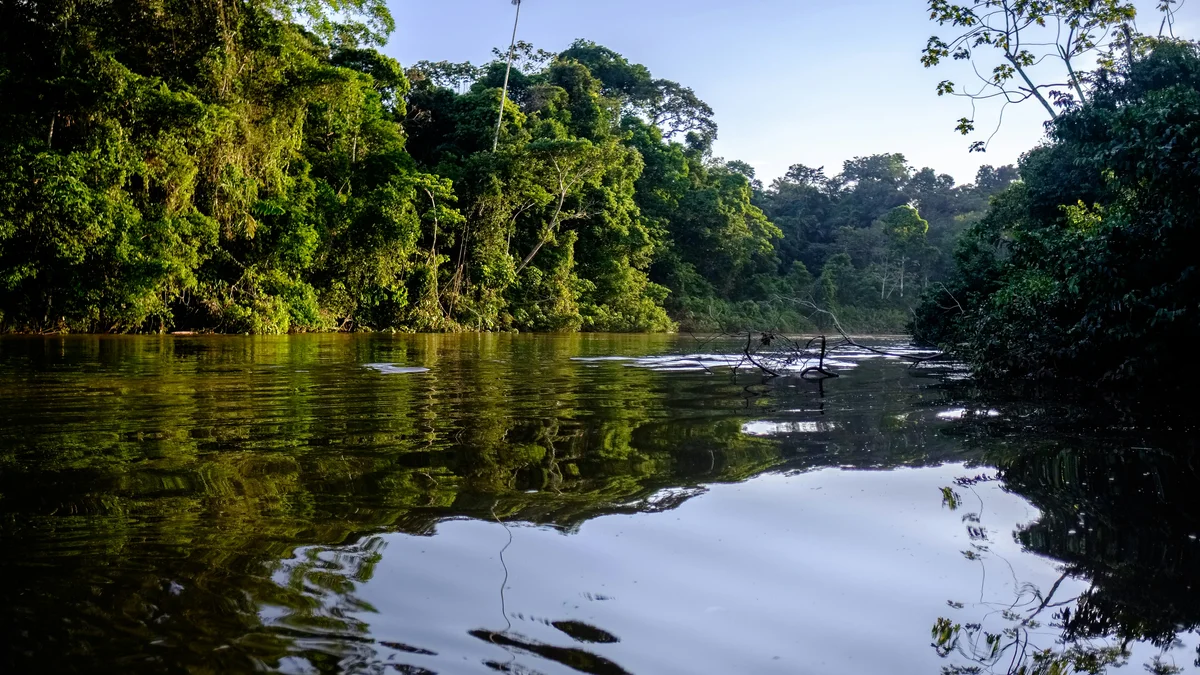
A 371,000-hectare tropical rainforest reserve at the geographic heart of Guyana, set aside by national law in 1996 for conservation and sustainable-forestry research. It's home to jaguars, giant river otters, and harpy eagles, with river lodges offering guided rainforest walks and wildlife-spotting by boat.
Visitor guide
The Iwokrama Forest is a protected rainforest reserve of about 3,716 square kilometres in central Guyana, part of the Guiana Shield. Established in 1996, it is managed by the Iwokrama International Centre for Rain Forest Conservation and Development as a place to test how tropical forest can be conserved and used sustainably.
Wikipedia places the forest roughly between 4 and 5 degrees north latitude, measuring about 85 kilometres east to west and 80 kilometres north to south. The Essequibo River forms its eastern boundary and the Siparuni River its northern boundary. The Pakaraima Mountains rise to the west and savannahs lie to the south-west and north-west. The Burro-Burro River runs through the centre, and most of its watershed lies inside the reserve. The Georgetown to Lethem road crosses the reserve, which makes it one of the more accessible parts of the Guyanese interior by road.
The forest is classified as IUCN category VI, a protected area managed for sustainable use of natural resources, and its governing body is the Protected Areas Trust. A government-linked source describes the Iwokrama International Centre as an autonomous non-profit organisation established by the Government of Guyana and the Commonwealth Secretariat in 1996. The idea behind the reserve is to combine conservation with sustainable use and local benefit, and the centre works with nearby Indigenous communities, notably the Makushi.
The reserve is covered by lowland tropical forest. Wikipedia mentions the white-throated toucan in a photo caption, and other sources associate the surrounding region with jaguars, giant otters, harpy eagles and many monkey and bird species, although which animals are seen depends on luck, season and guiding. The Rupununi region to the south has recorded more than 300 bird species along its main river, according to Wikipedia, which gives a sense of the area's richness.
A canopy walkway of suspension bridges and decks lets visitors view the treetops. Sources describe it as owned by the Iwokrama International Centre and run in partnership with the Makushi community of Surama, with heights reported up to about 30 metres, though sources vary. It is located near Atta Rainforest Lodge, which was built to give access at dawn and dusk when wildlife is more active.
Because the forest is in the interior, guests usually stay at a lodge and travel by road or boat. A private vehicle and driver suits the long distances on the Georgetown to Lethem road, which can be slow in the rains. Guides from local communities lead walks and river trips, and weather affects trails and river levels. A visit is best planned with an operator who can confirm access conditions.
Iwokrama is also notable as a working field site, where researchers and guides study the forest, its animals and the river systems that drain it. Because the reserve is large and the interior roads are limited, the visitor experience tends to be built around a small number of lodges and guided activities, and the Makushi guides of nearby communities add knowledge of local plants, tracks and traditions that a visitor would not easily find alone.
See every tour and attraction we cover in Guyana.