TorontoOntario · 36 tours
 Niagara FallsOntario · 25 tours
 New York CityNew York · 30 tours
 Las VegasNevada · 8 tours
 San FranciscoCalifornia · 16 tours
 VancouverBritish Columbia · 17 tours
 DubaiUAE · 54 tours
 Abu DhabiUAE · 5 tours
 Buenos AiresArgentina · 23 tours
 AthensGreece · 31 tours
 AucklandNew Zealand · 38 tours
 CancunMexico · 54 tours
No destinations match “”. Try searching all tours instead — that search understands full questions, not just place names.
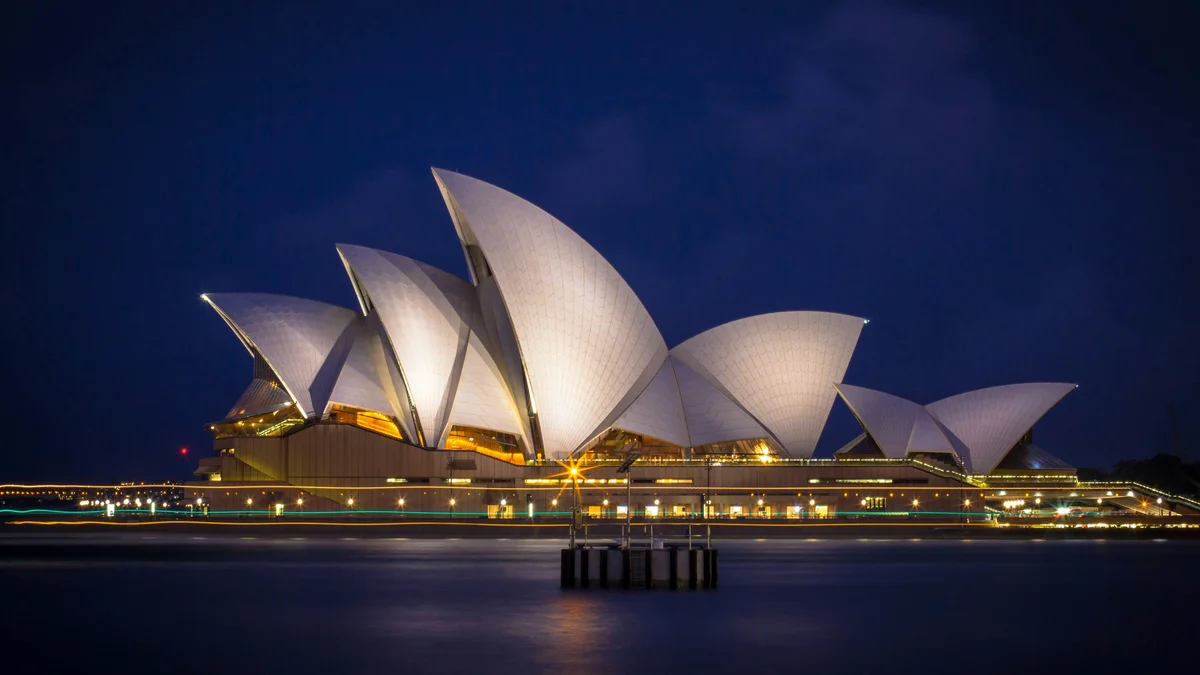
Designed by Danish architect Jørn Utzon and opened in 1973 after more than a decade of construction, the Opera House's sail-shaped shell roof has become one of the most recognizable silhouettes in the world. UNESCO added it to the World Heritage List in 2007, recognizing it as a masterpiece of 20th-century architecture. Inside, it houses multiple performance venues, including the Concert Hall and the Joan Sutherland Theatre, hosting opera, ballet, and orchestral performances year-round.
Visitor guide
The Sydney Opera House is a multi-venue performing arts centre on Bennelong Point in Sydney Harbour, New South Wales, Australia. Designed by the Danish architect Jorn Utzon, it opened in 1973 and was listed as a UNESCO World Heritage Site in 2007. Its sail-like shells make it one of the most recognisable buildings in the world.
An international design competition was announced in 1955, and on 29 January 1957 the judges selected Utzon's design from 233 entries, according to Wikipedia. Utzon drew inspiration from natural forms such as bird wings, shells and palm leaves. The Fort Macquarie Tram Depot, which had stood on the point, was demolished in 1958, and building work began in 1959.
The roof posed an extraordinary engineering challenge. The shells were ultimately resolved as sections of a sphere with a 75.2 metre radius, built from 2,194 precast concrete sections and covered with more than a million tiles made by the Swedish company Hoganas in glossy white and matte cream. Ove Arup and Partners were the structural engineers, and the building rests on 588 piers.
The original estimate in 1957 was 3.5 million pounds, with completion targeted for January 1963. Wikipedia records that the project finished roughly ten years late at a final cost of 102 million Australian dollars. After a change of state government in 1965, disputes with the Minister for Public Works escalated, and Utzon resigned on 28 February 1966 and never returned to Australia. The Australian architect Peter Hall took over the design of the interiors and led completion.
Queen Elizabeth II formally opened the Opera House on 20 October 1973. Utzon was later reconciled with the building: the Utzon Room, opened in 2004, was the first interior rebuilt to his design and holds his tapestry Homage to Carl Philipp Emanuel Bach. He received the Pritzker Architecture Prize in 2003 and died in November 2008.
Wikipedia lists several performance spaces. The Concert Hall seats 2,679 people, is the home of the Sydney Symphony Orchestra and contains the Grand Organ with over 10,000 pipes. The Joan Sutherland Theatre seats about 1,507, the Drama Theatre 544, the Playhouse 398 and the Studio around 280. The Utzon Room seats 210, and outdoor spaces include the Forecourt. The building hosts more than 1,800 performances a year, and Wikipedia reports that over ten million people visit it annually.
The Opera House was added to the New South Wales State Heritage Register in 2003 and the Australian National Heritage List in 2005, and it became a UNESCO World Heritage Site in 2007 under criterion i, which recognises a masterpiece of human creative genius. Its promontory setting means it is best appreciated from several angles, whether from the harbour, from the Royal Botanic Garden or from the forecourt up close.
Visitors can admire the exterior from the harbour foreshore, walk around the forecourt and, on a guided basis, step inside to see the venues. A private tour can pair the Opera House with Circular Quay, the Royal Botanic Garden and The Rocks, all within walking distance.
See every tour and attraction we cover in Sydney.