TorontoOntario · 36 tours
 Niagara FallsOntario · 25 tours
 New York CityNew York · 30 tours
 Las VegasNevada · 8 tours
 San FranciscoCalifornia · 16 tours
 VancouverBritish Columbia · 17 tours
 DubaiUAE · 54 tours
 Abu DhabiUAE · 5 tours
 Buenos AiresArgentina · 23 tours
 AthensGreece · 31 tours
 AucklandNew Zealand · 38 tours
 CancunMexico · 54 tours
No destinations match “”. Try searching all tours instead — that search understands full questions, not just place names.
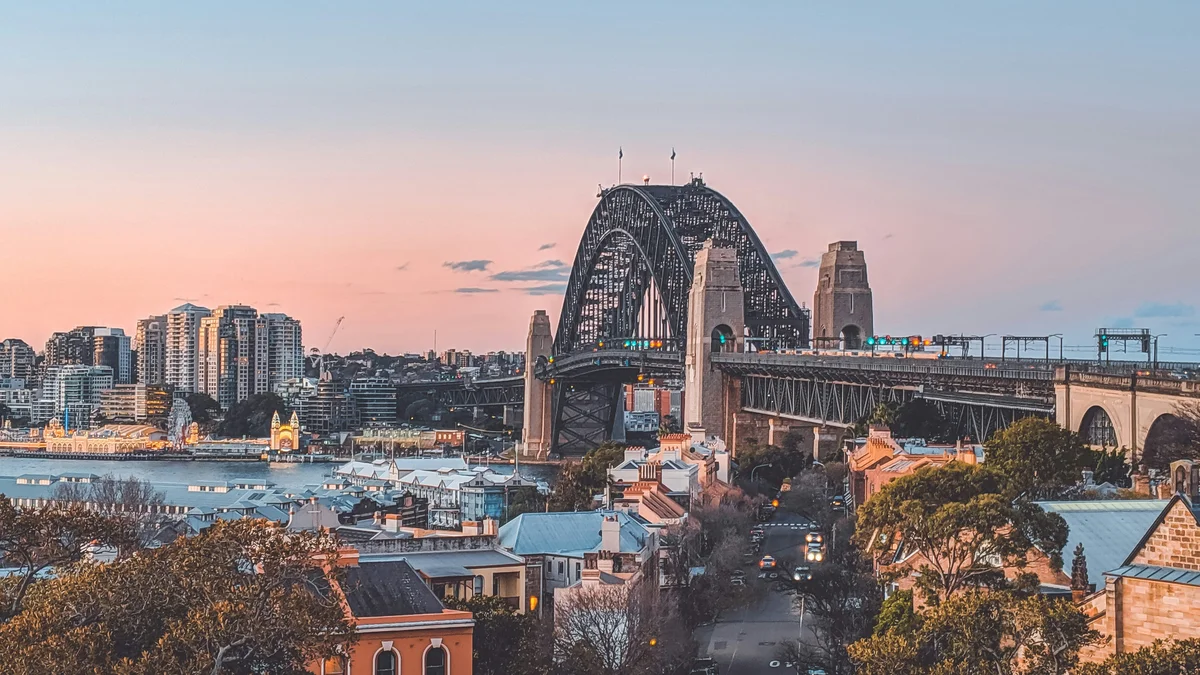
Opened in 1932, this steel arch bridge links Sydney's central business district to the North Shore across the harbour and quickly earned the nickname 'The Coathanger' for its shape. It remains one of the widest long-span bridges in the world, carrying road, rail, cyclists, and pedestrians. Since 1998, the BridgeClimb experience has let visitors climb to the very top of the arch for sweeping views over the harbour and city.
Visitor guide
The Sydney Harbour Bridge is a steel through-arch bridge across Sydney Harbour in New South Wales, Australia, linking the central business district at Dawes Point in The Rocks with Milsons Point on the North Shore. Opened on 19 March 1932, it carries road traffic, trains, cyclists and pedestrians, and is nicknamed the Coathanger for the shape of its arch.
The bridge was championed by the engineer John Bradfield of the New South Wales Department of Public Works, who was appointed Chief Engineer in 1914 and is called the father of the bridge. Wikipedia notes that his cantilever and arch designs drew on New York's Hell Gate Bridge. The contract was won by the British firm Dorman Long and Co of Middlesbrough, and Lawrence Ennis was its Director of Construction. The granite-faced concrete pylons were designed by Thomas S. Tait.
Wikipedia gives a total length of 1,149 metres, a width of 48.8 metres and a height of 134 metres above the water, with a main span of about 503 metres. The steelwork totals about 52,800 tonnes, of which the arch is roughly 39,000 tonnes, and about six million hand-driven rivets were used. The two halves of the arch met on 19 August 1930. Sixteen workers lost their lives during construction. The total cost was about 6.25 million pounds, and it was not fully repaid until 1988.
The bridge opened on 19 March 1932. Wikipedia records that before Premier Jack Lang could cut the ceremonial ribbon, a man named Francis de Groot, a member of the paramilitary New Guard, rode up in military-style uniform and slashed it with a sword. The ribbon was soon retied and the ceremony went ahead. The bridge was also nicknamed the Iron Lung, since its construction kept many people employed during the Depression.
The bridge has eight road lanes along the Bradfield Highway, and the central lanes are reversible to match tidal traffic flow. Two railway tracks form part of the North Shore line between Milsons Point and Wynyard. A cycleway runs along the western side and a pedestrian footway along the eastern side. The southeastern pylon holds a museum and a lookout, reached by about 200 steps from the walkway, with views across the harbour and toward the Opera House.
Since 1998 the BridgeClimb company has run guided climbs up the southern half of the arch, and Wikipedia notes that the Discovery Climb, launched in December 2006, uses the lower chord. The bridge is a focal point of Sydney's New Year's Eve fireworks, which have included displays such as the word Eternity in 1999, a tribute to the Sydney figure Arthur Stace.
The Sydney Harbour Bridge was listed on the New South Wales State Heritage Register on 25 June 1999 and on the Australian National Heritage List on 19 March 2007. Its construction also reshaped The Rocks, since several hundred buildings were demolished in the 1920s to make way for the approaches.
The bridge is seen from many vantage points around the harbour, including Circular Quay, Kirribilli, the Botanic Garden and from a ferry. A private tour can combine it with The Rocks and the Opera House, which are all close together.
See every tour and attraction we cover in Sydney.