TorontoOntario · 36 tours
 Niagara FallsOntario · 25 tours
 New York CityNew York · 30 tours
 Las VegasNevada · 8 tours
 San FranciscoCalifornia · 16 tours
 VancouverBritish Columbia · 17 tours
 DubaiUAE · 54 tours
 Abu DhabiUAE · 5 tours
 Buenos AiresArgentina · 23 tours
 AthensGreece · 31 tours
 AucklandNew Zealand · 38 tours
 CancunMexico · 54 tours
No destinations match “”. Try searching all tours instead — that search understands full questions, not just place names.
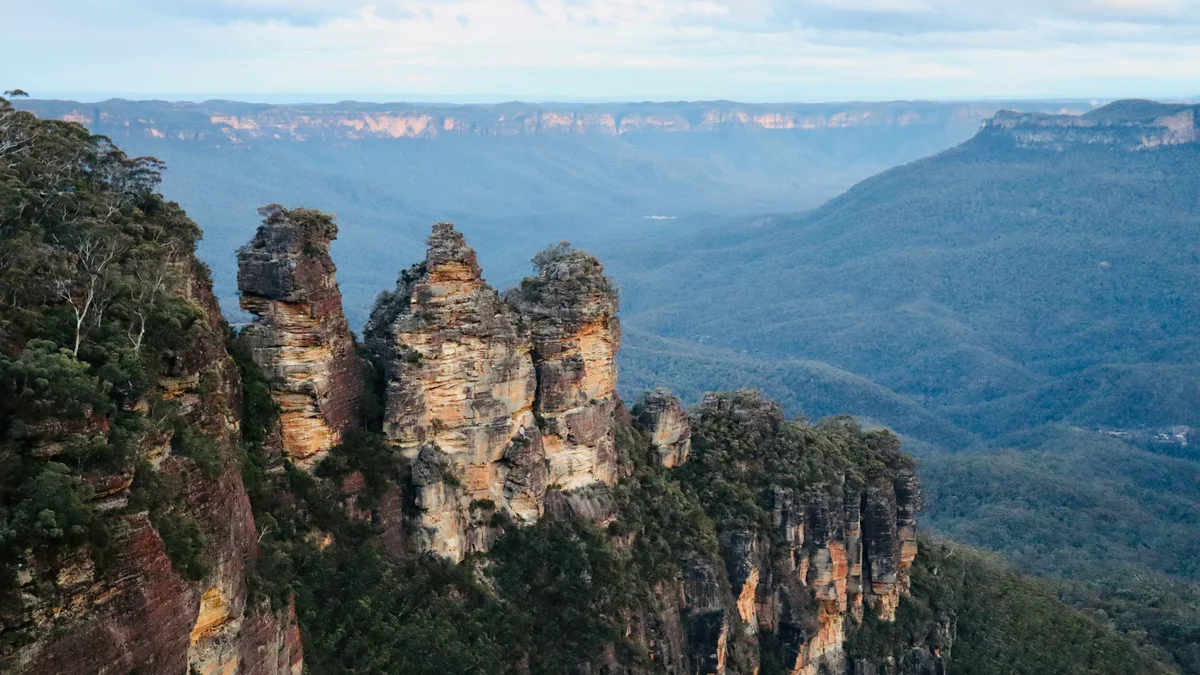
This UNESCO World Heritage eucalyptus wilderness rises west of Sydney, named for the blue haze given off by oil released from the region's dense gum tree forests. Its most famous landmark, the Three Sisters, is a trio of sandstone rock pillars visible from the Echo Point lookout in Katoomba, tied to a Dreamtime legend of the local Gundungurra people. Nearby, the Scenic World cableway and railway carry visitors down into the valley floor for a closer look at the surrounding cliffs and rainforest.
Visitor guide
The Blue Mountains are a deeply incised sandstone plateau west of Sydney, New South Wales, Australia, protected within the UNESCO-listed Greater Blue Mountains Area. The best-known landmark is the Three Sisters, a trio of sandstone pillars seen from Echo Point at Katoomba, about 102 km west of the Sydney central business district.
The Greater Blue Mountains Area was inscribed on the World Heritage List on 29 November 2000, according to Wikipedia, under natural criteria (ix) and (x). Its core area covers about 1,032,649 hectares and comprises eight protected areas, including seven national parks such as Blue Mountains, Wollemi, Kanangra-Boyd and Nattai, plus the Jenolan Caves Karst Conservation Reserve. Wikipedia notes that it is mostly a forested, deeply incised sandstone plateau rather than mountains in the conventional sense, with elevations from under 100 metres to around 1,300 metres.
The region is celebrated for its eucalypts, with Wikipedia giving figures of 91 to 96 species depending on the section. It is also the home of the Wollemi pine, discovered in 1994 and described as a living fossil, known from only a few small populations in remote gorges. More than 400 kinds of animal live in the area, including the tiger quoll, koala and yellow-bellied glider.
Wikipedia attributes the name to the bluish haze that hangs over the mountains. Essential oil from the eucalyptus forests evaporates in the warm air and scatters sunlight so that distant ridges appear blue. The effect is easiest to see across the Jamison Valley from the Katoomba lookouts.
Echo Point lies about 2 km south of the centre of Katoomba and looks out over the Jamison Valley, with Mount Solitary and the Ruined Castle also in view. The Three Sisters are named Meehni, Wimlah and Gunnedoo, with commonly cited elevations of roughly 922, 918 and 906 metres. They are shaped by long erosion of the soft sandstone by wind and rain. The Giant Stairway, a short walk from Echo Point, descends into the valley.
An Aboriginal story is widely told about the Three Sisters. In the version most often repeated, three sisters fell in love with men from a neighbouring group, which tribal law forbade, and a tribal elder turned the sisters to stone to protect them. This is a legend, and different versions are attributed to the Gundungurra and Darug peoples, the traditional custodians of the area. Some sources question how old particular versions of the story are, so it is best treated as a story rather than established history.
Katoomba is about 1,000 metres above sea level and was connected to the Main Western railway in 1874. Wikipedia explains that it was renamed Katoomba in 1877. Scenic World, in the southwest of the town, includes the Katoomba Scenic Railway, described as the steepest funicular railway in the world and originally built to serve coal and oil shale mining, plus the Scenic Skyway cable car across an arm of the Jamison Valley. Carrington Hotel, established in 1882, is among the town's heritage hotels.
The Blue Mountains are commonly visited as a day trip from Sydney. Weather in the mountains is cooler and can change quickly, with mist sometimes covering the valley views. A private tour provides flexibility to stop at several lookouts, small towns and gardens along the way.
See every tour and attraction we cover in Sydney.