TorontoOntario · 36 tours
 Niagara FallsOntario · 25 tours
 New York CityNew York · 30 tours
 Las VegasNevada · 8 tours
 San FranciscoCalifornia · 16 tours
 VancouverBritish Columbia · 17 tours
 DubaiUAE · 54 tours
 Abu DhabiUAE · 5 tours
 Buenos AiresArgentina · 23 tours
 AthensGreece · 31 tours
 AucklandNew Zealand · 38 tours
 CancunMexico · 54 tours
No destinations match “”. Try searching all tours instead — that search understands full questions, not just place names.
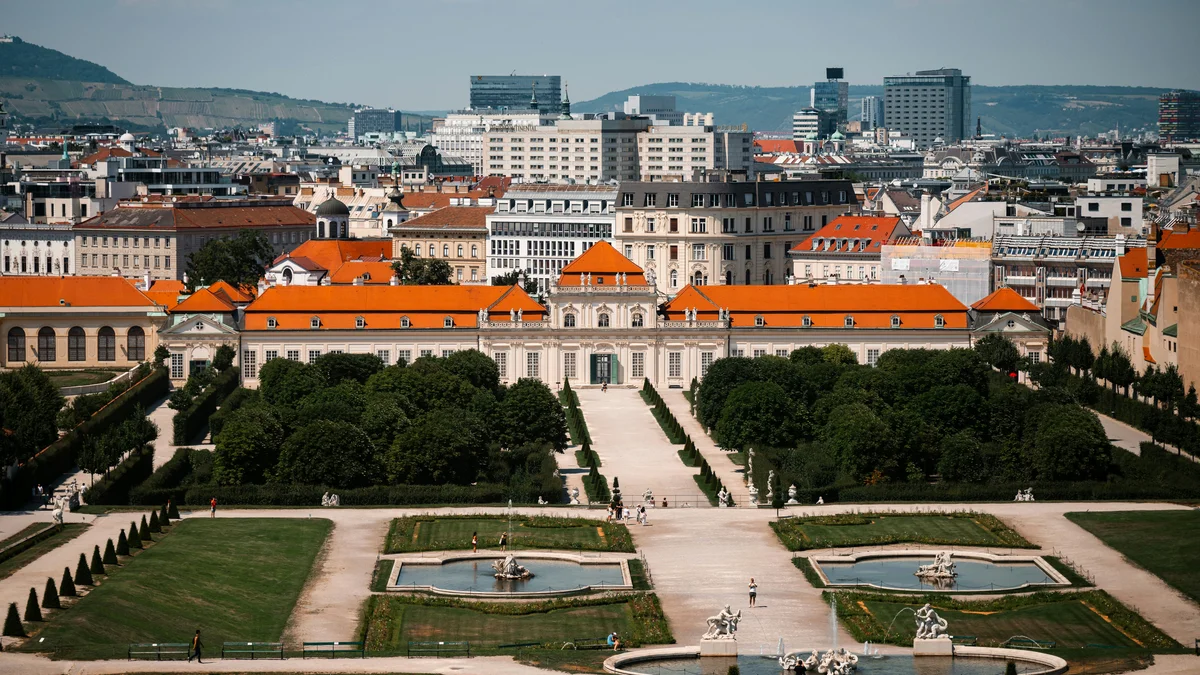
Belvedere is a Baroque palace complex built in the early 18th century as the summer residence of Prince Eugene of Savoy, consisting of the Upper and Lower Belvedere connected by a formal terraced garden. The Upper Belvedere now houses Austria's national gallery and is best known for holding the world's largest collection of Gustav Klimt paintings, including his 1908 masterpiece 'The Kiss.' The view from the garden's upper terrace, looking back across the reflecting pools toward the Upper Belvedere with Vienna's skyline beyond, is one of the city's classic photo spots.
Visitor guide
The Belvedere is a historic building complex and art museum in Vienna's third district, Landstraße, made up of the Upper and Lower Belvedere palaces, an orangery, palace stables and a formal Baroque garden. It was built as the summer residence of Prince Eugene of Savoy and forms part of the Historic Centre of Vienna World Heritage Site.
Prince Eugene bought land south of the Rennweg in 1697 and chose Johann Lukas von Hildebrandt as chief architect. The Lower Belvedere was under construction by 1712 and served as a Lustschloss, or pleasure palace, closely tied to the gardens. The Upper Belvedere followed, completed in 1723, and was conceived less as a private home than as a building for ceremonies, receptions and display. Eugene received the Ottoman ambassador Ibrahim Pasha there in 1719 while decoration was still under way.
Interior artists included Francesco Solimena, who painted the altarpiece for the palace chapel and the ceiling of the Gold Cabinet, and Carlo Innocenzo Carlone, who painted the ceiling fresco of the Marble Hall between 1721 and 1723. In the winter of 1732 to 1733 Hildebrandt gave the Sala Terrena its present look with a vaulted ceiling supported by four Atlas pillars.
The gardens were designed in the formal French manner by Dominique Girard, who had trained in the gardens of Versailles. They extend between the two palaces over three large terraces with symmetrical parterres, basins, steps, cascades, clipped hedges and sculptures. A sculptural programme alludes to the rise of Prince Eugene, linking him to the god Apollo. Bernardo Bellotto's painting View of Vienna from the Belvedere shows the famous perspective known as the Canaletto view, which has played a role in debates about Vienna's skyline.
Eugene died in 1736 without a will, and in 1752 Maria Theresa acquired the complex. In 1770 a masked ball was held there for the marriage of Archduchess Maria Antonia, the future Marie Antoinette. In 1776 Maria Theresa and Joseph II decided to move the Imperial Picture Gallery to the Upper Belvedere to make it accessible to the public; the museum's own chronology gives 1777 as the inauguration, while other sources say 1781, and it is often described as one of the world's first public art museums.
In 1896 Franz Joseph I decided the Upper Belvedere should be the residence of heir Archduke Franz Ferdinand. The Moderne Galerie opened in the Lower Belvedere on 2 May 1903, as Austria's first state collection devoted to modern art, partly through the efforts of the Vienna Secession. After 1918 the palaces were assigned to the Staatsgalerie.
The Austrian State Treaty, which re-established Austria as an independent and democratic state after the postwar Allied occupation, was signed at the Upper Belvedere on 15 May 1955. The Upper Belvedere appears on the Austrian 20-cent euro coin.
The museum presents Austrian art from the Middle Ages to the present. The Upper Belvedere houses the permanent collection, the Lower Belvedere is used for temporary exhibitions and Belvedere 21 shows contemporary art, film and music. The collection includes works by Gustav Klimt, Egon Schiele, Oskar Kokoschka, Monet, van Gogh and Rodin, and the Belvedere holds an important group of Klimt paintings, including The Kiss. The Baroque state rooms, including the Marble Gallery, Golden Room and Hall of Grotesques, remain open to the public.
See every tour and attraction we cover in Vienna.