TorontoOntario · 36 tours
 Niagara FallsOntario · 25 tours
 New York CityNew York · 30 tours
 Las VegasNevada · 8 tours
 San FranciscoCalifornia · 16 tours
 VancouverBritish Columbia · 17 tours
 DubaiUAE · 54 tours
 Abu DhabiUAE · 5 tours
 Buenos AiresArgentina · 23 tours
 AthensGreece · 31 tours
 AucklandNew Zealand · 38 tours
 CancunMexico · 54 tours
No destinations match “”. Try searching all tours instead — that search understands full questions, not just place names.
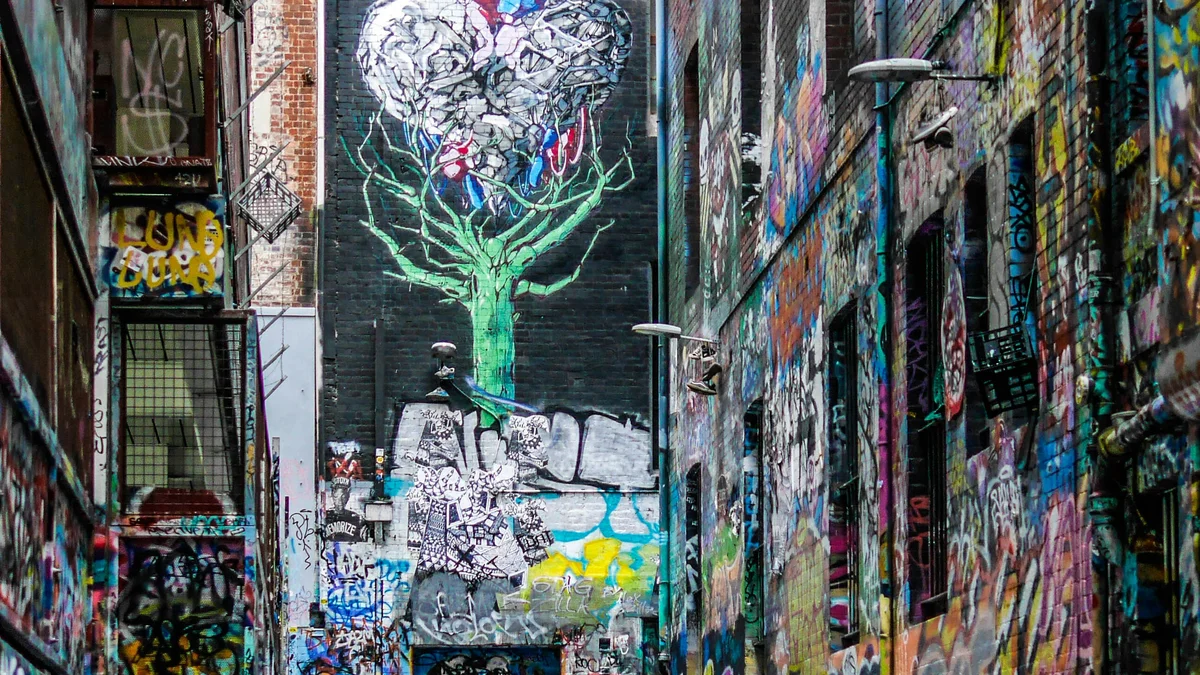
Threading behind and between Melbourne's main streets, the city's laneways have evolved from utilitarian service alleys into one of its defining attractions, covered in layered, ever-changing street art and lined with hidden cafes, bars, and boutiques. Hosier Lane and Union Lane are among the most famous, and Melbourne's relatively permissive stance on legal street art has helped the laneways become a genuine open-air gallery.
Visitor guide
Melbourne's laneways are the narrow lanes and arcades that run between and behind the main streets of the central city in Victoria, Australia. Once largely service alleys, they are now known for street art, cafes, bars and small shops, and they are a defining part of how people experience the city on foot.
Hosier Lane is the city's most famous street art laneway. It runs between Flinders Street and Flinders Lane, opposite Federation Square, and is named after the local businessman Robert Hosier. Wikipedia says it opened as a street art gallery in 1998 through the City Lights Initiative and has been a popular tourist attraction since the late 1990s. The City of Melbourne describes it as a long-standing de facto free-to-paint area that requires no permits, and its graffiti-covered walls are a popular backdrop for photography.
Wikipedia also records that in November 2013 more than 100 artists took part in the All Your Walls paint-up in Hosier and Rutledge Lanes, held with the National Gallery of Victoria, and that in 2013 the street artist Adrian Doyle painted the whole of neighbouring Rutledge Lane one colour, with council consent. The art is constantly layered and replaced, so no visit sees quite the same walls.
Wikipedia states that Melbourne earned a reputation as the stencil capital of the world after embracing stencil art early, and the Melbourne Stencil Festival began in 2004 and ran until 2010. In 2006 the artist Banksy wrote that the city's walls and back alleys had graffiti more diverse and original than any other city in the world. Melbourne's street artists, such as Rone, who has been active since 2002, have contributed to that reputation. Not all of this work has survived, since street art is temporary by nature and the City of Melbourne has said that protecting it is not practical.
Degraves Street is a short, narrow bluestone laneway of about 100 metres running between Flinders Street and Flinders Lane in the Hoddle Grid. It takes its name from the pioneer flour-millers and merchants William and Charles Degraves, who came to Melbourne from Hobart in 1849; eMelbourne records that they built a steam-driven flour mill at the corner of Flinders Street in 1851, and that the street was named by 1856. Today it is known for alfresco dining and cafe culture, and its art deco buildings, dining umbrellas and canopies give it a European feel.
The nearby Centre Place, a similar lane, is sometimes confused with it. Campbell Arcade, built in the 1950s, connects Flinders Street Station underground to Degraves Street, and the Majorca Building, designed by Harry Norris and built around 1928 to 1929, clad in terracotta, is a notable landmark at the northern end.
The laneways are best explored on foot, at a relaxed pace, with time to look up as well as down, since much of the art is on upper walls. Mornings are quieter, and a local guide can point out details and recent works that a first-time visitor might miss.
See every tour and attraction we cover in Melbourne.