TorontoOntario · 36 tours
 Niagara FallsOntario · 25 tours
 New York CityNew York · 30 tours
 Las VegasNevada · 8 tours
 San FranciscoCalifornia · 16 tours
 VancouverBritish Columbia · 17 tours
 DubaiUAE · 54 tours
 Abu DhabiUAE · 5 tours
 Buenos AiresArgentina · 23 tours
 AthensGreece · 31 tours
 AucklandNew Zealand · 38 tours
 CancunMexico · 54 tours
No destinations match “”. Try searching all tours instead — that search understands full questions, not just place names.
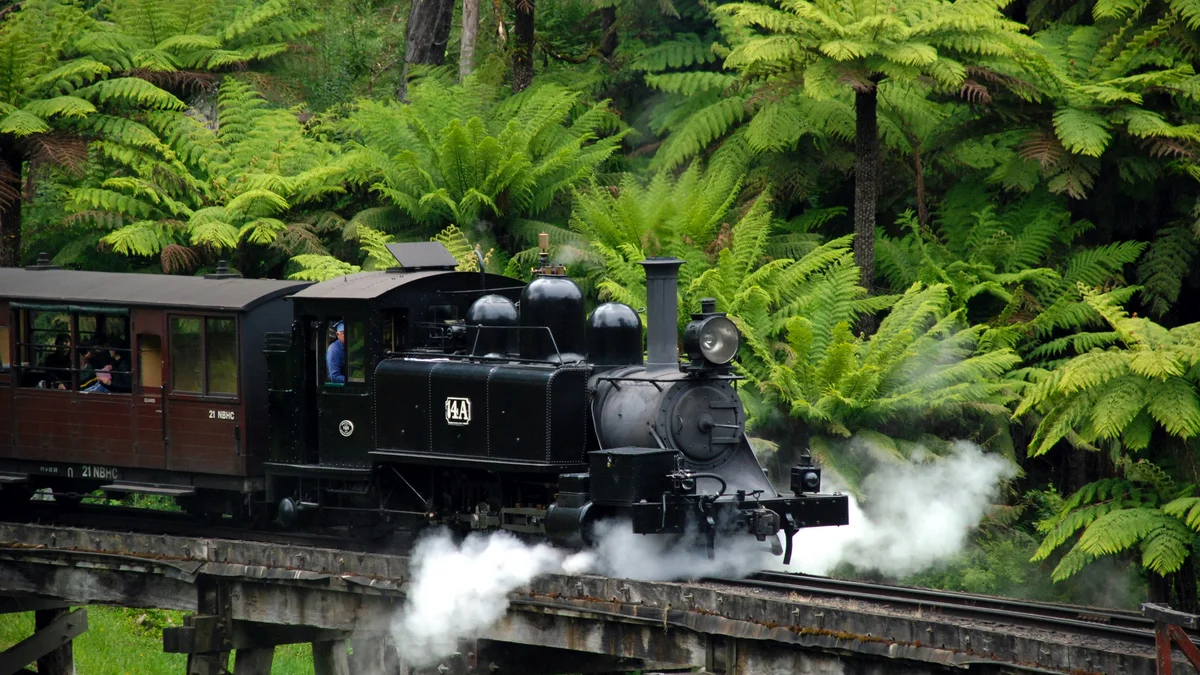
Puffing Billy is a heritage steam railway that opened in 1900 as a Victorian Railways narrow gauge line, closed in the 1950s, and was later reopened in stages by volunteer preservationists to run through the cool-climate forests of the Dandenong Ranges. Its open-sided carriages carry passengers across the iconic wooden Trestle Bridge and through dense fern gullies, offering a genuinely old-fashioned way to experience the ranges just outside Melbourne.
Visitor guide
Puffing Billy is a heritage steam railway in the Dandenong Ranges east of Melbourne, Victoria, Australia, running between Belgrave and Gembrook. Opened in 1900 as a narrow gauge line, it is operated today as a tourist railway with a large volunteer workforce and passes through forested hills and fern gullies.
Wikipedia describes Puffing Billy as a 2 ft 6 in (762 mm) narrow gauge heritage railway, 25.1 km long with 11 stations. The original line opened in 1900 as one of five Victorian Railways narrow gauge lines, branching from the broad gauge network at Upper Ferntree Gully. It was built to carry timber and farm produce, and also served the Nobelius nursery and orchard, and holiday traffic to Belgrave grew in the 1920s. Services declined after World War II, and operations stopped in 1953 after a landslide blocked the line between Selby and Menzies Creek. The line was formally closed in 1954.
The Puffing Billy Preservation Society was formed on 1 October 1955 by Harold L. Hewett. Trains resumed between Belgrave and Menzies Creek on 28 July 1962, and the line was extended to Emerald in 1965, Lakeside in 1975 and Gembrook on 18 October 1998. The Emerald Tourist Railway Act 1977 created a board to take over ownership and operation from Victorian Railways, and the Puffing Billy Railway Act 2022 replaced it with the Puffing Billy Railway Board.
Volunteers have been central since the railway's rescue. Wikipedia reports that in 2024 to 2025 about 379 active volunteers contributed more than 70,000 hours. Claims of historic rank among steam railways vary, so it is best described simply as a long-running preserved steam railway.
The heritage-listed Monbulk Creek trestle bridge is on the route, listed as the Monbulk Creek Rail Bridge, and it is one of the most photographed features of the line. The trains run through the southern foothills of the Dandenong Ranges, with tall forest and fern gullies. Belgrave is the main departure point, Menzies Creek has a museum with static and operating locomotives, and Lakeside, which opened in 1944 as a picnic platform for Emerald Lake Park, is where most trains run to. Gembrook is the end of the line.
The open-sided carriages are a characteristic feature. Wikipedia notes 15 NBH carriages built in 1918 to 1919, along with later replicas.
The steam fleet includes NA class 2-6-2 tank engines, a G class Garratt built by Beyer, Peacock and Company in 1926 and restored to steam in 2004, and a Climax geared locomotive built in 1928. Several locomotives and carriages appear on the Victorian Heritage Register under the item Puffing Billy Locomotives and Rolling Stock. Diesel locomotives are used on total fire ban days and for works trains.
The railway runs through the southern foothills of the Dandenong Ranges, a hilly, forested area on the eastern edge of Melbourne. Wikipedia notes the line passes through places such as Belgrave, Emerald and Gembrook, and the cooler hill climate means a light jacket is sensible.
Services usually run several times a day, but timetables and the choice of locomotive depend on the season and fire-danger conditions. A private tour allows the railway to be paired with gardens, lookouts and villages in the surrounding ranges.
See every tour and attraction we cover in Melbourne.