TorontoOntario · 36 tours
 Niagara FallsOntario · 25 tours
 New York CityNew York · 30 tours
 Las VegasNevada · 8 tours
 San FranciscoCalifornia · 16 tours
 VancouverBritish Columbia · 17 tours
 DubaiUAE · 54 tours
 Abu DhabiUAE · 5 tours
 Buenos AiresArgentina · 23 tours
 AthensGreece · 31 tours
 AucklandNew Zealand · 38 tours
 CancunMexico · 54 tours
No destinations match “”. Try searching all tours instead — that search understands full questions, not just place names.
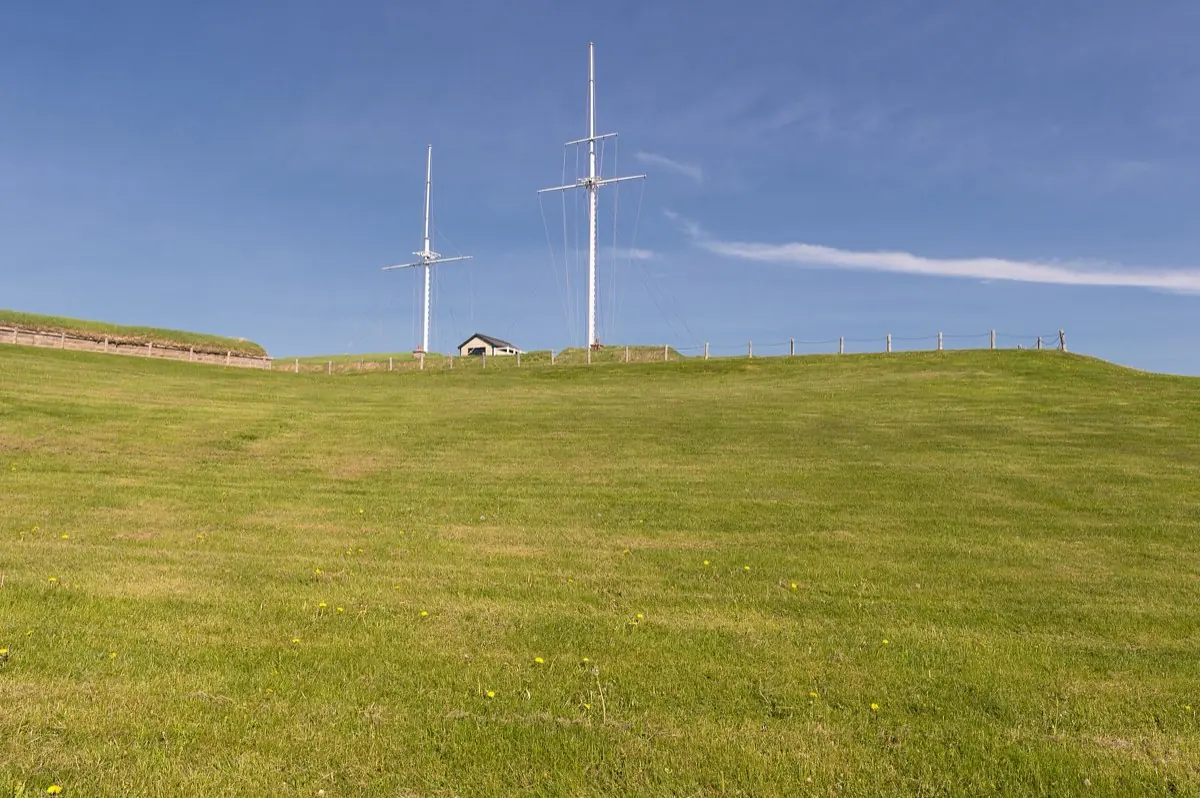
A star-shaped 19th-century fortress overlooking downtown Halifax and its harbour.
Visitor guide
Citadel Hill is the hilltop fortress that overlooks downtown Halifax and its harbour. Now the Halifax Citadel National Historic Site, managed by Parks Canada, it was designated a National Historic Site on May 29, 1935, and its star-shaped fort, built between 1828 and 1856, is the fourth fortification on the hill.
Four forts have stood here since Halifax was founded in 1749. Governor Edward Cornwallis established the first, a small redoubt near the summit, as part of the town's western perimeter. A larger second fort went up during the American Revolution; Parks Canada says its plans called for the hill to be cut down by 40 feet (about 12 metres), and that by the time the third fort was built the hill had been cut down by 15 feet. The third, designed in 1794 under Prince Edward, Duke of Kent, and completed around 1800, was the only one formally named Fort George, after King George III, by General Orders of October 20, 1798. By 1825 only its powder magazine remained intact.
The present fort took 28 years to build, from 1828 to 1856. It was intended to defend against both land attack and attack from the water, particularly by the United States, and its design includes tunnels, multiple lines of fire and thick ramparts commanding the harbour. Wikipedia notes it was built for smoothbore guns and was made obsolete by rifled artillery in the 1860s; it has never been attacked. British forces held it until 1906, and the Canadian Army used it later. During the First World War an internment camp held prisoners at the citadel (Parks Canada says it opened on October 1, 1914 and closed on October 3, 1916), and in the Second World War it served as barracks, signalling and the coordination point for anti-aircraft defences.
In the late 1940s downtown business interests proposed levelling the hill for parking. Historian Harry Piers's research helped save it, and the partly restored fort opened as a historic site in 1956. Parks Canada later restored it to its appearance in 1869, which is why the interpreters wear the uniforms of that year.
Parks Canada lists the Army Museum, guided and self-guided tours, and demonstrations and living-history programmes featuring the 78th Highlanders and the 3rd Brigade Royal Artillery in 1869. The Army Museum, located in the citadel's Cavalier Block, is an independent non-profit working with Parks Canada, with a focus on Nova Scotia's army history. A ceremonial noon gun is fired daily; Parks Canada says the tradition has continued since at least 1856, though some sources date it to 1857. Check Parks Canada for current firing arrangements.
The Halifax Town Clock, commissioned by Prince Edward in 1800 and opened on October 20, 1803, stands on the hill's eastern slope on Brunswick Street. The citadel also anchors the wider Halifax Defence Complex, with Georges Island, York Redoubt and others, and Parks Canada notes the site is part of the Toqi'maliaptmu'k Arrangement, a co-management partnership between the Mi'kmaq of Nova Scotia and Parks Canada.
Citadel Hill is a short walk from the Halifax Public Gardens and downtown, and a downhill walk away from the waterfront boardwalk. On a Voyzo private tour, a private vehicle and driver can take you from your accommodation to the gates and on to the harbourfront afterward.
See every tour and attraction we cover in Halifax.