TorontoOntario · 36 tours
 Niagara FallsOntario · 25 tours
 New York CityNew York · 30 tours
 Las VegasNevada · 8 tours
 San FranciscoCalifornia · 16 tours
 VancouverBritish Columbia · 17 tours
 DubaiUAE · 54 tours
 Abu DhabiUAE · 5 tours
 Buenos AiresArgentina · 23 tours
 AthensGreece · 31 tours
 AucklandNew Zealand · 38 tours
 CancunMexico · 54 tours
No destinations match “”. Try searching all tours instead — that search understands full questions, not just place names.
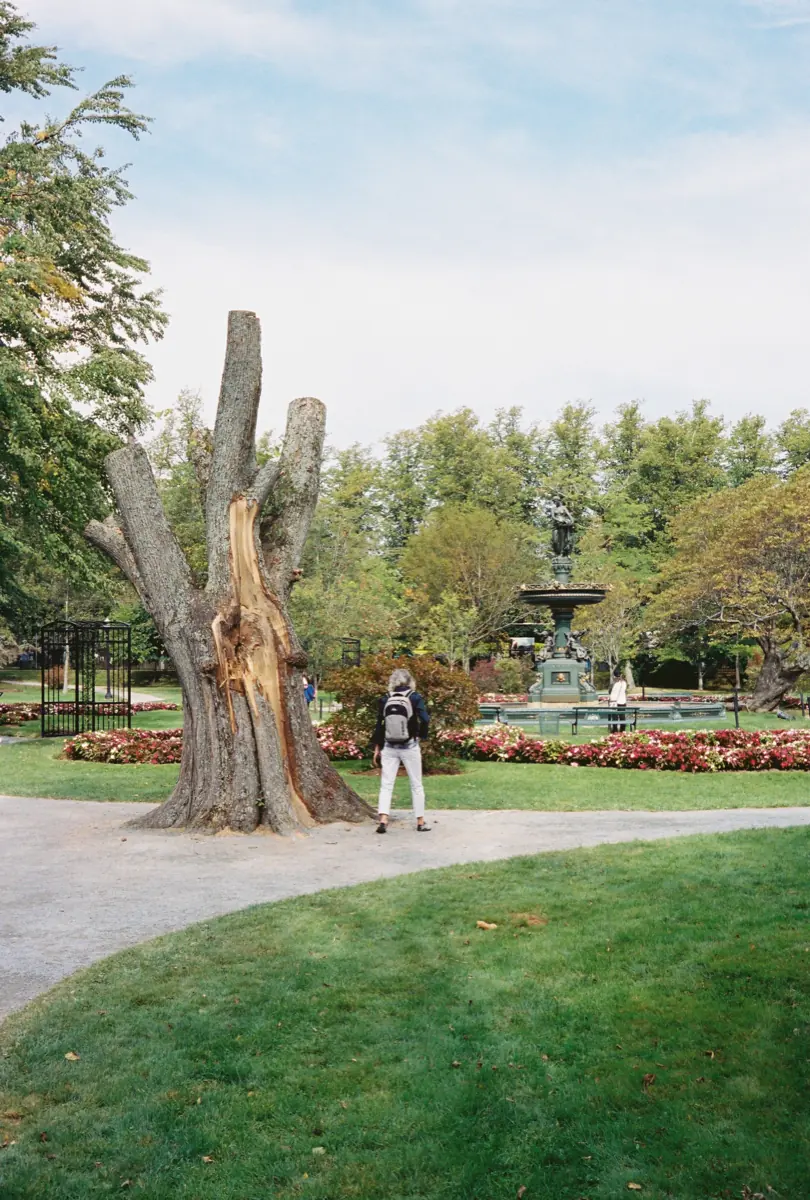
A formal Victorian garden in the middle of the city, one of the finest in North America.
Visitor guide
The Halifax Public Gardens fill a 6.5-hectare (16-acre) city block in downtown Halifax, bounded by Spring Garden Road, South Park Street, Summer Street and Sackville Street. Parks Canada calls them a rare surviving Victorian public garden in Canada, and the formal layout of paths, beds, ponds and bandstand is still largely the one laid out in the 1870s.
The story starts with the Nova Scotia Horticultural Society, whose garden was laid out in 1837 (the City of Halifax dates the Society's founding of the gardens to 1836). In 1866 a public park opened next door. The two were merged in 1874, and the combined grounds opened to the public in 1875. Sources vary slightly on whether 1874 or 1875 is the headline year, so it is safest to say the gardens took their present form in the mid-1870s.
The look of the gardens comes mainly from Richard Power, hired as superintendent in 1872, who imposed the axially symmetrical plan that still governs the site. Parks Canada notes that his original design survives largely intact, helped by his family's long stewardship of the grounds. The result is a textbook example of the Victorian Gardenesque approach: serpentine paths, geometric flower beds, carpet bedding, exotic plantings, commemorative statuary and a bandstand.
The bandstand was designed by architect Henry Busch. In 1887 Sir William Young donated three statues, representing Ceres, Flora and Diana, along with six large stone urns, and they remain along the Petit Allee and around the bandstand. Wikipedia also records a bronze Boer War soldier statue dating to about 1903, wrought-iron gates from 1907, and the pond named for Lawrence Griffin, a man hanged in 1821.
Parks Canada designated the gardens a National Historic Site on the strength of this surviving Victorian design and their continued use as a public park. Parks Canada's page gives the designation as 1983, while the City of Halifax and several other sources say 1984, so treat the exact year with a little caution. The site was also registered as municipal heritage property in 1991.
Hurricane Juan struck on 29 September 2003 and destroyed many of the old trees. According to Wikipedia, the gardens reopened on Canada Day 2004 after a restoration helped by roughly $1 million raised in a radio telethon; some survivors, such as an American elm dating to the 1860s, still stand. In July 2022 about 30 historic trees were girdled in an act of vandalism, and security has since been increased.
Expect three fountains, two stone bridges, three ponds, a small concession in the original Horticultural Hall, and long flower beds that change with the season. Free concerts have long been held at the bandstand on summer Sunday afternoons, and the gardens host Canada Day and Natal Day celebrations. Check the City of Halifax for current gate hours, events and rules, including the ban on feeding the ducks.
The gardens sit a short walk from Spring Garden Road shops, the Halifax Central Library and the Halifax Common, so they pair naturally with a downtown walk. On a Voyzo private tour, your driver can collect you door to door and drop you at a gate, so you can wander at your own pace.
Within a few minutes of the gardens you will find the Citadel Hill area, the Halifax waterfront and, a little further south, Point Pleasant Park.
See every tour and attraction we cover in Halifax.