TorontoOntario · 36 tours
 Niagara FallsOntario · 25 tours
 New York CityNew York · 30 tours
 Las VegasNevada · 8 tours
 San FranciscoCalifornia · 16 tours
 VancouverBritish Columbia · 17 tours
 DubaiUAE · 54 tours
 Abu DhabiUAE · 5 tours
 Buenos AiresArgentina · 23 tours
 AthensGreece · 31 tours
 AucklandNew Zealand · 38 tours
 CancunMexico · 54 tours
No destinations match “”. Try searching all tours instead — that search understands full questions, not just place names.
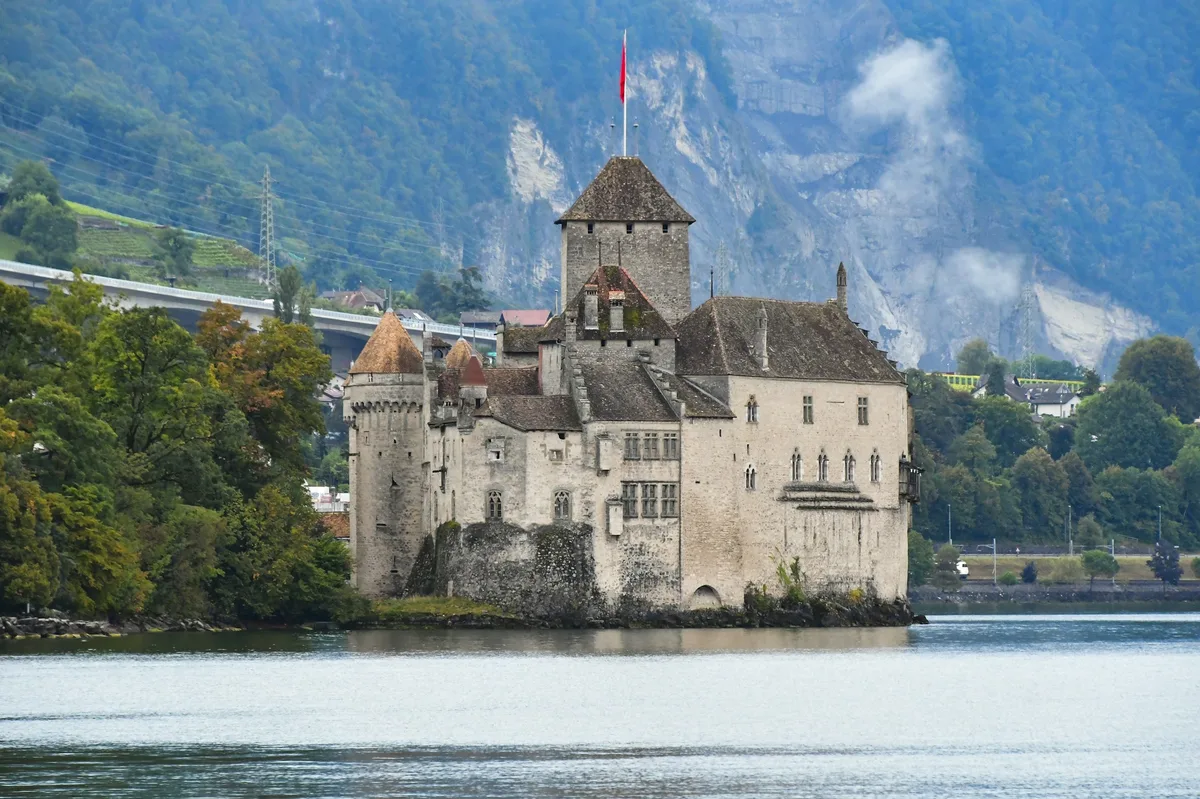
A moated island castle on the shore of Lake Geneva near Montreux, with Alpine peaks rising behind it — one of Switzerland's most-photographed lakeside landmarks.
Visitor guide
Chillon Castle, or Château de Chillon, is a medieval island castle on the shore of Lake Geneva, south of Veytaux in the Swiss canton of Vaud, close to Montreux. It stands on a small limestone rock that projects into the lake, with Alpine peaks rising behind it.
The castle sits at the eastern end of Lake Geneva, on the narrow shore between Montreux and Villeneuve that gives access to the Rhône valley. According to Wikipedia, it guarded the passage between the Vaud Riviera and the Rhône valley, controlling routes toward Italy and collecting tolls. It occupies Chillon island, a small, steep-sided oval rock, and the site has been military since the central Middle Ages.
A square donjon, or keep, was built in the 11th century, though who commissioned it is disputed. Count Peter II of Savoy greatly expanded the castle in 1248 and again in 1266 to 1267, and Master James of Saint George is credited with adding its distinctive windows. The House of Savoy controlled the castle, which served as a summer residence for the Counts of Savoy, housed a fleet on the lake and also held prisoners.
The Genevan monk and historian François de Bonivard was imprisoned at Chillon for six years from 1530. A Bernese army captured the castle in 1536 and freed the prisoners, including Bonivard. Lord Byron wrote the poem The Prisoner of Chillon in 1816, based on Bonivard's story, and Eugène Delacroix's painting of the same name was exhibited at the Salon of 1835. Gustave Courbet painted the castle several times during his Swiss exile, and Henry James's Daisy Miller of 1878 features a visit.
After 1536 the castle served as the Bernese bailiff's residence until 1798. In that year Vaud drove out the Bernese and declared the Lemanic Republic. During the later French occupation the castle was used as a munitions and weapons depot.
Late 19th-century restoration, led by specialists including Albert Naef, is regarded as an early example of rebuilding a structure in a historically accurate way. The castle belongs to the canton of Vaud and is classified as a Swiss Cultural Property of National Significance. Its own website calls it Switzerland's most visited historic monument, a claim that is promotional. Wikipedia reports visitor numbers of over 100,000 a year by 1939 and about 300,000 by 2005.
Lake Geneva covers about 580 square kilometres and is shared by Switzerland and France. Montreux is a major town on the northern shore, and the stretch between Lausanne and Vevey, known as Lavaux, is noted for its vineyard slopes. Wikipedia lists Chillon as the start of a well-known swimming event that runs to Geneva.
Chillon is best appreciated with some knowledge of Savoyard and Bernese history and the Byron connection. A private guide can provide that context, and a private vehicle and driver can link the castle with Montreux and the wider Lake Geneva shoreline.
See every tour and attraction we cover in Switzerland.