TorontoOntario · 36 tours
 Niagara FallsOntario · 25 tours
 New York CityNew York · 30 tours
 Las VegasNevada · 8 tours
 San FranciscoCalifornia · 16 tours
 VancouverBritish Columbia · 17 tours
 DubaiUAE · 54 tours
 Abu DhabiUAE · 5 tours
 Buenos AiresArgentina · 23 tours
 AthensGreece · 31 tours
 AucklandNew Zealand · 38 tours
 CancunMexico · 54 tours
No destinations match “”. Try searching all tours instead — that search understands full questions, not just place names.
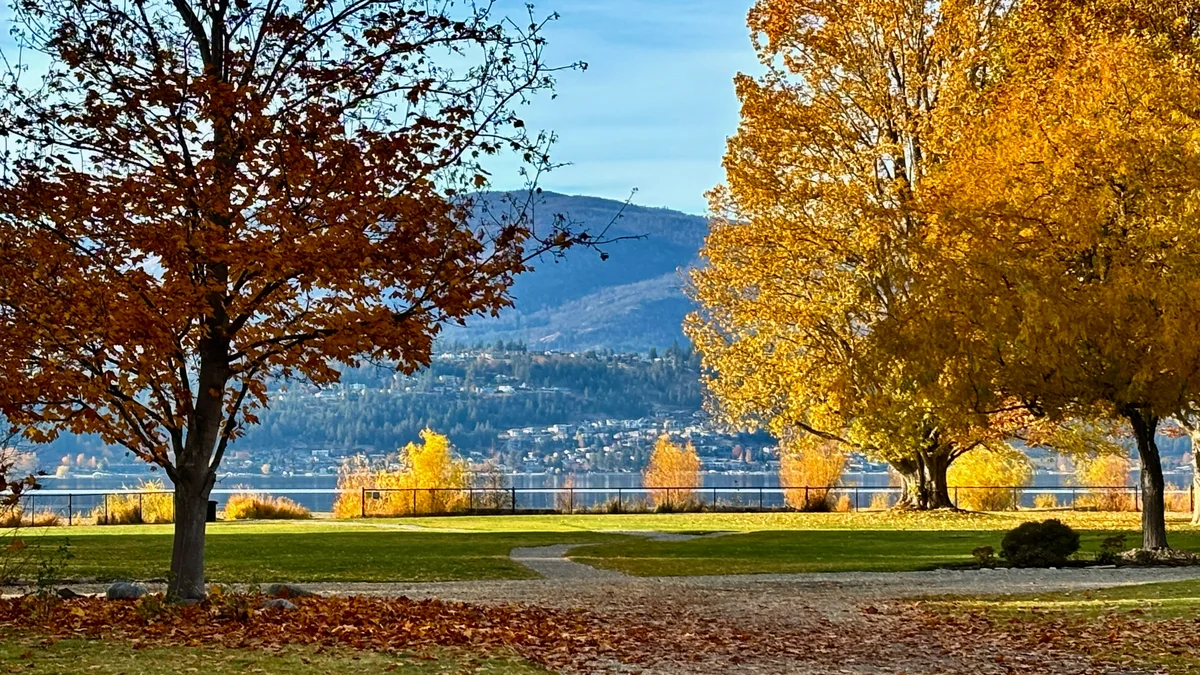
Kelowna's City Park stretches along the downtown waterfront of Okanagan Lake, with a sandy beach, mature trees, and a lakeside walking path connecting to the city's boardwalk. It is tied to the Ogopogo legend of Okanagan Lake and sits within walking distance of downtown's restaurants and cultural district.
Visitor guide
City Park is the green stretch of Kelowna's downtown lakeshore, running from the foot of Bernard Avenue along Okanagan Lake. It has long been where locals gather by the water, and it sits next to the downtown core, the marina area and the waterfront promenade.
Local history from The Kelowna Story, published by Know BC, says City Park's north-facing beach was the first site of trader Bernard Lequime's wharf and warehouse and the setting for the town's earliest regattas. Bernard and his brother Léon Lequime laid out Kelowna's street grid in 1892, according to a Canadian community-history site, naming several streets after family members. A local history article says the park area flooded for about three months each year before drainage controls, and that Water Street marks that old high-water line. After the first Okanagan Lake Bridge was built, changing currents pushed the sand north to Manhattan Beach. The Kelowna Story also describes a once-busy lakeside complex that included an aquatic centre, the Ogopogo Stadium, the Athans Diving Tower and an open-water swimming pool, of which little remains beyond an old building, some pilings and a small wharf.
The Kelowna Regatta grew out of the town's fall fair and a race meet at the steamer wharf in 1905, and the first formal regatta is dated to 1906; a local article credits newspaper editor George Rose with organizing it. Rose also sold shares in an Aquatic Association to raise money for an aquatic pavilion with seating for 800. The event became a two-day festival in 1910, added a pageant in 1930 and crowned its first Regatta Queen in 1931. In 1954 the park was remodelled with the Ogopogo Stadium and Pool, whose grandstand allowed national swimming, diving and rowing championships. A fire on 13 July 1969 destroyed the stadium, which was not rebuilt, although the pool and wharves stayed in use into the late 1970s. Sources differ on when the regatta ended, with one local account pointing to the 1980s and Kelowna Museums describing a final regatta in 2006, so treat end dates as approximate and check Kelowna Museums or the Okanagan Regional Library for authoritative detail. The park remains a festival and event space.
The Ogopogo is the legendary serpent of Okanagan Lake, and the legend is exactly that: no confirmed animal has been recorded. The Syilx name N'ha-a-itk (also written n̓x̌ax̌aitkʷ) refers to a sacred water being, and Syilx voices note the settler monster image came later. Several Ogopogo figures have stood in the city. The City of Kelowna's public art collection includes a painted-fibreglass Ogopogo at Kerry Park, which it lists among its oldest pieces and which entered the collection when the public art program started in 1998. Tourism Kelowna says an Ogopogo statue has existed in some form since 1960. A separate, larger Ogopogo play structure in the former City Park waterpark was removed on safety grounds after the park closed in 2017. Check the city for what is currently on site.
At the foot of Bernard Avenue, beside the park's north entrance, stands the fibreglass sculpture locally called The Sails, created by Scottish-born sculptor Robert Dow Reid in his Okanagan Mission studio. Local history says it was flown in by helicopter and lowered onto the fountain in October 1977, though the city's public art brochure and a local newspaper date it to 1978. The City of Kelowna gives its size as about 12 metres high and roughly 1,820 kilograms. It replaced an earlier concrete fountain, honouring local businessman Pasquale Capozzi, whose wind-blown spray reportedly drenched passers-by. Reid's dolphin sculpture Rhapsody is its companion piece on the waterfront.
The park offers lawns, mature trees, a swimming beach and lakefront paths, and the promenade links onward to marinas, restaurants and views of the lake bridge. Facilities, swimming areas and events change by season, and water-quality notices can apply, so check the City of Kelowna for current information.
With a private vehicle and driver and door-to-door pickup, a group can be dropped at the waterfront, walk the promenade at leisure, and be collected at a different point such as a winery or hotel, avoiding downtown parking.
See every tour and attraction we cover in Kelowna.