TorontoOntario · 36 tours
 Niagara FallsOntario · 25 tours
 New York CityNew York · 30 tours
 Las VegasNevada · 8 tours
 San FranciscoCalifornia · 16 tours
 VancouverBritish Columbia · 17 tours
 DubaiUAE · 54 tours
 Abu DhabiUAE · 5 tours
 Buenos AiresArgentina · 23 tours
 AthensGreece · 31 tours
 AucklandNew Zealand · 38 tours
 CancunMexico · 54 tours
No destinations match “”. Try searching all tours instead — that search understands full questions, not just place names.
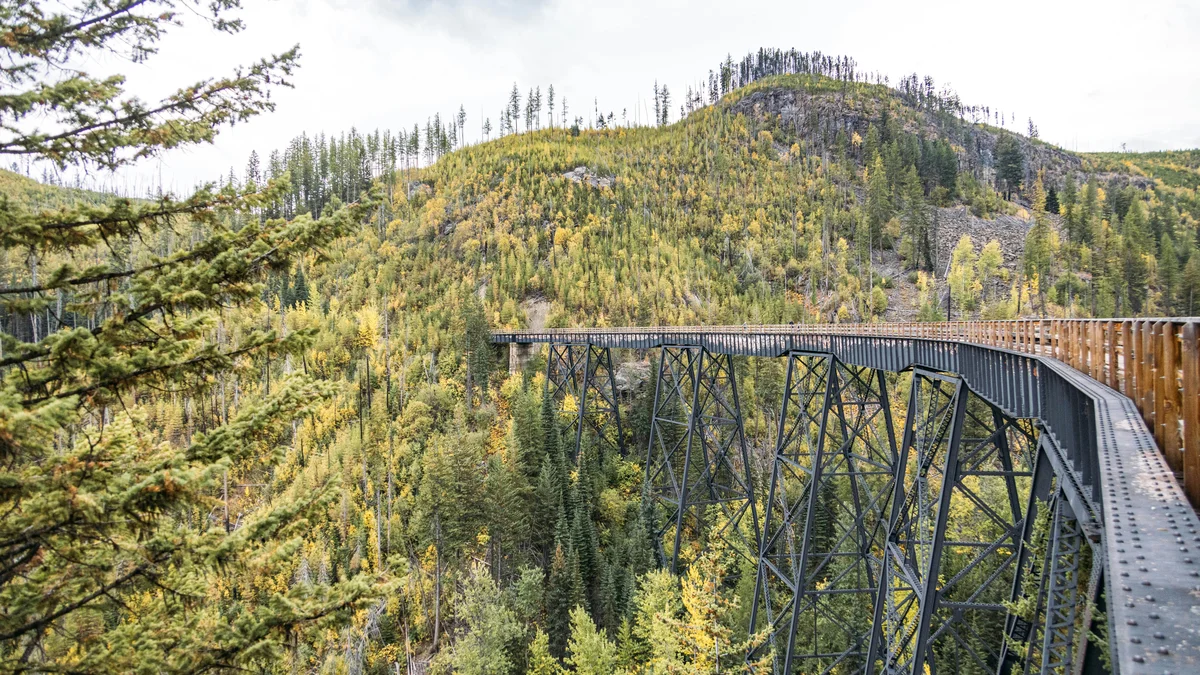
Part of the historic Kettle Valley Railway, the Myra Canyon Trestles are a series of 18 wooden and steel trestle bridges spanning a dramatic canyon in Myra-Bellevue Provincial Park southeast of Kelowna. Rebuilt after a 2003 wildfire destroyed much of the original structure, the trestles now form one of Canada's most scenic rail-trail cycling and hiking routes.
Visitor guide
The Myra Canyon Trestles are a run of timber and steel bridges and rock tunnels on the old Kettle Valley Railway grade high on Okanagan Mountain, south-east of Kelowna. Parks Canada recognizes the roughly 9.6-kilometre stretch as a National Historic Site of Canada, and it is now one of the best-known rail-trail rides in British Columbia.
The Kettle Valley Railway, a Canadian Pacific Railway subsidiary, was built to link the Kootenay and Boundary mining country with the coast. The Myra section was constructed between about 1912 and 1914, according to Parks Canada. Where the line had to cross steep side-canyons on Okanagan Mountain, the builders used trestles and tunnels to hold a gentle, continuous grade, and the Parks Canada heritage statement calls the result an outstanding engineering achievement that used conventional technologies in imaginative ways. The wider railway is closely associated with engineer Andrew McCulloch, who is credited as its chief engineer; check local histories before attributing any particular design decision to him.
Sources do not fully agree. Wikipedia and several local accounts describe 18 wooden trestles and two tunnels between Myra and June Springs stations, while some news reports speak of 16 wooden trestles plus two steel bridges. The difference seems to come from what is counted as a wooden trestle, so a safe summary is that the canyon has roughly twenty engineered structures altogether once the steel spans and tunnels are included. Parks Canada's list of surviving original wooden trestles names numbers 1, 12, 16 and 17, along with two steel trestles and two unlined tunnels, one with a 1940s concrete portal.
Passenger service on the Kettle Valley line ended in 1964, and the Myra stretch is recorded as being in rail service from 1914 until about the late 1970s, though sources differ on exact closure dates for each section. The province bought the corridor from the CPR in 1990, and in 1992 volunteers formed the Myra Canyon Trestle Restoration Society, which added boardwalks and railings. The route became part of the Trans Canada Trail. Parks Canada's national historic designation is dated 1 November 2002, though some local sources refer to a January 2003 ceremony.
In August 2003, the lightning-sparked Okanagan Mountain Park wildfire swept through the canyon. Most accounts agree that twelve wooden trestles were destroyed and the decks of the two steel bridges were damaged, though a few sources give higher totals. The fire burned some 26,000 hectares in the wider area and destroyed hundreds of homes in Kelowna.
Federal and provincial governments paid for reconstruction, with the Restoration Society and BC Parks managing the project; funding totals vary between sources, so no figure is given here. The first trestle to be rebuilt, No. 18, went up in the fall of 2004, and the rebuilt route officially reopened on 22 June 2008, with designers aiming to match the look of the originals.
The grade is gentle, which is why families and casual cyclists use it as well as keen hikers. Trails BC describes the crushed-gravel canyon section as roughly 20 kilometres of trestles and tunnels within a longer Chute Lake to McCulloch route, and notes that snow can linger on north-facing slopes into May. Access points include the Myra Canyon parking area and Myra-Bellevue Provincial Park. Always check the Myra Canyon Trestle Restoration Society, BC Parks or the City for current access, closures, fire-season or smoke restrictions, and rules about bikes and pets.
The canyon is reached by forest road, and parking can be tight in peak season. A private vehicle and driver with door-to-door pickup lets a group be dropped near the trailhead and collected at the other end rather than doubling back, which suits travellers who want to walk a few trestles and then move on to wineries or lakeside stops.
See every tour and attraction we cover in Kelowna.