TorontoOntario · 36 tours
 Niagara FallsOntario · 25 tours
 New York CityNew York · 30 tours
 Las VegasNevada · 8 tours
 San FranciscoCalifornia · 16 tours
 VancouverBritish Columbia · 17 tours
 DubaiUAE · 54 tours
 Abu DhabiUAE · 5 tours
 Buenos AiresArgentina · 23 tours
 AthensGreece · 31 tours
 AucklandNew Zealand · 38 tours
 CancunMexico · 54 tours
No destinations match “”. Try searching all tours instead — that search understands full questions, not just place names.
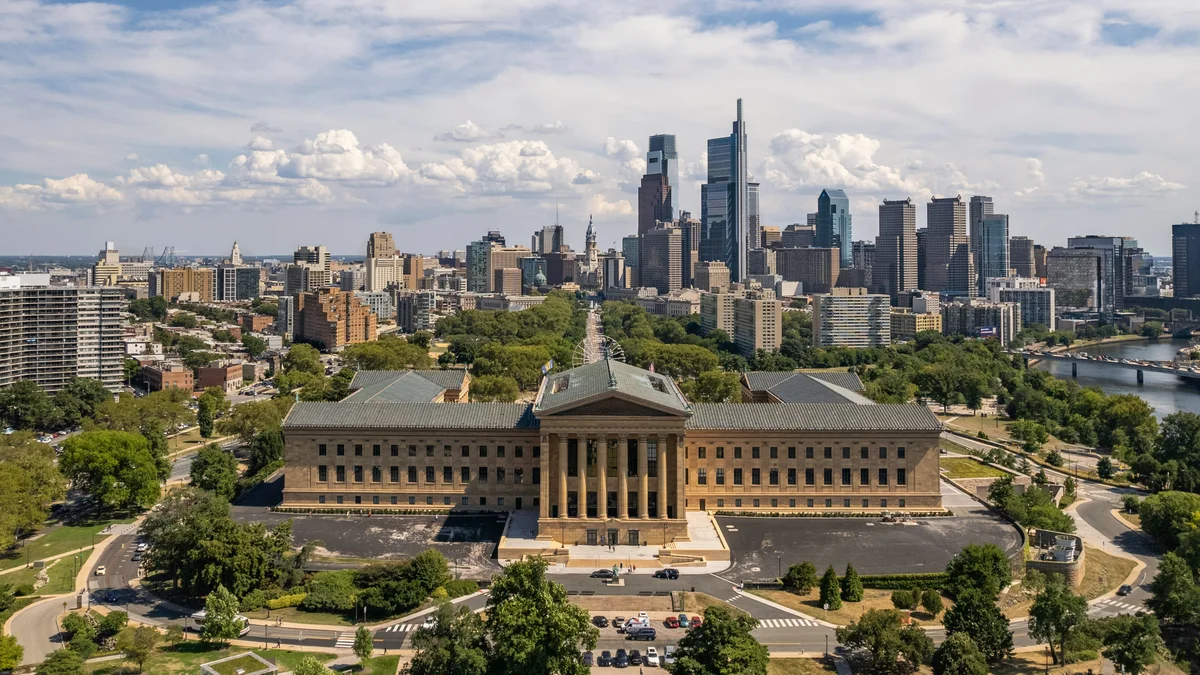
This neoclassical museum opened in 1928 and holds one of the largest art collections in the United States, spanning ancient artifacts to contemporary works. Its broad stone steps became world-famous after Sylvester Stallone ran up them in the 1976 film Rocky, and a bronze Rocky statue now stands near the base. From the top, the steps frame a real, sweeping view back down the Benjamin Franklin Parkway toward the city skyline.
Visitor guide
The Philadelphia Museum of Art is a large encyclopedic art museum whose columned main building crowns Fairmount at the western end of the Benjamin Franklin Parkway. The institution grew out of the 1876 Centennial Exhibition, and its Greek-temple-style home, completed in the 1920s, has become one of the city's best-known landmarks, partly thanks to the Rocky films. The museum describes its collection as spanning more than 4,000 years.
The museum was chartered in 1876 for the Centennial Exposition, and Memorial Hall, built as the exposition's art gallery, became its first home. It opened to the public on May 10, 1877 as the Pennsylvania Museum and School of Industrial Art. It was far from most residents, which is one reason the city later looked to a new site.
In 1895 the City Council funded a design competition, and by 1907 planners had settled on Fairmount, the rocky hill where the city's reservoir stood, as the site for a new museum that would anchor the planned Parkway. Mayor Thomas B. Smith laid the cornerstone in 1919. Horace Trumbauer and the firm Zantzinger, Borie and Medary collaborated on the design, with Howell Lewis Shay credited with the plan and massing and Julian Abele credited with detail work. The building is faced in Minnesota dolomite. Twenty second-floor galleries opened on March 26, 1928, while much of the interior was still unfinished. Its one completed pediment sculpture, Western Civilization, by C. Paul Jennewein, dates to 1933. Locals sometimes call the building the Parthenon on the Parkway.
Fiske Kimball directed the museum from 1925 to 1955 and oversaw the opening of the new building, which drew about one million visitors in 1928.
Wikipedia, citing museum figures, puts the holdings at more than 240,000 objects shown in over 200 galleries; museum pages have given figures from more than 200,000 to more than 240,000 objects, so treat totals as approximate. The collection covers European and American painting, sculpture, decorative arts, Asian art, prints, drawings, photographs, costume and textiles, and modern and contemporary work. Its Thomas Eakins holdings are described as among the most important anywhere, and its arms and armor collection is described as the second largest in the United States.
The museum is also known for rooms and architecture moved or reassembled indoors, including an Adam-style drawing room, the facade of a Burgundy church, a Chinese palace hall, a Japanese teahouse and a 16th-century Indian temple hall. Marcel Duchamp's Etant donnes was among the major acquisitions of the 1960s-1970s renovation era.
The East Terrace stairs became famous through the Rocky series. A bronze Rocky statue was commissioned in 1980, placed in 1982 for Rocky III, and moved in 2006 to the base of the stairs. The 2005 Live 8 concert was held at the museum's east entrance.
The museum's campus also includes the Rodin Museum and the Anne d'Harnoncourt Sculpture Garden along the Parkway, and the Perelman Building, which opened in 2007 and holds prints, drawings, photographs, costumes, textiles and design objects. A major expansion called the Core Project, designed by Frank Gehry, has been planned for years; check the museum for what galleries and entrances are open when you visit.
Hours, ticketing and which entrance to use change, so check the museum's website before you go. The Parkway setting makes it easy to pair with other nearby cultural sites.
On a Voyzo private tour, your driver can drop your group at the museum entrance of your choice and pick up when you are done, so the steps and the galleries do not have to be rushed into a parking-and-walking plan.
See every tour and attraction we cover in Philadelphia.