TorontoOntario · 36 tours
 Niagara FallsOntario · 25 tours
 New York CityNew York · 30 tours
 Las VegasNevada · 8 tours
 San FranciscoCalifornia · 16 tours
 VancouverBritish Columbia · 17 tours
 DubaiUAE · 54 tours
 Abu DhabiUAE · 5 tours
 Buenos AiresArgentina · 23 tours
 AthensGreece · 31 tours
 AucklandNew Zealand · 38 tours
 CancunMexico · 54 tours
No destinations match “”. Try searching all tours instead — that search understands full questions, not just place names.
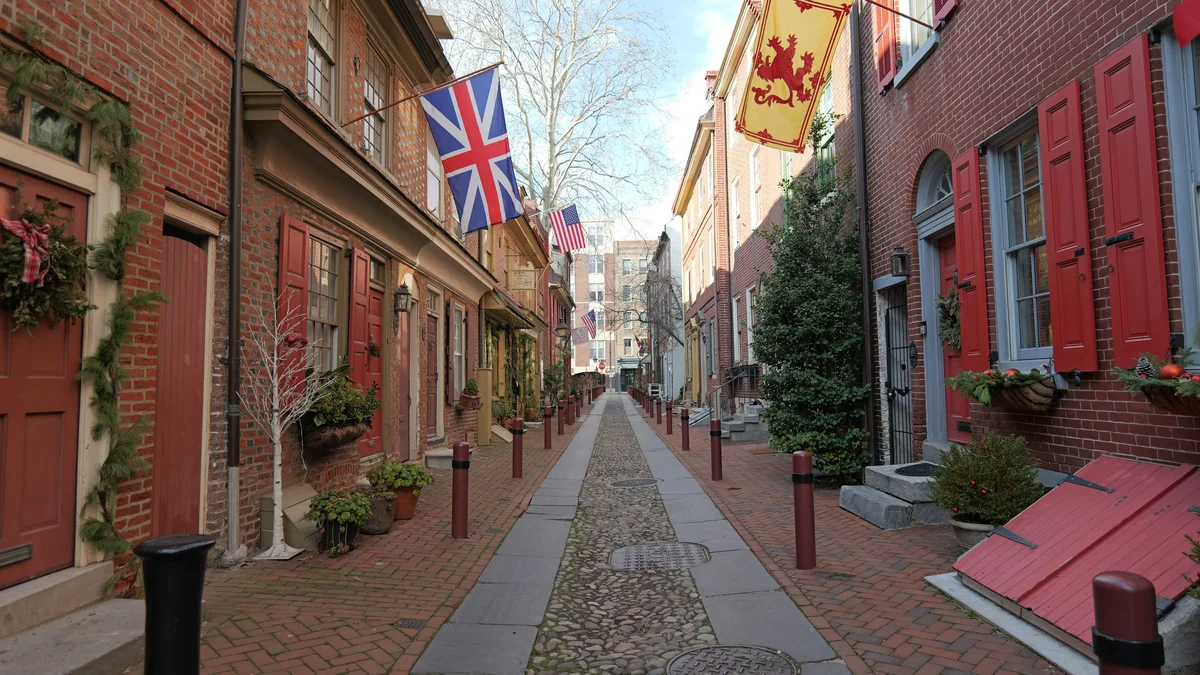
Dating back to 1703 according to the Elfreth's Alley Association, this narrow cobblestone lane in Philadelphia's Old City is one of the oldest continuously inhabited residential streets in the United States. Its 32 brick row houses were built for tradespeople and their families, named after blacksmith and property owner Jeremiah Elfreth. Several homes are still privately lived in today, while others form a small museum open to visitors.
Visitor guide
Elfreth's Alley is a narrow cobbled lane in Philadelphia's Old City, running between Front and Second Streets, lined with 32 houses that the Elfreth's Alley Association dates to between 1720 and 1836. It is a National Historic Landmark District and is often billed as the nation's oldest residential street, a title that is a popular label rather than a formal finding. People still live on the alley, and two of its houses are a museum.
The alley was opened between 1702 and 1704 by agreement between Arthur Wells and John Gilbert, who both lived on Front Street. The Elfreth's Alley Association says it began as a cart path and was created to relieve crowding near the port. It was first called Gilbert's Alley, then Preston's Alley, and by about 1750 took the name of Jeremiah Elfreth, a blacksmith and land developer. Wikipedia says Elfreth built No. 124 and the original dwelling at No. 126 between 1741 and 1762.
Early residents were mostly artisans and working-class laborers. Wikipedia lists shipwrights, silver and pewter smiths, glassblowers, and furniture builders, and says that in the 1770s about one-third of households were headed by women. The Association describes its museum as a celebration of the working people who helped build the country.
The Association dates the surviving buildings to between 1720 and 1836 while Wikipedia gives 1703 to 1836, so sources differ on the earliest house. The National Park Service's Colonials and Patriots survey describes the dwellings as a unique representation of Philadelphia architecture and notes that about half were built before the mid-18th century or before the Revolution.
The Association says Dolly Ottey led early efforts against the alley's deterioration, and the Elfreth's Alley Association was founded in 1934 to preserve the street and tell the story of its inhabitants. The alley was added to the National Register and designated a National Historic Landmark on October 9, 1960, and the Association credits that status with helping keep Interstate 95 construction from erasing the street. A historic marker was added in 2016.
The Association calls it one of the oldest continuously inhabited residential streets in the country, a careful wording. Wikipedia notes other places in the United States, such as Santa Fe and St. Augustine, also have homes about three centuries old, so treat "oldest" as a local boast.
The Elfreth's Alley Museum at Nos. 124 and 126 preserves the 18th-century home of two dressmakers, restored to a colonial-era appearance. Most other houses are private, so be quiet and respectful. Each June the Association holds Fete Day, per Wikipedia, and a holiday house tour in December. Check the Association for current dates and museum access.
The alley is short and best seen on foot, so a private Voyzo vehicle and driver with door-to-door pickup lets your group be dropped nearby and collected, with other Old City stops folded in.
See every tour and attraction we cover in Philadelphia.