TorontoOntario · 36 tours
 Niagara FallsOntario · 25 tours
 New York CityNew York · 30 tours
 Las VegasNevada · 8 tours
 San FranciscoCalifornia · 16 tours
 VancouverBritish Columbia · 17 tours
 DubaiUAE · 54 tours
 Abu DhabiUAE · 5 tours
 Buenos AiresArgentina · 23 tours
 AthensGreece · 31 tours
 AucklandNew Zealand · 38 tours
 CancunMexico · 54 tours
No destinations match “”. Try searching all tours instead — that search understands full questions, not just place names.
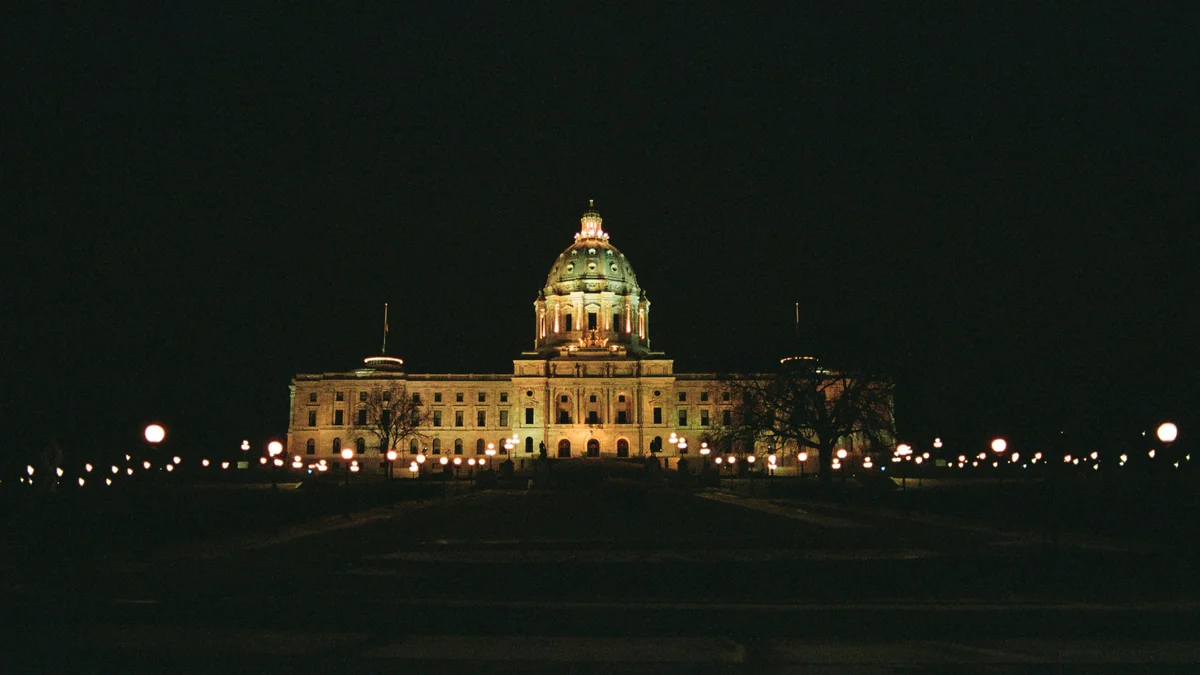
Completed in 1905 and designed by architect Cass Gilbert, Minnesota's working state capitol is topped by one of the largest unsupported marble domes in the world, modeled after St. Peter's Basilica in Rome. The building houses the state legislature, governor's office, and Supreme Court, and its ornate interior features murals, sculpture, and the gilded Quadriga statue group above the entrance. It sits on a landscaped mall in St. Paul with views toward the Cathedral of St. Paul across the city.
Visitor guide
The Minnesota State Capitol in Saint Paul is the state's third capitol building, designed by Cass Gilbert and opened to the public on January 2, 1905. White marble, a self-supporting dome and a gilded sculpture group called the Quadriga make it one of the most recognizable public buildings in the Upper Midwest.
Wikipedia dates the first capitol to the 1850s, and it was destroyed by fire on March 1, 1881. A Romanesque replacement designed by LeRoy Buffington was completed in 1882, according to the Minnesota Historical Society (Wikipedia gives 1883), and demolished in 1937. The present building replaced it. Gilbert's design was selected in 1895 in a competition with 40 other entrants, according to the Minnesota Historical Society, and the cornerstone was laid in 1898, and the Minnesota Historical Society records construction beginning on May 6, 1896, taking nine years and costing $4.5 million.
Gilbert drew on the Beaux-Arts classicism of the 1893 World's Columbian Exposition. The Historical Society says the exterior uses white Georgia marble and St. Cloud granite, with Minnesota granite for the ground floor, steps and terraces. Gilbert argued that a darker stone would look "glooming and forbidding." The building is more than 430 feet long, rises 220 feet to the top of the lantern, and has over 300,000 square feet of floor space.
The dome has three layers: a self-supporting marble outer shell, a brick-and-steel cone inside that supports the lantern, and a decorative masonry dome seen from the rotunda. Gilbert's design echoes St. Peter's Basilica in the Vatican, and the dome is often described as the second-largest self-supporting marble dome in the world, a claim that is hard to verify precisely.
At the base of the dome stands the Quadriga, titled The Progress of the State. Daniel Chester French sculpted the chariot and figures, and Edward Clark Potter made the horses. It was installed in December 1906. To save money it was made of hammered copper over a steel frame rather than bronze, then covered in gold leaf. The Minnesota Historical Society gives its size as about 21 feet long and 25 feet tall, weighing roughly four tons. The four horses are said to represent earth, wind, fire and water, and the charioteer, Prosperity, carries a staff marked "Minnesota."
Below it sit six heroic-scale figures representing Courage, Bounty, Integrity, Prudence, Truth and Wisdom. The Society notes that the statues in place now are replicas carved in 1975 to 1979 to replace the originals. Twelve stone eagles guard the dome.
The Capitol houses the Senate, the House of Representatives, the governor's office, the attorney general's office and a Supreme Court chamber. Wikipedia notes that the building opened with roughly 60 artworks. An eight-pointed star set into the rotunda floor represents the state motto, "L'Etoile du Nord," and lady slipper orchids, the state flower, appear on column capitals. The Governor's Reception Room was designed to hold paintings of Minnesota history. The building was added to the National Register of Historic Places in 1972.
Visitor access, tours and building hours change, so check the Minnesota Historical Society and the Capitol's official site before you plan. On a Voyzo private tour of Minneapolis-Saint Paul, your driver can combine the Capitol with other Saint Paul stops such as the James J. Hill House, with door-to-door pickup from your hotel.
See every tour and attraction we cover in Minneapolis-Saint Paul.