TorontoOntario · 36 tours
 Niagara FallsOntario · 25 tours
 New York CityNew York · 30 tours
 Las VegasNevada · 8 tours
 San FranciscoCalifornia · 16 tours
 VancouverBritish Columbia · 17 tours
 DubaiUAE · 54 tours
 Abu DhabiUAE · 5 tours
 Buenos AiresArgentina · 23 tours
 AthensGreece · 31 tours
 AucklandNew Zealand · 38 tours
 CancunMexico · 54 tours
No destinations match “”. Try searching all tours instead — that search understands full questions, not just place names.
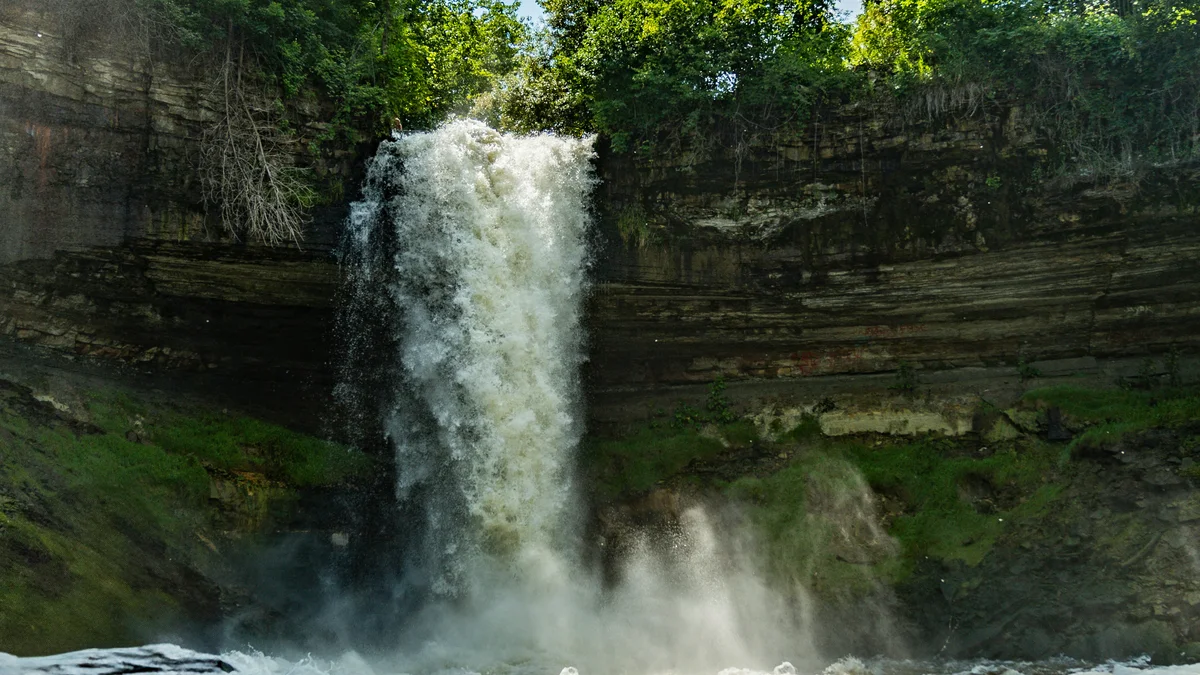
This 53-foot waterfall tumbles over a limestone ledge in Minnehaha Regional Park, framed by wooded bluffs along Minnehaha Creek just before it joins the Mississippi River. Henry Wadsworth Longfellow immortalized it in his 1855 epic poem 'The Song of Hiawatha' without ever having seen it in person, drawing on other travelers' accounts, and the falls have drawn visitors ever since. A paved path leads down into the gorge for a close-up view of the cascade and the limestone amphitheater it has carved out over time.
Visitor guide
Minnehaha Falls is a 53-foot waterfall on Minnehaha Creek in Minneapolis, set within Minnehaha Regional Park a short distance above the creek's meeting with the Mississippi River. The falls became widely known through Henry Wadsworth Longfellow's The Song of Hiawatha, though the poet never saw them.
Wikipedia and the National Park Service both give the drop as 53 feet. Minnehaha Creek runs about 22 miles from Lake Minnetonka, and the falls lie roughly three-quarters of a mile from the Mississippi. The water spills over Platteville Limestone resting on Saint Peter Sandstone, layers laid down by an Ordovician sea, and over time the falls have worked their way upstream from the river. The name comes from Dakota words that mean waterfall.
Longfellow's poem was published in 1855. The National Park Service notes that he never visited. Wikipedia points to earlier writing by Mary H. Eastman and to an 1852 daguerreotype by Alexander Hesler as part of how the falls reached the poet's imagination. The poem's popularity made the cascade a tourist draw. Near the falls stands a bronze sculpture of Hiawatha carrying Minnehaha by Jakob Fjelde, cast in 1912.
Landscape architect Horace W. S. Cleveland designed the park in 1883 as part of what became the Grand Rounds, and Wikipedia says the Minneapolis Park Board bought the falls and surrounding land in 1889. It is now officially Minnehaha Regional Park, run by the Minneapolis Park and Recreation Board and inside the Mississippi National River and Recreation Area, a National Park Service unit. The district was listed on the National Register of Historic Places in 1969.
Several historic buildings survive in the grounds. The Princess Depot, a small train station dating to about 1875, once served the Milwaukee Road. The John H. Stevens House is described by the city as built in 1849 and as among the earliest wood-frame houses in the area that became Minneapolis; it was moved into the park later. The Longfellow House, a replica of the poet's Cambridge home, serves as a hospitality center introducing the Grand Rounds National Scenic Byway, a loop of about 50 miles.
The park's own description mentions a staircase down into the gorge for views from below, and a trail beyond the falls past pools and stone bridges to the confluence with the Mississippi, with a sandy beach there. The falls themselves vary with the creek's flow, so a dry spell can mean a thin ribbon of water and a wet spring a roaring one. Check the park board for current access and conditions.
Minnehaha Regional Park is within Minneapolis and is easily combined with other stops in the city. On a Voyzo private tour, your driver can set the pace and meet you at whichever end of the trail suits your group.
See every tour and attraction we cover in Minneapolis-Saint Paul.