TorontoOntario · 36 tours
 Niagara FallsOntario · 25 tours
 New York CityNew York · 30 tours
 Las VegasNevada · 8 tours
 San FranciscoCalifornia · 16 tours
 VancouverBritish Columbia · 17 tours
 DubaiUAE · 54 tours
 Abu DhabiUAE · 5 tours
 Buenos AiresArgentina · 23 tours
 AthensGreece · 31 tours
 AucklandNew Zealand · 38 tours
 CancunMexico · 54 tours
No destinations match “”. Try searching all tours instead — that search understands full questions, not just place names.
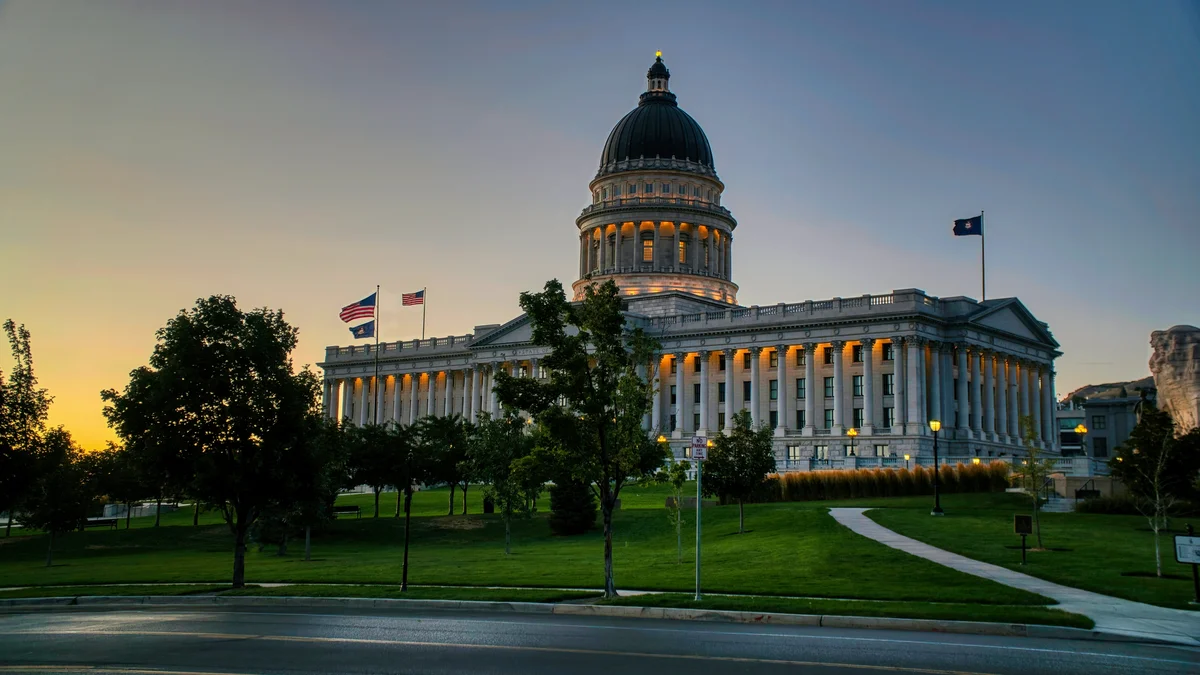
Completed in 1916 and perched on Capitol Hill above downtown, the Utah State Capitol is a Beaux Arts-influenced classical building topped with a copper dome. Its hilltop setting commands views over the city, and the building sits on a base-isolation system designed to protect it in an earthquake.
Visitor guide
The Utah State Capitol is a Neoclassical Revival building on Capitol Hill, designed by Utah architect Richard K.A. Kletting and built between 1912 and 1916. Its Corinthian columns, granite exterior and central dome make it one of the best-known buildings overlooking downtown Salt Lake City.
Salt Lake City donated 20 acres on Arsenal Hill to the Territory of Utah in 1888 for a future capitol. Kletting won the commission from eight submitted designs; Wikipedia records the final commission vote as four to three on March 13, 1912. A 1909 budget of $2.5 million stalled until 1911, when roughly $800,000 in inheritance taxes from the estate of railroad magnate E. H. Harriman and a $1 million bond made construction possible. Work began on December 26, 1912, and the building was dedicated on October 9, 1916. Costs came to about $2.7 million, and financial limits kept Kletting's full plans from being realized. The state became the 45th in the Union.
The Capitol was listed on the National Register of Historic Places on October 11, 1978. Today it is the centerpiece of a larger complex of roughly 40 acres.
The building is about 404 feet long and 240 feet wide, with an exterior of Utah granite that Wikipedia identifies as quartz monzonite from Little Cottonwood Canyon, and floors of marble from Georgia. Its structural core is concrete and steel. The National Register nomination gives about 285 feet to the top of the dome, while other sources cite lower figures from about 250 feet, so treat any number as approximate; the interior ceiling of the rotunda reaches about 165 feet. The rotunda displays a pendentive painting of Fremont and other explorers, and a ceiling painting by William Slater. Murals in the legislative chambers, a cyclorama painted in the 1930s as a WPA project, and hundreds of permanent and loaned artworks form the Capitol's art collection. The grounds hold monuments and memorials, including a veterans' memorial with a bronze statue of a Utah soldier.
A restoration from 2004 to 2008 returned the building to its original look, completed parts of Kletting's design and reversed earlier alterations. It also installed a base-isolation system, which the state describes as protecting the Capitol during an earthquake; Wikipedia cites 280 isolators and a design for a 7.3-magnitude quake, while another source reports 256, so the exact count is uncertain. The project cost is reported at about $260 million, and the building was rededicated in January 2008.
The Capitol offers self-guided, guided and virtual tours. Check the Capitol's official site for current tour availability, hours, security screening and any construction on the surrounding complex.
Capitol Hill sits above downtown, with views over the city toward the Wasatch Range, and a private vehicle and driver with door-to-door pickup makes it simple to pair with other Salt Lake City stops.
See every tour and attraction we cover in Salt Lake City.