TorontoOntario · 36 tours
 Niagara FallsOntario · 25 tours
 New York CityNew York · 30 tours
 Las VegasNevada · 8 tours
 San FranciscoCalifornia · 16 tours
 VancouverBritish Columbia · 17 tours
 DubaiUAE · 54 tours
 Abu DhabiUAE · 5 tours
 Buenos AiresArgentina · 23 tours
 AthensGreece · 31 tours
 AucklandNew Zealand · 38 tours
 CancunMexico · 54 tours
No destinations match “”. Try searching all tours instead — that search understands full questions, not just place names.
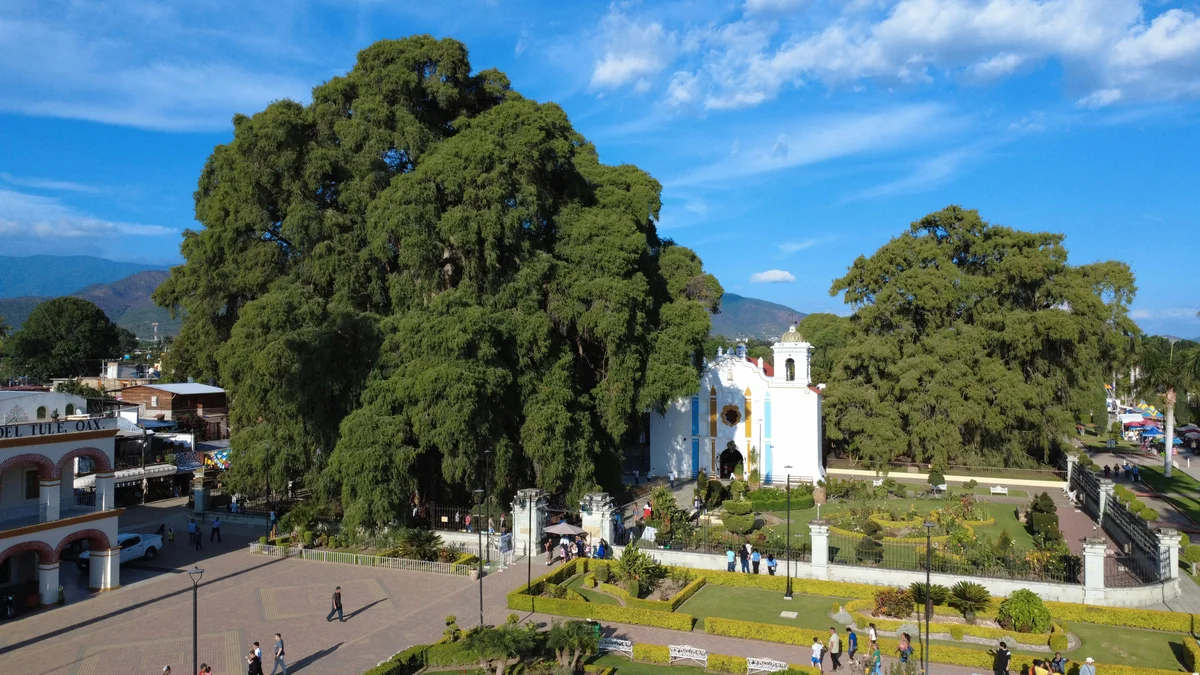
A massive Montezuma cypress growing beside the church in the town of Santa María del Tule, just outside Oaxaca City, with the stoutest trunk of any known tree, with raw diameter measurements of roughly 13 to 14 meters and a smoothed diameter of about 9.5 meters. Estimates of its age range from roughly 1,400 to over 2,000 years old.
Visitor guide
The Arbol del Tule is a giant Montezuma cypress growing in the churchyard of Santa Maria del Tule, about 9 kilometres east of Oaxaca City on the road to Mitla. It is famous for having what Wikipedia calls the stoutest trunk of any tree in the world.
The tree is a Montezuma cypress, Taxodium mucronatum, known in Mexico as an ahuehuete, a Nahuatl word glossed as old man of the water. It stands in the centre of the town of Santa Maria del Tule, beside the church.
Its dimensions are impressive and also a little contested. A 2005 measurement gave a trunk circumference of about 42 metres, equivalent to a diameter of around 14 metres, while a 1982 measurement gave about 11.4 metres for the diameter. Because the trunk is heavily buttressed, the raw diameter overstates its bulk; smoothed out, Wikipedia gives a diameter of about 9.4 metres, slightly wider than the giant sequoia considered the next most stout. Height is hard to measure because of the broad crown; a 2005 laser measurement gave about 35 metres, lower than earlier estimates of 41 to 43 metres.
The tree's age is uncertain. Popular estimates range from about 1,200 to 3,000 years, with one claim of 6,000, but the best scientific estimate based on growth rates is roughly 1,400 to 1,600 years. Local Zapotec tradition holds that a priest of the Aztec wind god Ehecatl, named Pechocha, planted it about 1,400 years ago. That is tradition, though Wikipedia notes it roughly matches the scientific estimate.
The tree is so large that it was once thought to be several trees growing together. DNA tests published in 1996 showed it is a single genetic individual, although this does not rule out a multi-trunk structure from one individual.
Wikipedia's description of the trunk is worth dwelling on: it is deeply fluted and buttressed rather than a smooth cylinder, which is why different measurements give such different diameters. The sheer breadth of the crown also means the tree is generally appreciated from the ground as a whole rather than measured top to bottom, and its shade covers a good part of the churchyard.
A report from 1990 said the tree was slowly dying because its roots had been damaged by water shortages, pollution and traffic, citing about 8,000 cars a day on a nearby highway. The tree was placed on UNESCO's tentative list of World Heritage Sites in 2001 and removed in 2013. No current health assessment is given here.
Visitors often look for shapes in the crown and trunk, a local pastime in which guides point out figures said to resemble animals. This is a folk tradition rather than anything scientific.
Santa Maria del Tule lies on the main route east of Oaxaca City toward Mitla and Hierve el Agua, so the tree is a natural stop on a private tour of the Valles Centrales. A private driver and guide can combine it with nearby villages and sites, and the church beside the tree is also worth a look.
See every tour and attraction we cover in Oaxaca City.