TorontoOntario · 36 tours
 Niagara FallsOntario · 25 tours
 New York CityNew York · 30 tours
 Las VegasNevada · 8 tours
 San FranciscoCalifornia · 16 tours
 VancouverBritish Columbia · 17 tours
 DubaiUAE · 54 tours
 Abu DhabiUAE · 5 tours
 Buenos AiresArgentina · 23 tours
 AthensGreece · 31 tours
 AucklandNew Zealand · 38 tours
 CancunMexico · 54 tours
No destinations match “”. Try searching all tours instead — that search understands full questions, not just place names.
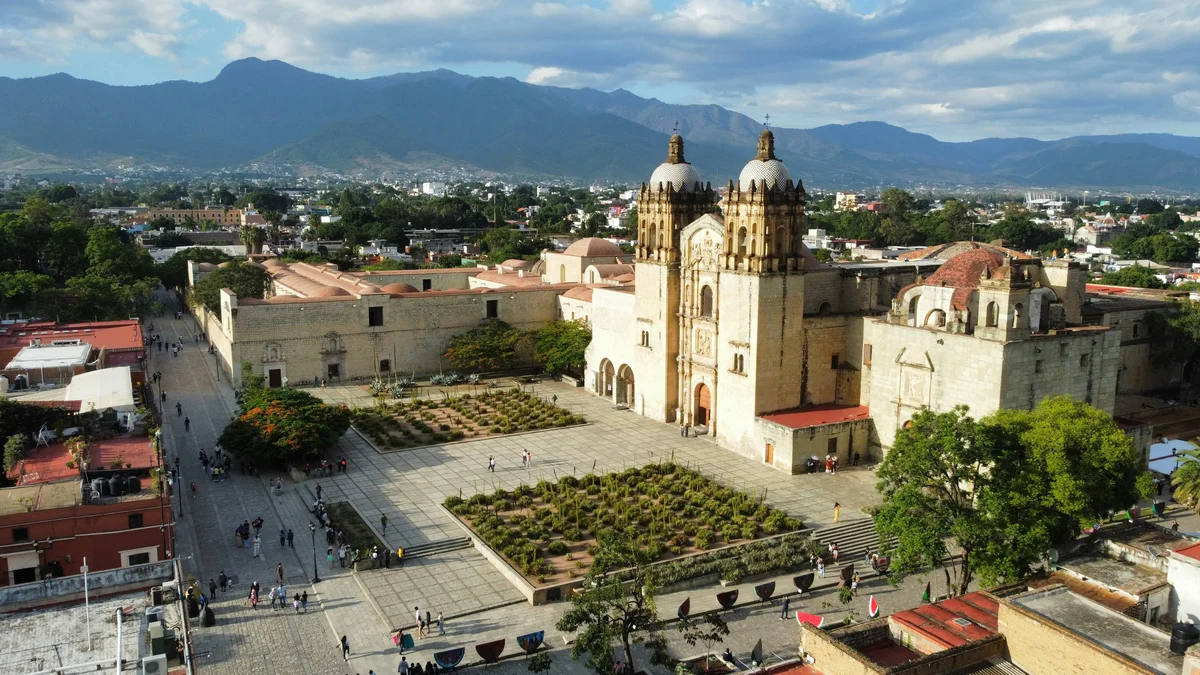
A monumental Baroque church and former Dominican monastery in the heart of Oaxaca City, begun in the late 16th century. Its ornate carved facade and gilded interior, along with the adjoining botanical garden and cultural museum, make it one of the city's most recognizable landmarks.
Visitor guide
The Templo de Santo Domingo de Guzman is a Dominican church and former monastery in Oaxaca City, Mexico, well known for its gilded interior. Its convent buildings now house the Museo de las Culturas de Oaxaca, one of the city's principal museums.
Sources differ on the exact start of construction; one gives 1570, another 1575 and a travel aggregator 1572 to 1724, so the building is best described as a project that unfolded over many decades. What the sources agree on is the broad outline. The Dominicans first settled at San Pablo, but that early convent fell into ruins after earthquakes in 1603, 1604 and 1608, and the friars moved temporarily to Cuilapan.
The new church was inaugurated in 1608, although its main altarpiece was not installed until 1612. The convent and its garden were completed in 1619. Plasterwork and gilding of the vaults began in 1659, the towers were complete by about 1660, and the interior vaults, staircases and towers were considered finished in 1666. The Chapel of the Rosary followed between 1724 and 1731. The monastery itself was active from 1608 to 1857.
The gilding is central to the church's identity. Descriptions of the interior mention gold-leafed altarpieces, elaborate stucco work and painted frescoes, and the Chapel of the Rosary is among the most richly decorated parts. The vaults and the convent's staircase were also gilded in the 17th century.
The interior suffered in the 19th century. In 1812 the building was occupied by the insurgent army during the Independence movement, and during the Reform era around 1859 it housed troops, which led to the destruction of most of the altarpieces and the scraping off of gold leaf. Another source places the looting of the altarpieces around 1869.
In 1902 President Porfirio Diaz returned the temple to the religious order, and in 1933 the property was declared a historical monument. Between 1956 and 1959 the main altarpieces of the church and of the Chapel of the Rosary were restored.
The former convent was recognised as the Regional Museum of Oaxaca on 20 December 1972. A comprehensive restoration of the building between 1994 and 1998 gave it its current name, Museo de las Culturas de Oaxaca. The complex is under the supervision of Mexico's National Institute of Anthropology and History and also includes the Fray Francisco de Burgoa library and the Nestor Sanchez public newspaper library.
The garden that was part of the original convent later became a botanical garden, according to the sources consulted.
The church stands in the historic centre of Oaxaca City, which is a UNESCO World Heritage Site. A private guided visit with a driver and guide suits it well, as the history of the building, from earthquakes to restoration, is easiest to appreciate with commentary.
See every tour and attraction we cover in Oaxaca City.