TorontoOntario · 36 tours
 Niagara FallsOntario · 25 tours
 New York CityNew York · 30 tours
 Las VegasNevada · 8 tours
 San FranciscoCalifornia · 16 tours
 VancouverBritish Columbia · 17 tours
 DubaiUAE · 54 tours
 Abu DhabiUAE · 5 tours
 Buenos AiresArgentina · 23 tours
 AthensGreece · 31 tours
 AucklandNew Zealand · 38 tours
 CancunMexico · 54 tours
No destinations match “”. Try searching all tours instead — that search understands full questions, not just place names.
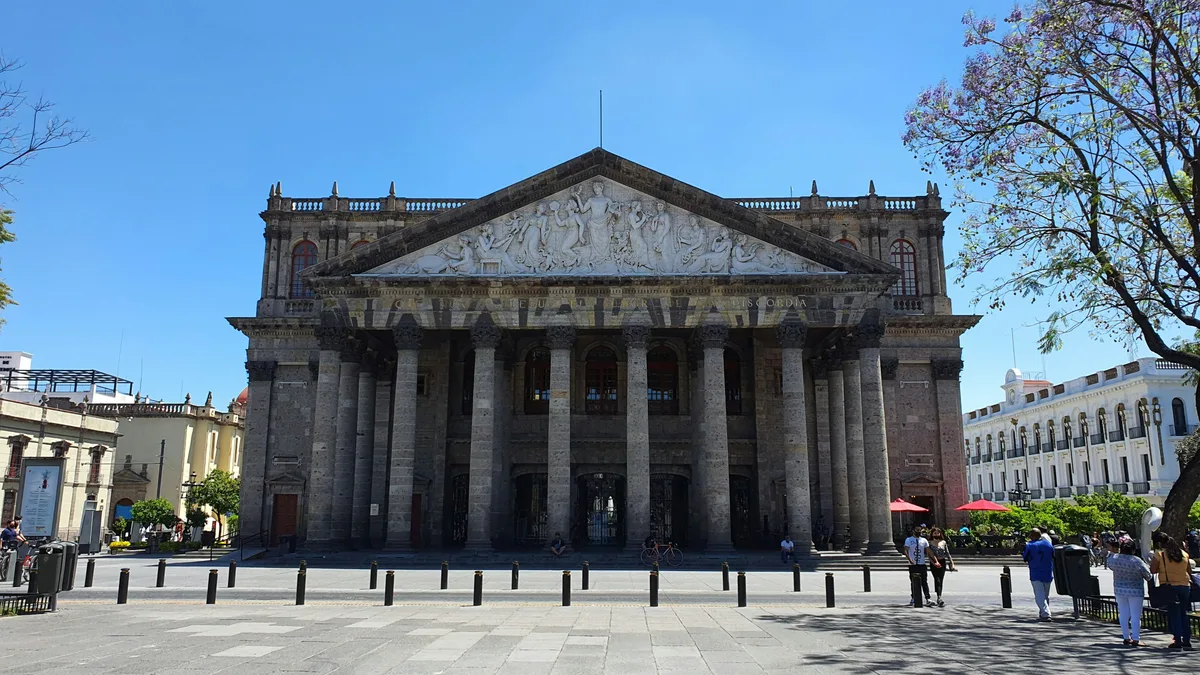
Completed in 1866, this neoclassical opera house on Plaza de la Liberación is modeled after Milan's La Scala and remains a working home for the Jalisco Philharmonic Orchestra and folkloric ballet performances. Its columned facade and interior ceiling mural are among the historic center's most photographed landmarks.
Visitor guide
The Teatro Degollado is a neoclassical theatre in the centre of Guadalajara, Jalisco, Mexico. Standing beside the cathedral, it is known for its Corinthian portico, its red and gold interior and a painted ceiling inspired by Dante's Divine Comedy.
According to Wikipedia, the theatre was proposed on 1 October 1855 by Antonio Perez Verdia to Governor Santos Degollado, and the decree to build it was signed on 12 December 1855. The cornerstone was laid in March 1856, and Jacobo Galvez was appointed to lead the early construction. Political conflict between liberals and conservatives, and a change of government during the Second Mexican Empire, slowed the work.
The theatre first opened on 13 September 1866 with a performance of Lucia di Lammermoor, in which the soprano Angela Peralta, known as the Mexican Nightingale, sang the title role, even though the building was still unfinished. The name honouring Santos Degollado, who had been killed in battle in 1861, was formally adopted on 18 December 1866. Further inaugurations followed over the next century, including in 1880, 1910, 1941 and 1964, reflecting later stages of completion and restoration.
A portico of sixteen Corinthian columns supports the pediment. Between 1953 and 1959 the artist Roberto Montenegro created a mosaic of Apollo and the nine Muses for the pediment. A phrase engraved beside the mosaic at the main entrance wishes that no hint of discord be heard within.
On the side facing Plaza Fundadores is a bronze relief by Rafael Zamarripa, the Friso de los Fundadores de Guadalajara, which is about 3 metres high and 21 metres long and depicts the city's founders.
The auditorium is famous for its painted decoration and its red and gold colour scheme. Before the first opening, Gerardo Suarez and Carlos Villaseñor painted a mural depicting the fourth canto of Dante Alighieri's Divine Comedy. A gilded eagle holding a Mexican flag and a chain in its beak was placed at the centre of the inner arch, and Felipe Castro painted murals titled Time and Hours and The Fame on the proscenium arch.
Between 1880 and 1890 the stucco in the concert hall was completed and gold was applied to the interior walls. Roberto Montenegro redecorated the interior in 1909 and 1910, adding a crystal lamp to the vault, and about fifty years later the architect Ignacio Diaz Morales directed a full restoration. A chamber hall for 200 people was added in May 2001.
The building is roughly 97 metres long, 36 metres wide and 22.5 metres high, and the main hall seats about 1,015 spectators, according to Wikipedia. The stage measures 54 by 18 metres. The theatre hosts a range of performances from traditional Mexican dance to opera.
The theatre sits on a plaza in the heart of the historic centre, close to the cathedral and the other landmark plazas. A private guided visit with a driver lets a guide explain the interior decoration and the story of its long construction.
See every tour and attraction we cover in Guadalajara.