TorontoOntario · 36 tours
 Niagara FallsOntario · 25 tours
 New York CityNew York · 30 tours
 Las VegasNevada · 8 tours
 San FranciscoCalifornia · 16 tours
 VancouverBritish Columbia · 17 tours
 DubaiUAE · 54 tours
 Abu DhabiUAE · 5 tours
 Buenos AiresArgentina · 23 tours
 AthensGreece · 31 tours
 AucklandNew Zealand · 38 tours
 CancunMexico · 54 tours
No destinations match “”. Try searching all tours instead — that search understands full questions, not just place names.
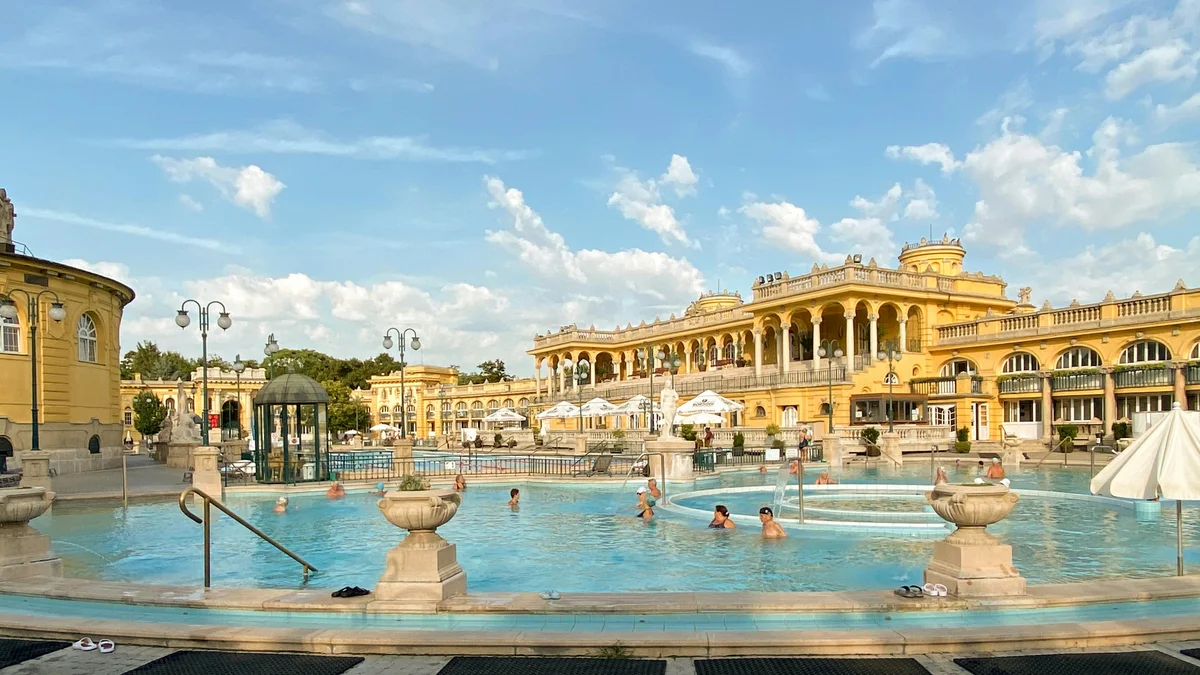
Széchenyi Thermal Bath is a real neo-Baroque bathing complex that opened in 1913 in City Park, drawing on naturally hot mineral springs found deep beneath Budapest. It's one of the largest spa complexes in Europe, with more than a dozen indoor and outdoor pools set within its grand yellow facade. Locals and visitors alike use its outdoor pools year-round, including during winter when steam rises off the water against the cold air.
Visitor guide
The Szechenyi Thermal Bath, known in Hungarian as the Szechenyi gyogyfurdo, is a medicinal bath complex in City Park, Budapest. Its yellow Neo-Baroque buildings and outdoor thermal pools are among the best-known bathing sites in the city, which is famous for its thermal water culture.
Wikipedia states that the bath opened on 16 June 1913 and was built in Neo-Baroque style to a design by Gyozo Czigler. Construction began on 7 May 1909. During planning in the 1880s the project was known as the Artesian bath, and at its 1913 opening it was named after Istvan Szechenyi, a nineteenth-century Hungarian statesman and reformer. The complex covers about 6,220 square metres, and was expanded in 1927 to its present size. A full renovation took place between 1999 and 2009.
The bath draws its water from deep wells. A well drilled beneath City Park by Vilmos Zsigmondy between 1868 and 1878 reached about 970 metres, and after the 1927 expansion a second well was needed. A second thermal spring found in 1938 at a depth of about 1,256 metres has a temperature of around 77 degrees Celsius. Wikipedia reports that the two springs reach 74 and 77 degrees and supply the baths with hot water daily, around six million litres by one figure in the article.
The water contains sulphate, calcium, magnesium and bicarbonate, together with significant amounts of metaboric acid and fluoride. Hungarian thermal baths are traditionally classed as medicinal, and the bath's name includes the word for a medicinal bath, but visitors with health concerns should consult a doctor rather than rely on general claims.
Wikipedia lists three outdoor pools, comprising a swimming pool, an adventure pool and a thermal sitting pool, with temperatures between 27 and 38 degrees Celsius, and fifteen indoor pools ranging from 18 to 38 degrees. The complex also has saunas and steam rooms. Originally it had separate sections for men and women, and the bath is now mixed in its main swimming and thermal sections. Attendance in 1913 was reported at over 200,000.
The baths sit in City Park near Heroes' Square, which lets a private tour combine a soak with other sights on the Pest side. The article says some of its facts rely on primary sources, so details such as pool temperatures and the number of pools may change. Visitors are typically advised to bring swimwear and a towel or hire them there, and rules and facilities are set by the operator, so it is wise to confirm them before going.
The early attendance figures and the later expansions recorded in the article show how quickly the bath became part of Budapest life in the early twentieth century, when it grew from a modest opening in 1913 to the larger complex of 1927. Its history makes it as much a piece of the city's social heritage as a place to bathe, and a guide can explain how thermal bathing fits into Budapest's wider story.
See every tour and attraction we cover in Budapest.