TorontoOntario · 36 tours
 Niagara FallsOntario · 25 tours
 New York CityNew York · 30 tours
 Las VegasNevada · 8 tours
 San FranciscoCalifornia · 16 tours
 VancouverBritish Columbia · 17 tours
 DubaiUAE · 54 tours
 Abu DhabiUAE · 5 tours
 Buenos AiresArgentina · 23 tours
 AthensGreece · 31 tours
 AucklandNew Zealand · 38 tours
 CancunMexico · 54 tours
No destinations match “”. Try searching all tours instead — that search understands full questions, not just place names.
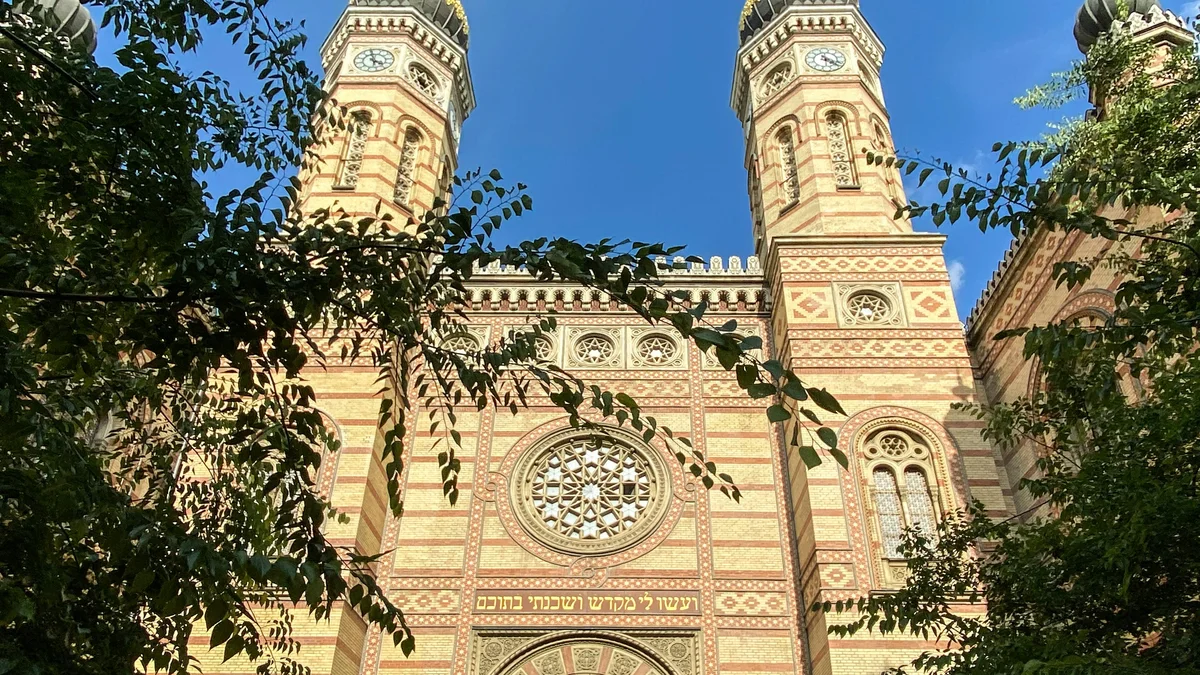
The Dohány Street Synagogue is a real Moorish Revival synagogue completed in 1859 in Budapest's historic Jewish Quarter, and remains the largest synagogue in Europe and the second-largest in the world after New York's Temple Emanu-El. Its twin onion-domed towers and richly patterned brick facade are instantly recognizable. The complex also houses the Hungarian Jewish Museum and the Raoul Wallenberg Holocaust Memorial Park in its rear courtyard.
Visitor guide
The Dohany Street Synagogue, also called the Great Synagogue, is a Neolog Jewish congregation and synagogue in the seventh district of Budapest, Hungary. Wikipedia describes it as the largest synagogue in Europe, seating about 3,000 people, and it is a major centre of Neolog Judaism.
The synagogue was built between 1854 and 1859 and consecrated on 6 September 1859. The Viennese architect Ludwig Forster designed the exterior, and the Hungarian architect Frigyes Feszl contributed to the interior. The style is Moorish Revival, drawing on Islamic architecture of North Africa and medieval Spain, including the Alhambra. Forster argued that there was no distinctive Jewish architectural style and so chose forms associated with related Middle Eastern peoples.
The facade is built of alternating yellow and red brick, with twin octagonal towers topped by onion domes and a rose window over the main entrance. It is about 75 metres long and 27 metres wide, with a maximum height of 43.6 metres. Inside, there are three aisles and two balconies, supported by a cast-iron structure. The ark and the gold and coloured geometric frescoes are attributed to Feszl. The synagogue is unusual in having pipe organs, and Wikipedia says Franz Liszt and Camille Saint-Saens played the original organ.
The synagogue was bombed by the Arrow Cross Party in February 1939. During World War II it was used as a base for German radio and as a stable, and it was seriously damaged in air raids and the Siege of Budapest. In 1944 it stood inside the Jewish ghetto in Pest, where it sheltered many hundreds of people. More than 2,000 people who died of hunger and cold during the winter of 1944 to 1945 were buried in its courtyard, which became an improvised cemetery.
The Hungarian Jewish Museum and Archives, built in 1930 in matching style and attached in 1931, stands on the site of the house where Theodor Herzl, the founder of modern political Zionism, was born. The Heroes' Temple, completed in 1931, seats about 250 and memorialises Hungarian Jews who died in World War I. The rear courtyard holds the Raoul Wallenberg Holocaust Memorial Park, whose centrepiece is the Tree of Life by the sculptor Imre Varga, shaped like a weeping willow with the names of victims on its leaves. The park also honours diplomats who saved Jewish lives, including Carl Lutz, Giorgio Perlasca and Angelo Rotta.
Restoration began in the early 1990s after the return of democracy, with funding from the Hungarian government and international donors. Sources differ on the completion date, with Wikipedia giving 1996 in one place and 1998 in another. The Central Synagogue in Manhattan was inspired by this building. Because it is an active place of worship and a memorial site, visitors are expected to dress respectfully and follow the rules of the congregation. A private guide can provide context about the history of the Jewish Quarter around it.
See every tour and attraction we cover in Budapest.