TorontoOntario · 36 tours
 Niagara FallsOntario · 25 tours
 New York CityNew York · 30 tours
 Las VegasNevada · 8 tours
 San FranciscoCalifornia · 16 tours
 VancouverBritish Columbia · 17 tours
 DubaiUAE · 54 tours
 Abu DhabiUAE · 5 tours
 Buenos AiresArgentina · 23 tours
 AthensGreece · 31 tours
 AucklandNew Zealand · 38 tours
 CancunMexico · 54 tours
No destinations match “”. Try searching all tours instead — that search understands full questions, not just place names.
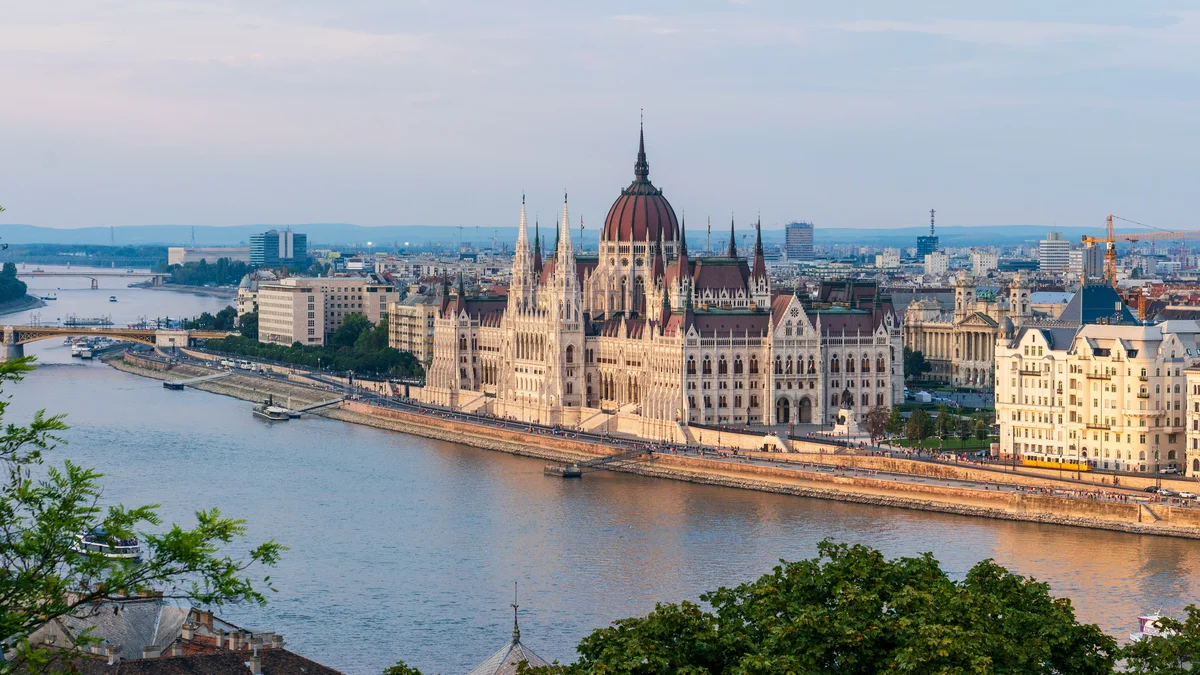
The Hungarian Parliament Building is a real Gothic Revival landmark built between 1885 and 1902 on the Danube's eastern bank, and remains one of the largest legislative buildings in Europe. Its symmetrical facade, central dome, and riverside setting make it one of the most photographed buildings in Central Europe, especially when lit up at night. The Hungarian Crown Jewels, including the Holy Crown of Hungary, are displayed beneath the central dome.
Visitor guide
The Hungarian Parliament Building, known in Hungarian as the Orszaghaz, is the seat of the National Assembly of Hungary, standing on Kossuth Square beside the Danube in Budapest. Designed by Imre Steindl in the Gothic Revival style, it has been the largest building in Hungary since its completion according to Wikipedia.
Steindl won an international design competition. Wikipedia says his neo-Gothic plans closely resemble the Palace of Westminster in London, and that the Gothic character also draws on Vienna City Hall, while the Renaissance Revival dome was inspired by the Maria vom Siege church in Vienna. Hungarian politicians of the period wanted the building to signal a commitment to western Europe. The facade is symmetrical, with a central dome and two identical halls on opposite sides of the building.
Buda, Obuda and Pest were merged to form Budapest in 1873, and in 1879 the Diet decided to build a new parliament. Construction began in 1885. The building was inaugurated in 1896 to mark the presumed thousandth anniversary of the Hungarian state, the keys were handed over in 1902, and Hungary's national tourism portal gives the construction period as 1885 to 1902, while some sources give 1904 for final completion, which is why sources give different dates. Steindl did not live to see the building finished; Hungary's national tourism portal says he died shortly before the inauguration.
The dome is 96 metres high, a figure chosen to refer to the year 896, the traditional date of the founding of Hungary. The building is 268 metres long and 123 metres wide, with 691 rooms, ten courtyards, 29 staircases and roughly 250 sculptures inside and out. Builders used about 40 million bricks, roughly half a million decorative stones and 40 kilograms of gold. Stained glass and glass mosaics are by Miksa Roth.
The central hall is sixteen-sided and has the two legislative chambers on either side. The modern National Assembly meets in the Lower House, and the Upper House is used for conferences. A grand ornamental staircase with ceiling frescoes leads to the central hall, where the Holy Crown of Hungary has been displayed since 2000. The crown also appears in Hungary's coat of arms.
The facade carries statues of Hungarian rulers, Transylvanian leaders and military figures, and two lions flank the eastern staircase. Kossuth Square also contains a memorial to the 1956 revolution, the Kossuth Memorial and an equestrian statue of Francis II Rakoczi. On 23 October 1989 Matyas Szuros declared the Hungarian Republic from a balcony facing the square. The building is part of the UNESCO World Heritage Site covering Budapest and the Banks of the Danube, first inscribed in 1987 and extended in 2002, under criteria ii and iv. Because visits are organised, a private guide can help plan the best viewpoints, including across the river from the Buda side.
See every tour and attraction we cover in Budapest.